








Permitted development does not remove Building Regulations duties. This guide explains which acoustic requirements loft conversions, extensions and changes of use trigger, and when testing or a noise assessment is needed.
- 8 Minute Read
Noise Risk Assessment: What to consider and how to get it right
In recent years, the knowledge that noise at work can cause permanent and disabling hearing damage has impacted the design and construction of workplaces in the UK, especially those where manufacturing processes are part of the day-to-day activity.

Adam Martin
23 September 2026
Categories:
Noise at Work, Risk Assessments, Hearing Protection
Quick take
A noise risk assessment is a structured evaluation of the noise hazards in a workplace, the workers exposed to them, and the controls needed to protect hearing. It is a legal requirement under the Control of Noise at Work Regulations 2005 for any employer whose workers may be exposed to noise capable of damaging their hearing.
A compliant assessment identifies the noise sources, estimates or measures exposure, compares that exposure against the legal action values of 80 dB(A) and 85 dB(A), specifies control measures, and is carried out by a competent person.
A noise risk assessment is not the same thing as a noise survey, although a survey is often needed to complete the assessment properly. If you cannot say with confidence where your workplace sits relative to the action values, formal measurement is almost always required.
What is a noise risk assessment?
A noise risk assessment is a formal, documented evaluation of noise risk in a workplace. A complete assessment sets out:
- the noise sources present, including machinery, tools, processes, vehicles and plant
- which workers are exposed to those sources, and for how long each day
- the likely or measured level of that exposure
- whether the exposure sits below, at, or above the legal action values
- the control measures already in place and those still needed
- any workers who are at particular risk and may need health surveillance
The duty comes from Regulation 5 of the Control of Noise at Work Regulations 2005. It is not advisory, it is not reserved for heavy industry, and there is no version of it that applies only to employers who consider themselves noisy.
The assessment establishes the current level of risk, shows where action is needed, and creates a documented baseline that later reviews can be measured against. Without that baseline you cannot prove a control measure worked, or show an inspector what has changed since the last time anyone looked.
It is worth being clear about what the assessment is not. It is not a form completed once and filed to satisfy an inspector. A useful assessment is a working management document that shapes what equipment gets bought, how shifts are planned, where hearing protection zones are drawn and which workers are referred for audiometric testing. If yours has never changed a decision, it is probably not doing its job.
The assessment also sits within a wider set of duties. The Health and Safety at Work etc. Act 1974 obliges employers to assess and manage workplace risks generally, and the noise assessment is the noise-specific expression of that duty, running alongside COSHH and manual handling assessments rather than replacing them. Noise-induced hearing loss is permanent and cumulative, which is why the Regulations single it out. For more on how hearing damage develops, see our guide to avoiding noise-induced hearing loss.
Is a noise risk assessment a legal requirement?
Yes, where work is liable to expose employees to noise at or above the Lower Exposure Action Value.
Regulation 5 of the Control of Noise at Work Regulations 2005 requires every employer to make a suitable and sufficient assessment of the risk to the health and safety of employees from exposure to noise at work.
The duty is triggered as soon as an employer has reason to believe any employee may be exposed at or above the Lower Exposure Action Value of 80 dB(A). Note what that does not say. It is not triggered by confirmed measurement above 80 dB(A), but by reasonable belief that the threshold may be reached, which is a much lower bar and one that catches many workplaces that do not think of themselves as noisy.
“Suitable and sufficient” is the legal standard applied to the assessment, and it is proportionate rather than fixed. A small workshop with two noise sources and clearly limited exposure can be assessed through a fairly simple process using manufacturer data and HSE guidance. A multi-source industrial site with shift rotation, mobile plant and impulsive noise cannot, and will need formal measurement to reach the same standard.
There are no exemptions. Not for small businesses, not for infrequent or seasonal exposure, and not for noise that has always been part of the job.
Where an employer has failed to assess, HSE can serve an improvement notice requiring compliance within a set period. Persistent failure, serious breaches or refusal to comply can escalate to prohibition notices, prosecution, unlimited fines and, in the most serious cases, custodial sentences for directors. Civil exposure matters too: when a worker brings a hearing loss claim, a missing or inadequate assessment may also significantly weaken an employer’s position when defending a subsequent occupational hearing-loss claim.
For a full breakdown of what compliance with the Noise at Work Regulations requires beyond the risk assessment, including control measures, training and health surveillance, see our noise at work compliance checklist.
Noise risk assessment vs noise survey: what is the difference?
This is the most common point of confusion on the topic, and getting it wrong tends to produce either an assessment with no evidence behind it or a survey report that nobody turns into action.

A noise risk assessment is the evaluation process. It is the document and the thinking behind it. It draws on whatever evidence is available, including observation, worker feedback, manufacturer data and measurement where needed, to characterise the risk and specify what should be done about it.
A noise survey is a data collection exercise. A competent person uses calibrated sound level meters and, where appropriate, personal dosimeters to measure actual noise levels and calculate each worker’s daily personal noise exposure. The survey is an input to the risk assessment. It is not the assessment itself.
When a survey is needed
Where an employer cannot establish with confidence, from observation and information already held, whether exposure reaches the Lower Exposure Action Value, measurement may be necessary. Regulation 5 treats measurement as something used “if necessary”, alongside observation of working practices and reference to relevant noise data. In practice, where noise is a genuine concern, measured data is usually what makes an assessment defensible.
In practice this covers most workplaces where noise is a genuine concern. The informal test of whether something “sounds loud” is not a defensible method and will not survive scrutiny.
When a survey may not be needed
Occasionally the risk assessment can be completed without new measurement. Manufacturer noise emission data for specific equipment, published exposure data for a well-characterised industry task, or recent survey data that still reflects current conditions may be enough. This should be a considered judgement recorded in the assessment, with reasons, rather than a default assumption made to avoid the cost of measurement.
In most workplaces with significant noise sources, the two pieces of work happen together as a single engagement. The risk assessment defines what the survey needs to cover, and the survey produces the data that allows the assessment to be finished with confidence.
For a full explanation of what a workplace noise survey involves, including what is measured, how results are expressed and how to interpret them, see our guide to workplace noise surveys.
Who should carry out a noise risk assessment?
The Regulations require the assessment to be carried out by a competent person. HSE defines competence as sufficient training, experience or knowledge to do the job properly. No specific qualification is prescribed, but the assessment has to be fit for purpose, and competence is judged against the complexity of the workplace being assessed.
Where exposure is clearly and comfortably below the action values and the noise sources are few and well documented, an internal health and safety manager with relevant training may be competent to complete the assessment using manufacturer noise data and HSE guidance.
Where exposures are high, variable or difficult to characterise, using a suitably qualified acoustic consultant can provide greater confidence that exposure has been assessed correctly. That typically means complex noise environments, multiple interacting sources, impulsive noise, or exposure close to the Upper Exposure Action Value, where accurate assessment depends on judgements about sampling, task duration and peak levels. Look for someone with formal acoustic qualifications such as membership of the Institute of Acoustics, practical experience of workplace noise assessment, access to calibrated Class 1 equipment, and working knowledge of the HSE L108 framework.
Competence matters more here than in many other areas because of how the failure mode works. An assessment that underestimates exposure or misses a high-risk role is not partial compliance, it is non-compliance, and the employer carries responsibility for its quality regardless of who produced it.
There is a strong case for combining internal and external input. A consultant brings calibrated equipment, tested methodology and independence. An internal assessor knows the shift patterns, the seasonal peaks and the tasks that only happen during maintenance shutdowns. The most reliable assessments come from a consultant taking the measurements while the employer supplies the operational context.
NOVA Acoustics provides HSE-aligned workplace noise risk assessments and noise surveys across England and Wales. Our consultants are qualified members of the Institute of Acoustics with experience of workplace noise assessment across all sectors. Find out more about our noise at work surveys and assessments.
When is a noise risk assessment required?
The trigger is reasonable belief that exposure may reach 80 dB(A), not confirmed measurement above it. If there is a reason to think noise might be an issue, it must be assessed.
Practical indicators that an assessment is needed:
- workers have to raise their voices to hold a conversation with someone standing about a metre away, which HSE treats as a rough indicator of around 85 dB(A)
- noisy power tools, machinery or equipment are used for significant parts of the working day
- workers have reported ringing in the ears or muffled hearing after a shift
- hearing protection is already being worn, which is an acknowledgement that a noise risk exists and needs to be formally assessed
- noise complaints have come from workers or their safety representatives
Sectors where an assessment is almost certainly required
Construction and demolition, manufacturing of all kinds, agriculture and horticulture, printing, woodworking and joinery, food and drink production, live music and entertainment venues, waste management and recycling, engineering and fabrication workshops, and broadcast and music production at the higher-exposure end.
Sectors where it is often overlooked
Hospitality, particularly commercial kitchens and busy bars where extraction plant, dishwashing and amplified music combine over a long shift. Healthcare, including dental surgeries and wards with continuous equipment noise. Education, where workshops, music practice rooms and sports halls produce exposures nobody has measured. Retail, where stock room machinery and mechanical delivery equipment can push individual roles above the action values even though the shop floor is quiet.
The noise risk assessment methodology, step by step

Step 1: Identify all noise sources
Walk the workplace and list every significant source of noise: machinery, hand tools, processes, HVAC and extraction plant, vehicles and forklifts, and noise entering from outside through open doors and roller shutters.
Do not restrict the exercise to the loudest areas. Include everywhere workers spend time, including break rooms next to production areas, walkways through noisy zones and offices with a plant room on the other side of the wall.
Mobile plant needs particular attention. Map when and where each item is used and which workers end up near it, because exposure from mobile equipment often falls on people who are not operating it.
Step 2: Identify who is exposed
List every role and, where relevant, every individual who spends time near significant noise sources. Account for direct exposure from operating equipment, indirect exposure from working alongside someone who is, and intermittent exposure from passing through noisy areas or attending to equipment periodically. Contractors, maintenance engineers and visitors belong on the list too.
Flag anyone at particular risk: workers with a declared hearing condition, young workers, new and expectant mothers (relevant for vibration as well as noise), and roles where clear verbal communication is part of the safety system and noise masking creates a secondary risk.
Step 3: Estimate or measure exposure levels
Start with estimation. For each combination of role and noise source, estimate the likely daily personal noise exposure (L<sub>EP,d</sub>) from the level of the source and the duration of exposure. Manufacturer noise emission data, published industry reference figures and HSE’s noise exposure calculators and ready-reckoners all support this stage.
Confirm through measurement wherever the estimate approaches the action values or is uncertain, using a competent person and calibrated equipment. Measurement should produce daily personal exposure figures for each role, peak sound pressure levels (L<sub>Cpeak</sub>) where impulsive noise is present, and noise maps where those add value. Results are then compared against the action values and the exposure limit value.
Step 4: Compare against the action values
The Regulations set a three-tier framework based on daily or weekly personal noise exposure:

Step 5: Identify and evaluate control measures
For every role and source where exposure exceeds or approaches an action value, work through the control hierarchy in order:
- Elimination or substitution. Can the noise source be removed altogether, or replaced with a quieter alternative? Procurement is the cheapest point at which to reduce noise.
- Engineering controls. Can the noise be reduced at source or in its path through enclosures, acoustic screens, damping, vibration isolation or a change to the process itself?
- Organisational controls. Can exposure duration be cut through job rotation, rescheduling of noisy tasks, or moving workstations away from sources?
- Hearing protection. Where risk remains after the above, suitable protection must be provided and its use enforced.

Record the controls you considered and why each was implemented or rejected. The “reasonably practicable” test requires evidence of genuine consideration. A line stating that engineering controls were “not feasible” with no reasoning behind it is one of the things HSE inspectors look for and one of the easiest findings to make.
Step 6: Identify at-risk individuals and health surveillance needs
Use the exposure findings to identify which workers need health surveillance, meaning audiometric testing. HSE expects surveillance for employees likely to be regularly exposed above the Upper Exposure Action Value, and for anyone at risk for another reason, including workers who already have some hearing loss or who are known to be particularly sensitive to noise damage.
Workers already showing signs of hearing impairment need priority attention, which may mean enhanced protection and, in some cases, temporary or permanent redeployment away from the noisiest tasks. Our employer’s guide to health surveillance covers the process in detail.
Step 7: Record the findings and produce the assessment document
Covered in the next section.
Unsure whether your workplace needs a formal noise survey to complete the risk assessment, or whether the data you already hold is sufficient? Our guide on whether you need a noise risk assessment or a noise survey covers the decision in detail.
Documentation requirements: what you must record
A compliant noise risk assessment document should contain all of the following:
- the date of the assessment and the date set for review
- the name of the assessor and the qualifications or experience supporting their competence
- the scope of the assessment, meaning the roles, work areas and noise sources it covers
- a description of each noise source assessed, including type, location and typical operating pattern
- exposure estimates or measured levels for each role and source combination, expressed as L<sub>EP,d</sub> in dB(A), and L<sub>Cpeak</sub> in dB(C) where impulsive noise is present
- a comparison of each exposure against the action values and the exposure limit value, stating clearly whether exposure is below the Lower Exposure Action Value, between the two action values, or at or above the Upper Exposure Action Value
- the control measures already in place and an assessment of how effective they are
- the control measures recommended, each with a timetable and a named person responsible
- the reasons any control measure was judged not reasonably practicable, which matters most for the engineering controls HSE will expect to see considered
- the workers identified as requiring health surveillance and a plan for delivering it
- the training requirements arising from the assessment
- the location and specification of hearing protection zones, where required
- the review date and the events that will trigger an earlier review
Format
HSE does not mandate a format. The assessment can be a standalone consultant’s report, a structured internal form, or a section within a broader health and safety management system. What matters is that it contains the required elements and can be produced on request during an inspection.
For a simple workplace with a small number of sources and clearly low exposure, a short written summary can be sufficient. For a complex environment, a formal consultant’s report is the appropriate output.
Retention
Keep the assessment and any noise survey reports indefinitely in practice. They form the baseline for every future review and become important evidence if a civil claim is brought.
Health surveillance records need a longer view still. Noise-induced hearing loss develops slowly and a claim may arrive decades after the worker has left, so audiometric records should be retained for the very long term. At least 40 years is the widely applied benchmark, drawn from the requirement that applies to health records under COSHH, and it is the standard most occupational health providers work to. General health and safety records should be kept for a minimum of three years.
Hearing protection and noise risk assessments
Hearing protection is the last line of defence, not the first response. The risk assessment has to show that noise reduction at source and organisational controls were considered before protection was relied on. An assessment that jumps straight to issuing earplugs has skipped the part HSE is most interested in.
At the Lower Exposure Action Value of 80 dB(A), hearing protection must be made available and provided on request. Workers are not obliged to wear it, but it has to be accessible without them having to ask a manager for permission.
At the Upper Exposure Action Value of 85 dB(A), hearing protection becomes mandatory wherever risk remains after other controls have been applied, and hearing protection zones must be marked and enforced.
Selecting the right protection
The risk assessment informs the specification. Protection must bring the effective level at the ear below 85 dB(A). HSE advises aiming for a level at the ear of roughly 70 to 80 dB(A), and specifically warns against reducing it below 70 dB(A). Adequacy is checked using the SNR (Single Number Rating) method or the more detailed HML method, with octave band data where low frequency noise is significant.
Over-protection carries real risk. Protection that attenuates too much stops workers hearing reversing alarms, verbal instructions and the change in machine sound that signals a fault. It also makes people feel isolated, which is one of the most common reasons protection gets removed mid-shift. Where moving vehicles are present or verbal communication forms part of the safety system, the assessment should flag this explicitly.
Compatibility, comfort and enforcement
Hearing protection has to work alongside the other PPE worn in the same environment, including hard hats, eye protection and respiratory equipment. Assess and record that compatibility rather than assuming it.
Comfort is a compliance issue, not a nicety. Protection that irritates will not be worn consistently, and inconsistent use collapses the protection actually achieved. Where several suitable options exist, involving workers in the choice improves uptake considerably.
All hearing protection supplied must meet the product safety requirements for the GB market and carry either UKCA or CE marking, both of which remain acceptable, and should be tested to the relevant part of the BS EN 352 series.
Issuing protection and considering the matter closed is not compliance. The assessment should state how use will be enforced, monitored and recorded.
After the assessment: turning findings into action
The assessment is a starting point. Its value comes entirely from the actions it generates.
Produce an action plan as part of the assessment document rather than as a separate exercise that happens later, or does not happen at all. Every finding that requires a control measure needs a named owner, a specific action and a completion date.
Prioritise by severity. The highest exposures and the largest exceedances should be dealt with first. The common failure pattern is a team working through the cheap and easy items while the role with the worst exposure stays exactly as it was.
Communicate the findings to workers. Employees have a right to know what the assessment found about their own exposure, and providing that information is part of the information, instruction and training duty under the Regulations, not an optional courtesy.
Brief supervisors and line managers separately. They are the people making daily decisions about who runs which machine and for how long, and they enforce hearing protection zones in practice. An assessment that stays with the health and safety team changes very little.
Implement engineering controls before leaning on PPE, and record the date each measure went in. That record is the evidence HSE expects to see when it asks what has actually changed.
Then re-assess. Once controls are in place, re-measure or re-estimate exposure to confirm they achieved the reduction intended. This step gets skipped more often than any other, and it is a frequent enforcement finding: controls installed, never verified, and quietly less effective than assumed. Our employer’s guide to managing noise in the workplace goes further into the implementation stage.
When to review and update a noise risk assessment
The Regulations require review whenever there is reason to believe the assessment is no longer valid, which covers any change capable of affecting exposure.
Equipment changes. New machinery is installed, including replacements described as equivalent, which frequently are not acoustically. Existing machinery is modified, repaired or refitted with different components. New tools enter the workflow.
Process and production changes. Output volumes rise, which extends exposure duration even when the noise level stays the same. Shift patterns change, since longer shifts and altered rotations both change the daily exposure calculation. New tasks are introduced with different noise profiles.
Layout changes. Machinery is relocated, moving a source closer to a workstation. Acoustic screening is added, removed or altered. New workstations are created near existing sources.
Workforce changes. New workers move into exposed roles, which is particularly relevant where someone has a declared pre-existing hearing condition. Young workers take on noisy tasks. Contractors or agency staff pick up work previously assessed only for permanent employees.
Health and safety indicators. A worker reports tinnitus, ringing after shifts or difficulty hearing. Audiometric testing shows deterioration in any worker’s hearing. Workers report that their protection is inadequate or uncomfortable. Complaints are raised by workers or safety representatives.
Regulatory activity. An HSE inspection raises concerns about noise management. An improvement notice is served. A civil claim is brought relating to noise-induced hearing damage.
HSE does not prescribe a fixed review interval. In practice, an assessment more than three years old in a workplace that has changed is likely to be treated as out of date. In a genuinely stable environment a longer interval can be defended, provided you can document evidence that conditions have not changed.
Why choose NOVA Acoustics
A noise risk assessment is only as useful as the competence behind it. An assessment that underestimates exposure, misidentifies the right control measures, or fails to document its findings in the format HSE expects offers no protection to workers or to the employer. NOVA Acoustics produces noise risk assessments and surveys that are technically rigorous, practical to act on, and documented to the standard inspectors expect.
Qualified acoustic consultants. Our workplace noise specialists are qualified members of the Institute of Acoustics with experience across construction, manufacturing, agriculture, hospitality, healthcare, education and entertainment. Qualification and sector experience both matter, because reliable results come from applying the right methodology to the specific workplace rather than a generic template.
Support that continues past the report. We do not hand over a survey and disappear. The team advises on control measures, supports hearing protection selection, helps plan hearing protection zones, and can return to verify that implemented controls achieved the reduction they were supposed to. That follow-through is what turns a report into a working compliance programme.
Calibrated Class 1 equipment. Every NOVA noise survey uses calibrated Class 1 sound level meters, the standard required for reliable personal exposure assessment. Equipment is calibrated before and after every survey session and the calibration records are included in the report.
HSE-aligned reporting. Our reports present exposure levels clearly, compare them against the action values, summarise risk by role, and set out control recommendations you can act on. They are written to be used rather than filed.
National coverage. With offices in Leeds, Manchester, London, Birmingham, Nottingham, Liverpool, Cambridge, Newcastle, Sheffield, Bristol, and Hull, we can get to sites across England quickly. When timing matters, ahead of an HSE inspection, after a worker complaint or following a significant equipment change, fast mobilisation makes a practical difference.
UKAS accreditation (No. 8568). NOVA is a UKAS-accredited testing laboratory, which reflects independently audited quality standards across the business and underpins all of our acoustic work, workplace noise assessment included.
Talk to our team about your workplace noise risk assessment. We will confirm what is needed, scope the work and provide a no-obligation quote. Get in touch.
Frequently asked questions
What is a noise risk assessment?
A noise risk assessment is a formal, documented evaluation of the noise hazards in a workplace. It identifies the noise sources, determines which workers are exposed and at what level, compares that exposure against the legal action values under the Control of Noise at Work Regulations 2005, and specifies the control measures needed to protect hearing. It must be carried out by a competent person and kept up to date as conditions change.
Is a noise risk assessment a legal requirement?
Yes. Regulation 5 of the Control of Noise at Work Regulations 2005 requires every employer to carry out a suitable and sufficient noise risk assessment where workers may be exposed to noise capable of damaging their hearing. The duty applies across all sectors and all business sizes. There are no exemptions for small employers or for workplaces where noise is considered unavoidable.
What is the difference between a noise risk assessment and a noise survey?
The risk assessment is the overall evaluation. It identifies risks, evaluates control measures and documents the actions required. A noise survey is a measurement exercise using calibrated sound level meters to establish actual exposure levels, and it provides data that feeds into the assessment. The two are related but distinct, and most assessments in workplaces with significant noise sources need a survey behind them to be completed properly.
Who can carry out a noise risk assessment?
A competent person, meaning someone with sufficient training, experience and knowledge to do it reliably. In simple, low-risk environments an internal health and safety manager with relevant training may be enough. Where exposure may approach or exceed the action values, a qualified acoustic consultant is strongly recommended. HSE expects the level of competence to be proportionate to the complexity and risk of the workplace.
What are the noise action values?
There are three tiers of daily or weekly personal noise exposure. The Lower Exposure Action Value is 80 dB(A), with a peak of 135 dB(C), and triggers information, training and the availability of hearing protection. The Upper Exposure Action Value is 85 dB(A), with a peak of 137 dB(C), and makes hearing protection mandatory alongside a full control programme and hearing protection zones. The Exposure Limit Value is 87 dB(A), with a peak of 140 dB(C), and must never be exceeded. The limit value is assessed taking the protection provided by hearing protectors into account, whereas the action values are not.
How often does a noise risk assessment need to be reviewed?
Whenever there is reason to believe it may no longer be valid. That includes new or replacement equipment, changes to production volumes or shift patterns, layout changes, new workers in exposed roles, worker health reports and contact from HSE. There is no fixed mandatory interval, but an assessment more than three years old in a workplace that has changed is unlikely to reflect current conditions.
What records do I need to keep from a noise risk assessment?
The written assessment itself, covering noise sources, workers exposed, exposure levels, control measures and the action plan. Alongside it: any noise survey reports, training records, hearing protection records, and health surveillance records where applicable. HSE guidance says health surveillance records should be kept for at least as long as the employee remains employed, and many employers keep them for longer because enquiries and hearing loss claims can arise many years later. All of it must be available if HSE asks to see it.
What happens if I do not have a noise risk assessment?
HSE can issue an improvement notice requiring compliance within a set period. Failure to comply can lead to prohibition notices, prosecution, unlimited fines and, in serious cases, custodial sentences for directors. Workers who suffer hearing loss may also bring civil claims, and the absence of a noise risk assessment substantially weakens any defence the employer might otherwise have.
Summary
A noise risk assessment is a legal duty, not good practice you can get to later. Regulation 5 of the Control of Noise at Work Regulations 2005 applies in every sector and to every size of business, and the duty is triggered by the reasonable belief that exposure may reach 80 dB(A) rather than by proof that it does.
The quality of the assessment determines whether it is worth anything. A superficial exercise that underestimates exposure, misses a high-risk role, or lists control measures without evidence that they were properly considered is not compliance. It will not protect workers, and it will not hold up in an enforcement action or a civil claim years down the line.
Getting it right means measuring where measurement is needed, working through the control hierarchy honestly, documenting the reasoning, and reviewing the assessment when the workplace changes.
NOVA Acoustics delivers noise risk assessments and noise surveys that are technically rigorous, aligned with HSE guidance, and carried out by qualified acoustic consultants with experience across sectors and sites throughout England.
Whether you need a noise risk assessment for the first time, a review of an existing assessment, or a formal noise survey to complete your assessment with measured data, NOVA Acoustics can help.
Book a workplace noise assessment | Contact your nearest NOVA team
Sources
Legislation
- The Control of Noise at Work Regulations 2005 (SI 2005/1643) — https://www.legislation.gov.uk/uksi/2005/1643/contents
- Regulation 5: Assessment of the risk to health and safety created by exposure to noise at work — https://www.legislation.gov.uk/uksi/2005/1643/regulation/5
- Health and Safety at Work etc. Act 1974 — https://www.legislation.gov.uk/ukpga/1974/37/contents
- The Control of Substances Hazardous to Health Regulations 2002 (SI 2002/2677), Regulation 11, health records retention — https://www.legislation.gov.uk/uksi/2002/2677/regulation/11
- The Product Safety and Metrology etc. (Amendment) Regulations 2024 (SI 2024/696), extending recognition of CE marking for PPE — https://www.legislation.gov.uk/uksi/2024/696/contents/made
HSE guidance
- HSE, Controlling noise at work (L108), third edition, 2021 — https://www.hse.gov.uk/pubns/books/l108.htm
- HSE, Noise exposure calculators and ready-reckoners — https://www.hse.gov.uk/noise/calculator.htm
- HSE, Selecting hearing protection — https://www.hse.gov.uk/noise/hearingprotection.htm
Recent posts

A Construction Noise Management Plan (CNMP) sets out how a construction project will identify, assess and control the noise and vibration affecting nearby sensitive receptors: residents, schools, healthcare facilities and businesses. CNMPs are usually required as a planning condition on major projects, as part of a Section 61 consent application, or as a procurement requirement from developers and clients.
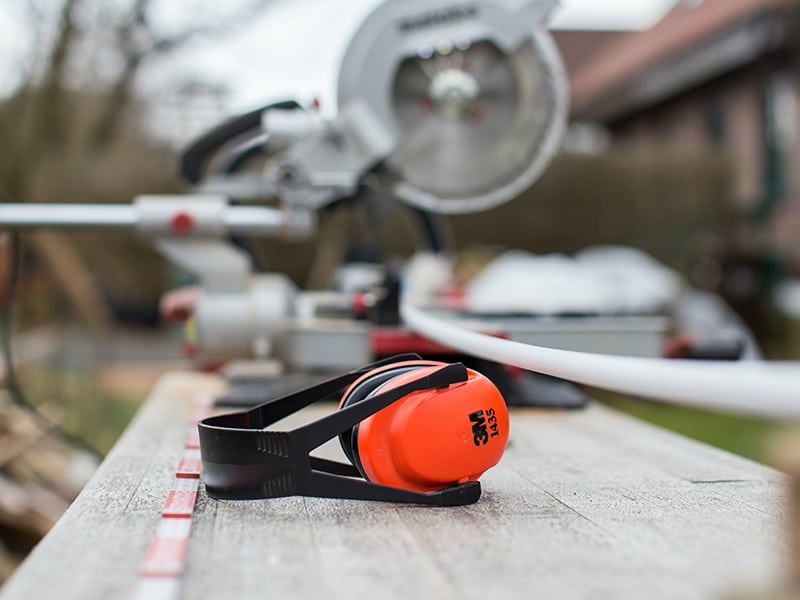
In recent years, the knowledge that noise at work can cause permanent and disabling hearing damage has impacted the design and construction of workplaces in the UK, especially those where manufacturing processes are part of the day-to-day activity.