







- 8 Minute Read
Construction Noise Management Plans (CNMP): The Complete Guide
A Construction Noise Management Plan (CNMP) sets out how a construction project will identify, assess and control the noise and vibration affecting nearby sensitive receptors: residents, schools, healthcare facilities and businesses. CNMPs are usually required as a planning condition on major projects, as part of a Section 61 consent application, or as a procurement requirement from developers and clients.

Adam Martin
29 September 2026
Categories:
Blog
Quick take
A Construction Noise Management Plan (CNMP) sets out how a construction project will identify, assess and control the noise and vibration affecting nearby sensitive receptors: residents, schools, healthcare facilities and businesses.
CNMPs are usually required as a planning condition on major projects, as part of a Section 61 consent application, or as a procurement requirement from developers and clients.
A good CNMP identifies the sensitive locations around the site, assesses which activities will generate the most significant impact, specifies the controls that will be applied, and sets out how compliance will be monitored, reported and enforced.
CNMPs should remain responsive to changes in site activities, working hours or surrounding conditions. Where a CNMP has been approved to discharge a planning condition, material changes may need to be agreed with the relevant Local Planning Authority (LPA) or Environmental Health Officer (EHO), depending on the requirements of the condition.
What is a Construction Noise Management Plan?
A Construction Noise Management Plan is a structured document setting out how a contractor will manage the noise and vibration impacts of construction activity on the surrounding area across the project programme.
Its purpose is to demonstrate to the planning authority, the local authority environmental health team and neighbouring receptors that the impacts have been assessed, that controls will be applied, and that a framework exists to monitor compliance and respond to complaints.
A CNMP is a commitment rather than a description. It is a formal undertaking that the specified controls will be implemented. Once approved it becomes part of the project’s planning framework, and departing from it carries regulatory and contractual consequences.
It is not a list of noisy activities. A CNMP is receptor-focused and risk-based: it links specific site activities to their likely acoustic impact at named locations, specifies what will be done about each, and establishes the monitoring and reporting that will prove it.
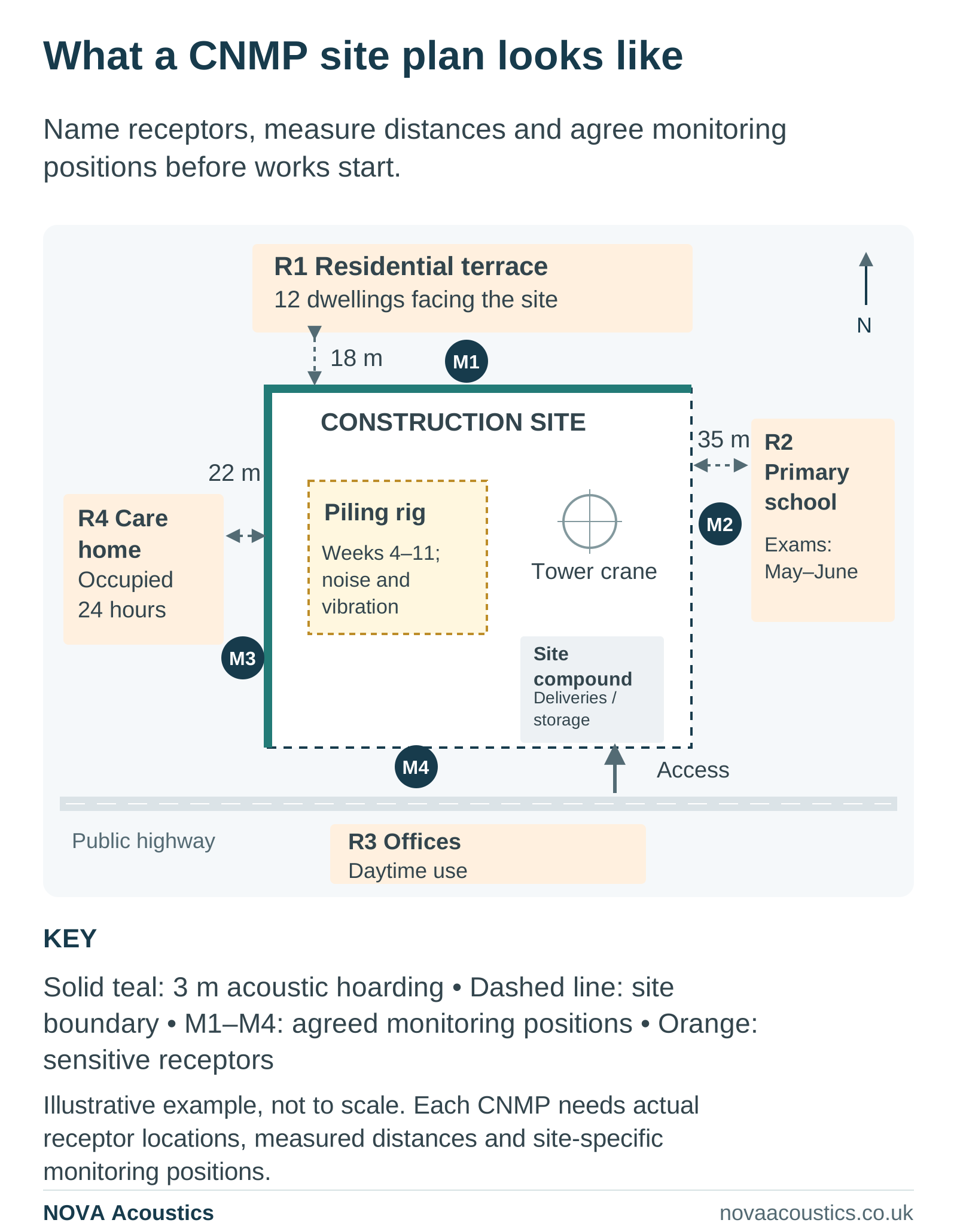
Depth should be proportionate. A CNMP for a small residential scheme in a quiet suburb is a very different document from one for a mixed-use development in a dense urban centre. The structure stays the same; the level of assessment and the intensity of the control and monitoring programme scale with the project and the sensitivity of its surroundings. Where the site needs baseline measurement to support that assessment, our noise survey services cover the data collection stage.
When is a CNMP required?
As a planning condition
This is the most common trigger. Many planning permissions for significant projects carry a condition requiring a CNMP to be submitted to and approved by the local planning authority, or its environmental health department, before construction starts.
Typical wording runs along these lines: “No development shall commence until a Construction Noise Management Plan has been submitted to and approved in writing by the Local Planning Authority. The plan shall include details of [specified content]. Construction shall be carried out in accordance with the approved plan unless otherwise agreed in writing.”
The phrase to watch is “no development shall commence”. Breaching a pre-commencement condition is not a technicality, and it can constitute a breach of planning control and create enforcement and programme risk.
As part of a Section 61 application
Section 61 of the Control of Pollution Act 1974 lets contractors apply for advance consent for construction noise. A CNMP typically forms the technical basis of that application and of the conditions attached to any consent granted. Our guide to Section 61 noise consent covers the process in full.
As a client or procurement requirement
Developers and major clients increasingly write CNMP requirements into tender documents, particularly on residential-adjacent sites, sensitive urban locations, and projects near schools, hospitals or listed buildings. This reflects the developer’s own planning obligations and their interest in community relations. Public sector frameworks often require contractors to demonstrate a noise and vibration management capability as standard.
When producing one voluntarily makes sense
On projects near sensitive receptors where nothing demands it, a CNMP is still worth producing. It demonstrates good neighbourly practice, reduces the risk of a Section 60 notice landing mid-programme, and gives you a defensible evidence base if complaints arrive.
Where a project has been through an environmental impact assessment, the construction noise chapter contains commitments that need translating into an operational site document. The CNMP is that document. For the wider planning picture, see our guide to noise impact assessment for planning permission.
If your project requires a Section 61 consent application alongside a CNMP, see our dedicated guide to Section 61 noise consent for construction.
The legal and regulatory framework
Control of Pollution Act 1974, Sections 60 and 61
Section 60 lets a local authority serve a notice on those carrying out construction works, specifying which plant may or may not be used, the hours work may take place, and noise limits at specified points. It is reactive and can arrive at any time. There is a 21-day right of appeal to the magistrates’ court, and contravening a notice without reasonable excuse is an offence.
Section 61 works the other way round. The contractor applies before work begins, setting out the works, the method and the steps proposed to minimise noise. The authority must decide within 28 days, and if it fails to respond or attaches conditions the applicant can appeal within 21 days.
The protection consent gives is worth stating precisely. Carrying out works in accordance with a consent is a defence to proceedings for contravening a Section 60 notice, and in practice an authority is unlikely to serve one for activities it has already consented to. But consent does not of itself provide a defence against statutory nuisance proceedings brought by an individual under Section 82 of the Environmental Protection Act 1990. It manages your relationship with the regulator, not a neighbour’s right to act.
BS 5228
BS 5228 is the technical standard for construction noise and vibration, in two parts: Part 1 for noise, Part 2 for vibration. Both are the 2009 editions with the 2014 amendment.
It supplies what a CNMP is built from: noise emission data for construction plant, methods for predicting levels at receptors, guidance on control measures and the reductions they achieve, and criteria for judging significance. BS 5228 should generally form the methodological basis of a CNMP, unless the planning condition or relevant authority requires an alternative approach. Referencing the methodology clearly is important, as officers need to understand how noise and vibration have been assessed and how the proposed controls have been determined. Our BS 5228 standards hub page summarises what it covers.
One common mix-up is worth clearing up. BS 5228 governs construction and open site noise. BS 4142 rates industrial and commercial sound affecting residential premises, which is about how the finished development will operate. Different phases, different standards, and a condition may require both.
Planning policy
The National Planning Policy Framework treats noise as a material planning consideration, covering the construction phase as well as the finished development. CNMPs are one of the mechanisms the planning system uses to manage it.
Local policy matters as much as national policy. Many authorities publish supplementary planning documents setting out their own CNMP requirements: content, submission timescales and how the plan will be assessed. Read the local plan before drafting. Our practical guide to the NPPF and noise covers the national position.
Environmental Protection Act 1990
Section 80 allows local authorities to serve abatement notices for statutory nuisance, construction noise included. For work on trade or business premises the statutory defence is that best practicable means were used. A CNMP documenting the controls considered, applied and monitored is direct evidence towards that defence, which is one of the strongest practical arguments for producing a thorough one.
For a broader overview of how the NPPF addresses noise in the planning system, see our practical guide to NPPF and noise.
How a CNMP differs from a Section 61 application
These two get conflated constantly. The distinction is straightforward once you separate the document from the process.
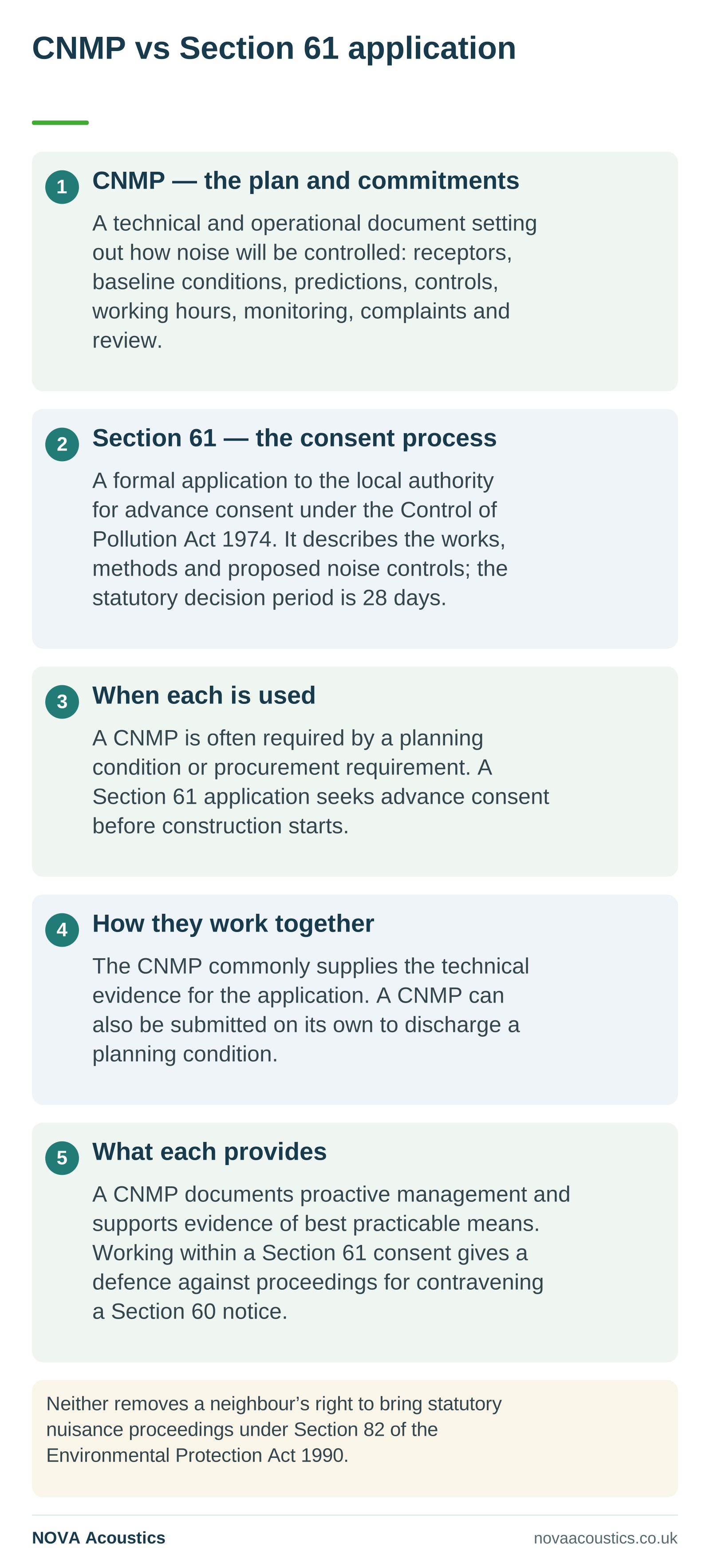
A Section 61 application is a formal legal application to the local authority for advance consent. It is a regulatory process with a statutory timescale, ending in a consent with conditions attached, or a refusal.
A CNMP is a technical and operational document describing how noise will be controlled. It is not an application. It is the evidence base an application, or a planning condition, is satisfied by.
How they connect. A CNMP is commonly submitted as part of a Section 61 application, supplying the predictions, controls and monitoring arrangements the authority needs to assess it, and the consent conditions may then require the contractor to work in accordance with it. The routes also run independently: many CNMPs are submitted to discharge a planning condition with no Section 61 application involved.
What each gives you. A Section 61 consent gives legal protection against proceedings for contravening a Section 60 notice, provided you work within its conditions. A CNMP alone does not. What it does is demonstrate proactive management, support a best practicable means defence, and give you a documented record when a complaint arrives. Where a CNMP is submitted with a Section 61 application that is approved, it effectively becomes part of the consent framework.
For a full explanation of the Section 61 consent process, including how to apply and how it interacts with a CNMP, see our Section 61 guide.
What a CNMP must contain
Use this as a checklist when commissioning a CNMP or reviewing one before submission.
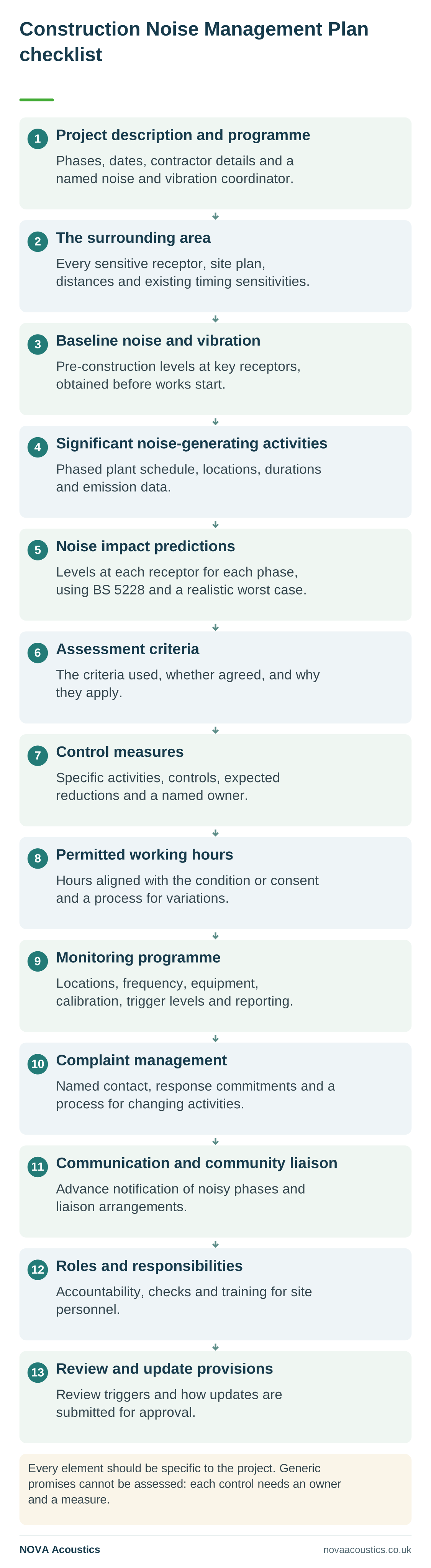
- Project description and programme. Project name, location and nature. Key phases with anticipated dates. Principal contractor and site management structure. Contact details for the noise and vibration coordinator responsible for implementation on site.
- The surrounding area. Every noise-sensitive receptor within the area of influence: homes, schools, hospitals, care homes, offices. A plan showing the site boundary, receptor locations and distances. The existing acoustic environment, including timing sensitivities such as exam periods or hospital shift patterns.
- Baseline noise and vibration. Measured or estimated pre-construction noise levels at key receptors, typically expressed as L<sub>A90</sub> or L<sub>Aeq</sub> depending on the chosen assessment method, plus vibration baselines where piling, demolition or compaction is planned. This provides the reference against which later impacts can be assessed, and it cannot be recovered once work starts.
- Significant noise-generating activities. A phased schedule of the activities that will dominate: demolition, piling, concrete breaking, heavy plant. For each, the plant involved, where it happens and how long it runs, with an activity noise table giving emission levels drawn from BS 5228 Part 1 Annex C or manufacturer data.
- Noise impact predictions. Predicted levels at each receptor for each significant phase, calculated using BS 5228 methodology, covering worst-case conditions as well as representative ones.
- Assessment criteria. What the predictions are judged against: the planning condition, the Section 61 application, BS 5228 significance criteria based on exceedance of background, local authority policy, or a combination. State explicitly which apply and why.
- Control measures. A schedule tied to specific activities and phases, following the BS 5228 hierarchy: quieter plant, acoustic screening, programming around sensitive times, working hour limits, plant maintenance, siting operations away from receptors, and housekeeping such as avoiding idling and metal-on-metal contact. For each, give the expected reduction and name who implements and enforces it.
- Permitted working hours. The hours work will take place, aligned with condition or consent restrictions, plus the process for agreeing variations where deviations are foreseeable, such as early concrete pours or weekend working.
- Monitoring programme. Locations, normally at or near the most exposed receptors. Frequency and methodology, including equipment, calibration and who carries it out. Trigger levels. Reporting frequency, format and recipients.
- Complaint management. How complaints will be received, recorded, investigated and answered. A named contact with direct details. Response commitments, commonly acknowledgement within 24 hours and investigation within 48. The process for changing site activities in response.
- Communication and community liaison. How residents and businesses will be told about noisy phases before they start: notification letters, a dedicated contact line, website updates. Any liaison group arrangements, and how the authority and receptors are notified ahead of unusually noisy activities.
- Roles and responsibilities. Who is accountable for each element: site manager, environmental manager, noise and vibration coordinator, subcontractors. Training requirements for site personnel.
- Review and update provisions. What triggers a review, and how updates are submitted for approval where the condition requires it.
Writing a CNMP: practical guidance
Who should write it
A CNMP containing noise predictions and significance assessments needs acoustic competence, specifically BS 5228 methodology and construction noise experience. It is not a document a general health and safety consultant can produce reliably without specialist input.
In practice CNMPs are produced by acoustic consultants working alongside the contractor’s project management and environmental teams. The consultant brings the methodology; the project team supplies programme information, plant schedules and site layouts.
What the contractor needs to supply
- Site layout drawings, current and phased
- The construction programme with key activity phases identified
- A plant and equipment schedule for each phase
- Proposed working hours
- Subcontractor information where it relates to noisy activities
- Any community liaison commitments already made
Gathering this before instructing a consultant is the single biggest lever on turnaround time.
Common drafting pitfalls
Generic control measures. “All practicable means will be used to minimise noise” commits to nothing and can be assessed against nothing. Officers reject plans on this more than anything else.
Best-case predictions only. Authorities expect worst-case scenarios. A plan modelling only average conditions reads as one that is hiding something.
Undeliverable monitoring. Design the programme around the access, power and resources the site will actually have.
Missing the critical receptor. Every site has one location that is closest, most exposed or most vulnerable. It should drive the control programme rather than sit in a list with the others.
Producing it too late. The CNMP usually has to be approved before commencement, and late production creates programme risk.
Timing
A Section 61 application has a 28-day statutory decision period. An application to discharge a planning condition is generally determined within eight weeks, and environmental health consultation can extend that. Drafting and internal review come before either clock starts, so build the whole sequence into the pre-commencement programme.
Once a CNMP is in place, monitoring is what demonstrates compliance. See our guide to construction noise monitoring for what it involves and how it is reported.
Vibration in a CNMP
Many CNMPs cover vibration as well as noise, particularly where the project involves piling, demolition, tunnelling, compaction or heavy earthworks. The vibration content follows the same structure as the noise content but draws on BS 5228 Part 2.
Activities to assess. Driven and bored piling. Drop hammer demolition. Compaction using vibratory rollers and plate compactors. Rock breaking. Tunnelling and underground works. Heavy vehicle movements across the site.
Two separate criteria. Vibration is assessed against structural damage thresholds, expressed as peak particle velocity (PPV), and against human response. The gap between them is large: levels that disturb people sit far below anything threatening a building. A CNMP addressing only structural damage will not prevent complaints.
Structural damage. BS 7385 Part 2 gives guide values for cosmetic damage from groundborne vibration, varying by structure type and frequency. Older masonry, listed buildings and structures already in poor condition warrant more conservative limits than reinforced or framed buildings. Pre-construction condition surveys near vibration-intensive work are strongly advisable and sometimes required by condition. They protect the contractor as much as the neighbour, because they establish what damage already existed.
Human response. Hospitals, care homes, schools, laboratories and precision manufacturing can have requirements more stringent than structural limits, because occupants or equipment are unusually sensitive. BS 6472-1 provides the framework for assessing human exposure to vibration in buildings.
Baseline and live monitoring. Measuring pre-existing vibration before work starts guards against claims for pre-existing damage. During vibration-intensive phases, real-time monitoring at sensitive structures gives both early warning and an evidential record. Trigger levels should state the PPV at which action is required and who holds the authority to stop work. Our guide to noise, vibration and dust monitoring covers the methodology in more depth.
Monitoring, reporting and complaint management
Monitoring in practice
Agree monitoring positions with the environmental health team before work starts, normally at or near the most exposed receptor facade. Monitoring locations should be selected to represent the relevant receptors, facades or agreed compliance positions, with the measurement setup reflecting the purpose of the assessment rather than assuming standard free-field conditions.
Use Class 1 sound level meters with data logging. Unattended equipment allows continuous 24-hour logging on sensitive sites, which is often the only practical way to evidence compliance across a long programme. Calibrate before and after every session and keep the records, because they are part of the compliance evidence.
Trigger levels
Set a tiered system rather than a single limit:
- Alert. Noise approaches the agreed limit. Increase vigilance, check plant and activities.
- Action. Noise reaches or exceeds the limit. Apply additional controls and notify the environmental health officer.
- Stop. Noise significantly exceeds the limit, or vibration approaches structural limits. Cease the activity until controls have been reviewed and agreed.

Set triggers below the condition limits rather than at them. A trigger set at the limit tells you about a breach after it has happened. The point of the system is to buy time to correct course.
Reporting
Report to the environmental health team at the frequency the CNMP or condition specifies, commonly weekly or monthly during active phases, with immediate notification when a trigger is exceeded.
Write for a non-specialist reader: levels against limits with a clear pass or fail, then the raw data for anyone who wants to check. A report only an acoustician can interpret will not do its job with a planning officer or a resident.
Complaints
Run a dedicated complaints line or email address, separate from general site contact details. Log every complaint with the date and time, its nature, the complainant’s details where given, what was happening on site at that moment, any monitored levels from that period, and the response taken. Submit the log as part of regular reporting.
Proactive communication reduces complaints more than any other single measure. Advance notification letters to nearby residents, sent at least 48 hours before noisy activities begin, are good practice and sometimes required by condition. People tolerate disruption they were warned about far better than disruption that arrives unannounced.
NOVA Acoustics provides construction noise monitoring, including unattended continuous monitoring, calibrated equipment and regular reporting to planning authorities. Get in touch to discuss your project.
Updating a CNMP during a project
A CNMP is not submitted once and filed. Programmes change, activities arrive that nobody anticipated, and the plan has to keep up.
Common triggers for an update:
- A new phase commencing. Each major phase brings different activities, plant and receptor impacts. Update before the phase begins, not during it.
- Programme changes. If work slips into more sensitive periods, closer to exam dates or into weekends, the assessment needs revisiting.
- New or replacement plant. Where plant differs from what the CNMP assumed, particularly if it is noisier, predictions must be recalculated and controls reviewed.
- Monitoring results. If levels are consistently approaching trigger levels, strengthen the controls rather than waiting for a breach.
- A pattern of complaints. Repeated complaints, even where individual events sit below trigger levels, suggest the plan is not protecting receptors adequately.
- Changes around the site. A new sensitive receptor nearby, such as a temporary school or a medical facility, warrants a review against that receptor’s specific sensitivities.
Where the condition requires local authority approval of the CNMP, updates usually need approval too. Build that lead time into the programme. Submitting an amendment the day before a new phase starts is not a defensible position.
Keep clear version control: dates, version numbers and a summary of what changed in each revision. That history is part of the compliance record, and it is what you will rely on if the project is ever challenged. Ongoing construction noise monitoring is usually what surfaces the need for an update in the first place.
Why choose NOVA Acoustics
A Construction Noise Management Plan is a technical document with real contractual and regulatory consequences. A plan that underestimates impacts, specifies impractical controls or fails to satisfy the planning authority can delay commencement, trigger enforcement and damage community relations. NOVA Acoustics produces CNMPs that are technically rigorous, practically deliverable and written to be approved rather than revised.
BS 5228 expertise. Our consultants apply BS 5228 methodology for noise prediction, significance assessment and control specification. That methodological basis is what separates a CNMP that gets approved from one that comes back with questions.
Section 61 and CNMP as one service. We routinely produce CNMPs as part of Section 61 consent applications, handling the legal application and the technical documentation together. For contractors running both processes against a pre-commencement deadline, that is considerably more efficient than coordinating two consultants.
Monitoring by the team that wrote the plan. We provide noise and vibration monitoring throughout the project, from unattended continuous equipment to reporting and trigger level management. The same team that set the commitments delivers the monitoring, so the methodology matches the plan.
National coverage. Offices in Leeds, Manchester, London, Birmingham, Nottingham, Liverpool, Cambridge, Newcastle, Sheffield, Bristol, and Hull let us mobilise across England quickly. That matters for tight pre-commencement programmes, and for projects that have started without an approved plan in place.
Experience across project types. We have produced CNMPs for residential and commercial development, infrastructure, demolition schemes and major urban regeneration. Our construction noise and vibration assessment service is calibrated to the project in front of us rather than issued from a template.
UKAS accreditation (No. 8568). NOVA is a UKAS-accredited testing laboratory, which reflects independently audited quality standards across the business and applies to all of our acoustic work.
Whether you need a CNMP from scratch, a Section 61 application to accompany it, or a monitoring programme to demonstrate compliance, NOVA Acoustics can manage the full process. Get in touch.
Frequently asked questions
A CNMP is a document identifying the noise-sensitive receptors near a construction site, assessing the noise and vibration impacts of significant construction activities, specifying the control measures that will be applied, and setting out how compliance will be monitored, reported and enforced. CNMPs are typically required by planning condition, as part of a Section 61 consent application, or as a procurement requirement on sensitive sites.
Most often as a planning condition on major projects, requiring the plan to be submitted to and approved by the local planning authority or environmental health department before work commences. CNMPs are also required as part of Section 61 consent applications under the Control of Pollution Act 1974, and increasingly as a standard procurement requirement from developers and public sector clients on sensitive or complex sites.
A Section 61 application is a formal legal application to the local authority for advance consent for construction noise, with a 28-day statutory decision period. A CNMP is a technical management document describing how noise will be controlled. A CNMP is commonly submitted as the evidence base for a Section 61 application and becomes part of the consent framework if approved, but many CNMPs are submitted to planning authorities under planning conditions with no Section 61 application involved.
A project and programme description; noise-sensitive receptors and baseline levels; a schedule of significant noise-generating activities with plant emission data; predicted levels at receptors; assessment criteria; control measures; permitted working hours; a monitoring programme with trigger levels; a complaint procedure; community liaison arrangements; roles and responsibilities; and review and update provisions.
For many projects, yes. Where work involves piling, demolition, heavy compaction or tunnelling, vibration impacts on nearby structures and building occupants must be assessed alongside noise. BS 5228 Part 2 provides the framework. Pre-construction condition surveys of nearby structures are strongly advisable, and sometimes required by condition.
For a straightforward project with a clear programme and few sensitive receptors, allow two to four weeks from instruction to a submission-ready document. Large urban sites and schemes requiring detailed BS 5228 modelling take longer. Authority review adds time on top: 28 days for a Section 61 decision, generally up to eight weeks for a planning condition discharge.
Yes, and it should be. Common triggers include new phases commencing, programme changes, new or replacement plant, monitoring results approaching trigger levels, and complaints suggesting the plan is not protecting receptors. Where the condition requires local authority approval, updates normally need approval before implementation, so allow lead time.
No. Working in accordance with a Section 61 consent is a defence to proceedings for contravening a Section 60 notice, but the consent does not of itself provide a defence against statutory nuisance proceedings brought by an individual under Section 82 of the Environmental Protection Act 1990. A well-documented CNMP supports a best practicable means defence, which is why the plan matters even where consent is in place.
Summary
A CNMP is an operational commitment, not paperwork produced to clear a condition and then filed. Done properly it manages construction noise risk before it becomes a problem, protects community relations, and leaves a defensible record across the life of the project.
The technical content has to be grounded in BS 5228. Generic control schedules without noise predictions or significance assessment will not satisfy a planning authority or an environmental health department, and a plan that comes back for revision costs programme time at the point where there is least of it available.
Get the sequencing right as well. The CNMP is a pre-commencement document, the approval routes have statutory clocks attached, and neither can be compressed once the programme is fixed.
NOVA Acoustics provides CNMP production, Section 61 applications and construction noise and vibration monitoring as integrated services, covering the full construction noise management lifecycle from pre-commencement approval to project completion.
Whether you need a CNMP for a new project, support with a Section 61 application, or a monitoring programme to demonstrate ongoing compliance, NOVA Acoustics has the expertise.
Get in touch to discuss your project | Learn more about our construction noise services
Sources
Legislation
- Control of Pollution Act 1974, Section 60 (control of noise on construction sites)
https://www.legislation.gov.uk/ukpga/1974/40/section/60 - Control of Pollution Act 1974, Section 61 (prior consent for work on construction sites)
https://www.legislation.gov.uk/ukpga/1974/40/section/61 - Environmental Protection Act 1990, Part III (statutory nuisance)
https://www.legislation.gov.uk/ukpga/1990/43/part/III
Standards
- BS 5228-1:2009+A1:2014, Code of practice for noise and vibration control on construction and open sites: Noise
https://knowledge.bsigroup.com/products/code-of-practice-for-noise-and-vibration-control-on-construction-and-open-sites-noise - BS 5228-2:2009+A1:2014, Code of practice for noise and vibration control on construction and open sites: Vibration https://knowledge.bsigroup.com/products/code-of-practice-for-noise-and-vibration-control-on-construction-and-open-sites-vibration
- BS 7385-2:1993, Evaluation and measurement for vibration in buildings: Guide to damage levels from groundborne vibration
https://knowledge.bsigroup.com/products/evaluation-and-measurement-for-vibration-in-buildings-guide-to-damage-levels-from-groundborne-vibration - BS 6472-1:2008, Guide to evaluation of human exposure to vibration in buildings: Vibration sources other than blasting
Planning policy
- National Planning Policy Framework
https://www.gov.uk/government/publications/national-planning-policy-framework–2 - Planning Practice Guidance: Noise
https://www.gov.uk/guidance/noise–2