



BB93 is the Department for Education’s performance standard for school acoustics. Requirement E4 of the Building Regulations says each room or space in a school building should have acoustic conditions and insulation against noise appropriate to its use, and Approved Document E states that the normal way of satisfying E4 is to meet the values in Section 1 of BB93. E4 applies to new school buildings, extensions and buildings converted to school use. BB93 also sets slightly less demanding values for refurbishment, which clients often write into the project brief.
For more on how the Building Regulations deal with sound, see our acoustic standards hub.
Three of BB93’s measures matter most when you are thinking about treatment.
Indoor ambient noise level. Background noise from outside and from building services such as ventilation. Panels don’t fix this; it is mainly a matter of glazing, ventilation and the building envelope.
Reverberation time (Tmf). How long sound takes to die away in a room, averaged across the mid frequencies. This is the measure absorptive treatment controls most directly, and it is the focus of this article.
Sound insulation between spaces. How well walls, floors and doors stop sound passing between rooms. Panels inside a room do nothing for this. NOVA carries out UKAS-accredited sound insulation testing where that is the issue.
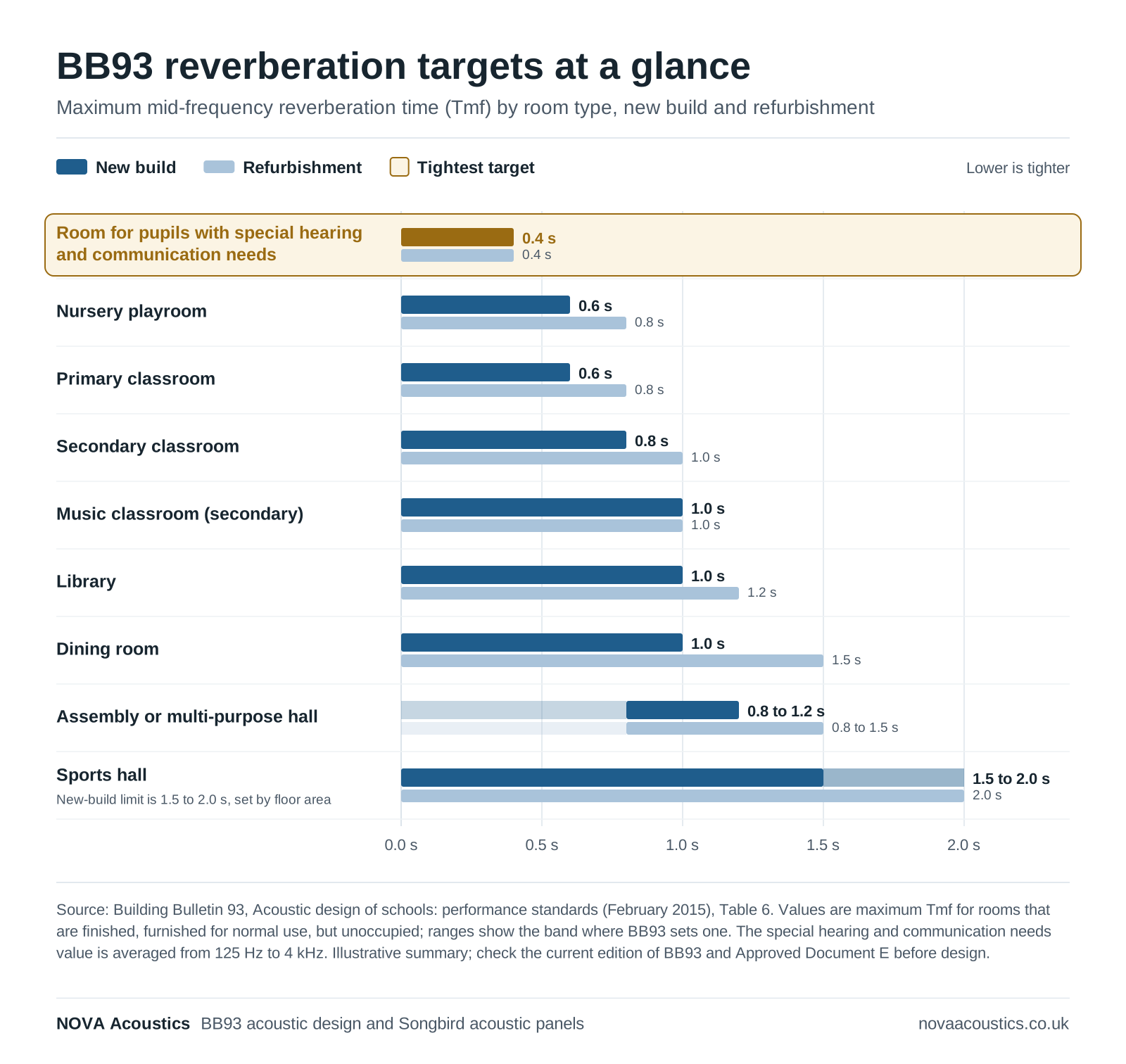
BB93 sets these reverberation times for rooms that are finished and furnished for normal use, but unoccupied:
Space | New build | Refurbishment |
Nursery playroom | 0.6 s or less | 0.8 s or less |
Primary classroom | 0.6 s or less | 0.8 s or less |
Secondary classroom | 0.8 s or less | 1.0 s or less |
Room for pupils with special hearing and communication needs | 0.4 s or less | 0.4 s or less |
Library | 1.0 s or less | 1.2 s or less |
Dining room | 1.0 s or less | 1.5 s or less |
Assembly or multi-purpose hall | 0.8 to 1.2 s | 0.8 to 1.5 s |
Sports hall | 1.5 to 2.0 s or less, depending on floor area | 2.0 s or less |
For the full detail of what BB93 requires, including ambient noise and sound insulation targets for every room type, see our complete guide to BB93.
Reverberation time depends on the volume of the room and the total sound absorption in it: a bigger room rings for longer, and more absorption shortens the ring. You can’t easily change a classroom’s volume, so you add absorption. In a finished school room with a hard floor, plastered walls and plenty of glazing, that means acoustic panels on the walls or rafts and baffles at ceiling level.
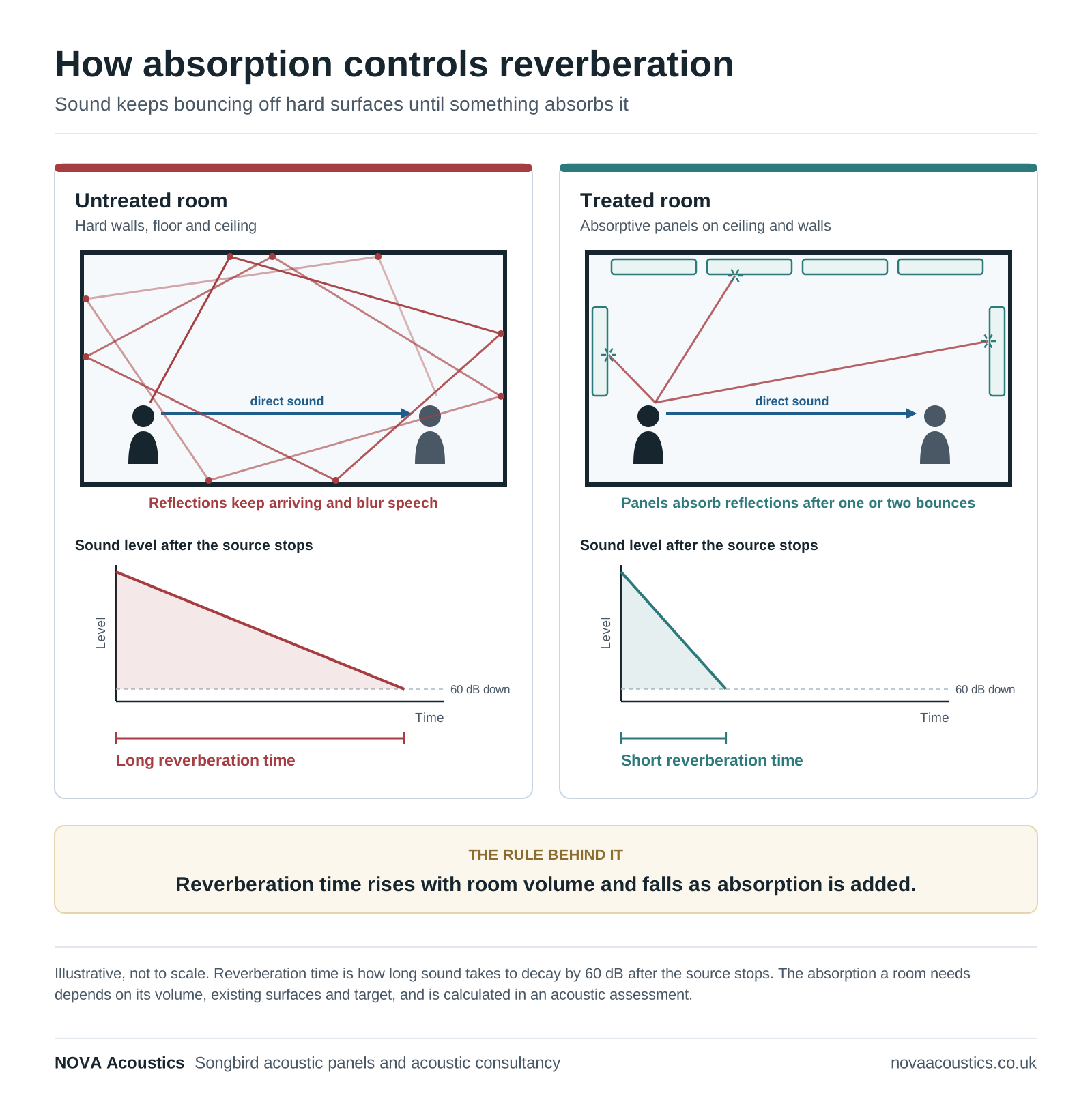
Absorbers are graded under BS EN ISO 11654 from Class A, the most absorptive, down to Class E. Class A absorbs the most sound per square metre, which matters in schools, where display boards, windows and whiteboards already take up much of the wall.
Every Songbird panel achieves Class A absorption. So in a school, choosing between Songbird panels is not really an absorption-performance decision. The real questions are how much absorptive area each room needs, where it can go, how it looks, how it installs and, in a school, whether it will survive the environment.
How much treatment a room needs depends on its volume, its existing surfaces and the target, so it is worked out in an acoustic assessment rather than guessed. We don’t publish a “panels per classroom” figure, because two classrooms of the same floor area can need very different amounts depending on ceiling height, glazing and floor finish.
Placement matters too. Ceiling treatment is efficient and out of harm’s way, and in halls and sports halls, rafts and baffles are often the only practical way to get enough absorption into a large volume. In classrooms, our advice is to spread absorption across the ceiling and walls, which tends to control reflections more evenly. Explore the Songbird range.
Acoustic performance is only half of the specification question in a school. The other half is whether the panel survives where it is fixed. In our experience, this is often underestimated at design stage.
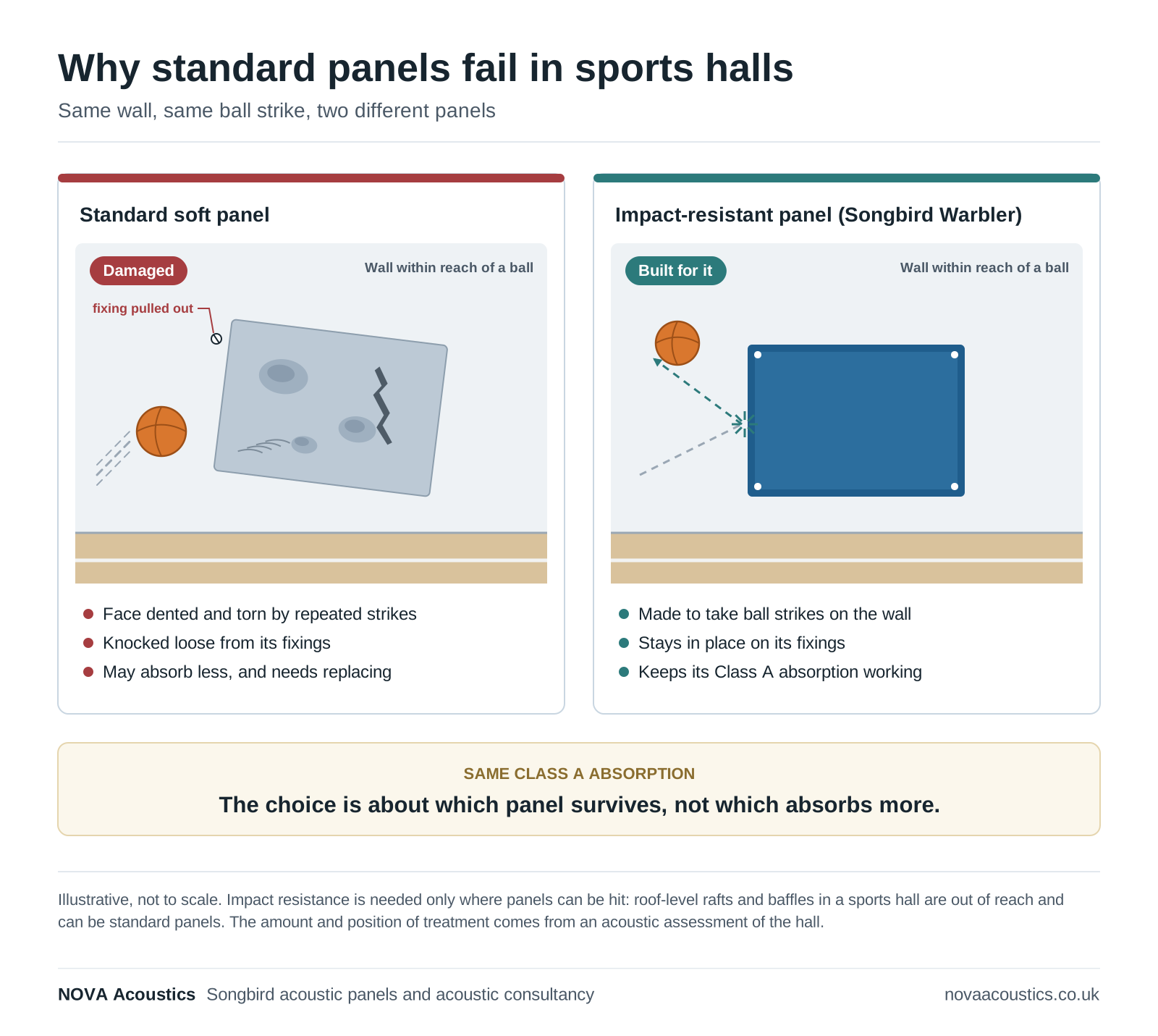
Sports halls are the clearest case. Balls hit the walls all day, and a standard soft panel within reach will dent, tear or come off its fixings. A damaged panel isn’t just unsightly. Depending on the damage it may absorb less, and it leaves the school with a replacement cost it didn’t plan for.
Elsewhere the risk is lower but not zero: bags in corridors, chairs and trolleys in dining halls, more contact at low level in primary and SEND classrooms. Ceiling rafts and upper walls are out of reach almost everywhere. Our advice is to match the panel to the risk at each location rather than putting the toughest product everywhere.
All three products below have the same Class A absorption; what differs is the room and what the panels have to withstand. In each project, our consultants measured the room first and used the results to set the amount and layout of treatment.
Skylark in classrooms: Lycée Français Charles de Gaulle, London
The Lycée in South Kensington had more than 30 classrooms with high ceilings and reflective finishes. Sound built up during lessons, speech was hard to follow, and the school needed a fix that wouldn’t spoil the rooms or disrupt teaching.
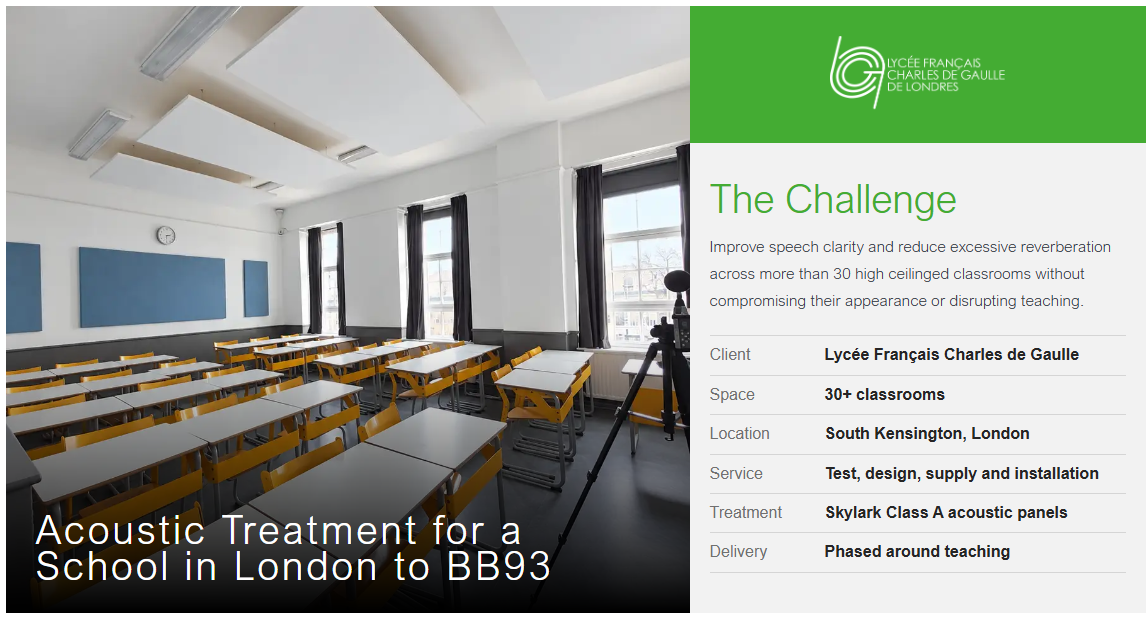
We carried out on-site reverberation testing and assessed each teaching space, then designed a layout of Skylark wall panels and suspended ceiling rafts for every room. The white rafts sit between the existing lights and the blue wall panels sit within the teaching space, so the treatment reads as part of the room. Installation was phased around the working school.
Read the Lycée Français Charles de Gaulle case study.
Finch on a drama studio ceiling: Kidderminster
A finished school drama studio had harsh, uncomfortable acoustics, and teachers were particularly sensitive to the noise. The walls and floor were needed for teaching and performance, so treatment had to go entirely on the ceiling.
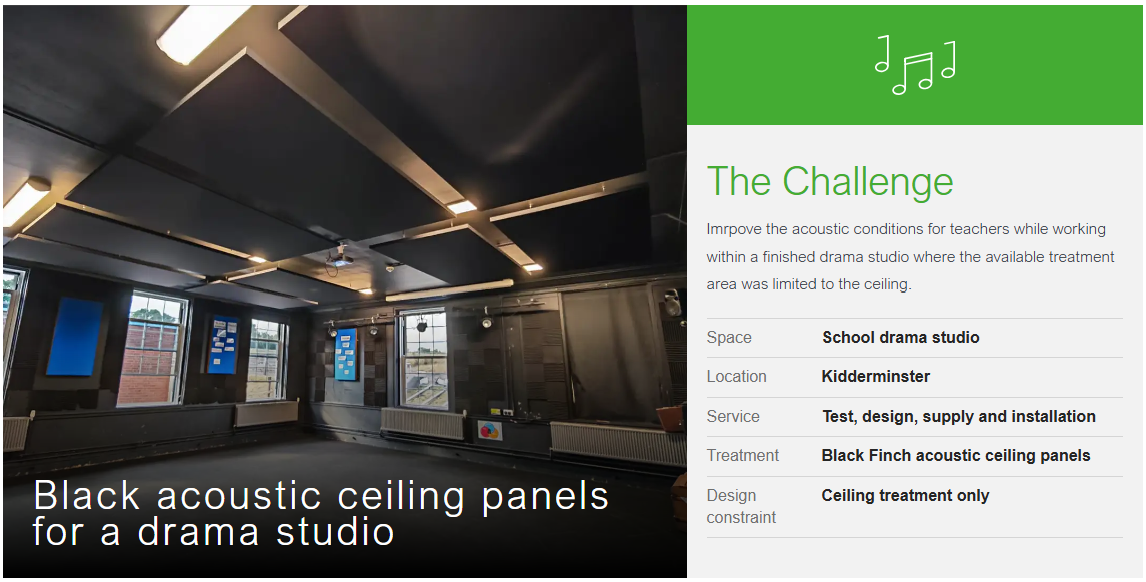
After on-site testing, we calculated the absorption needed and arranged black Finch panels across the ceiling, working around the existing strip lights and projector. The black finish matches the studio’s dark walls and stage area and leaves the performance floor clear.
Read the Kidderminster drama studio case study.
Warbler in sports halls: Galliford Try
Sports halls are where Warbler belongs. Wall treatment in a sports hall is within reach of balls and PE equipment, and Warbler is Songbird’s impact-resistant panel, made for exactly that. It has the same Class A absorption as the rest of the range.
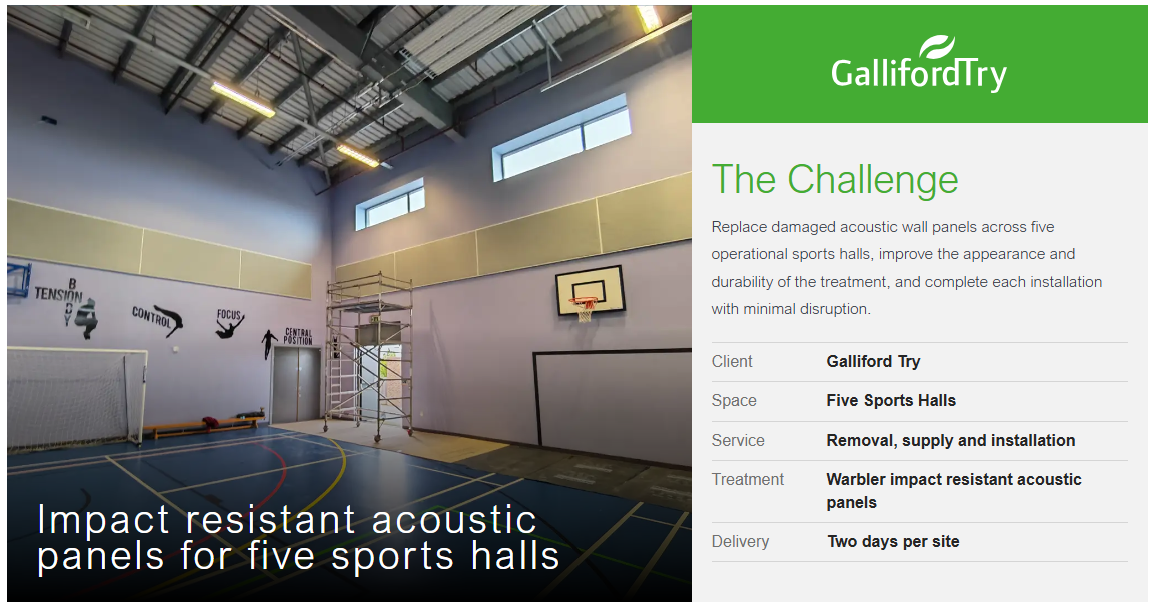
You don’t choose it for better absorption; you choose it because it keeps that absorption working in a room where a softer panel would be damaged. We supplied Warbler for sports halls delivered with Galliford Try.
Read the Galliford Try sports halls case study.
Choosing between them
As a starting point from these projects: Skylark for classroom walls and ceiling rafts, Finch where a ceiling-only scheme or a particular finish suits the room, and Warbler where panels on the walls will be hit. Colour and layout are part of the specification too, especially in primary and SEND settings, so decide them alongside the acoustic design. Wall linings in corridors and escape routes also have reaction-to-fire requirements under Approved Document B, so check each panel’s fire classification against its location.
Specifying acoustic treatment for a school? Tell us about your rooms and our consultants will recommend the right Songbird panels, quantities and layout for each one.
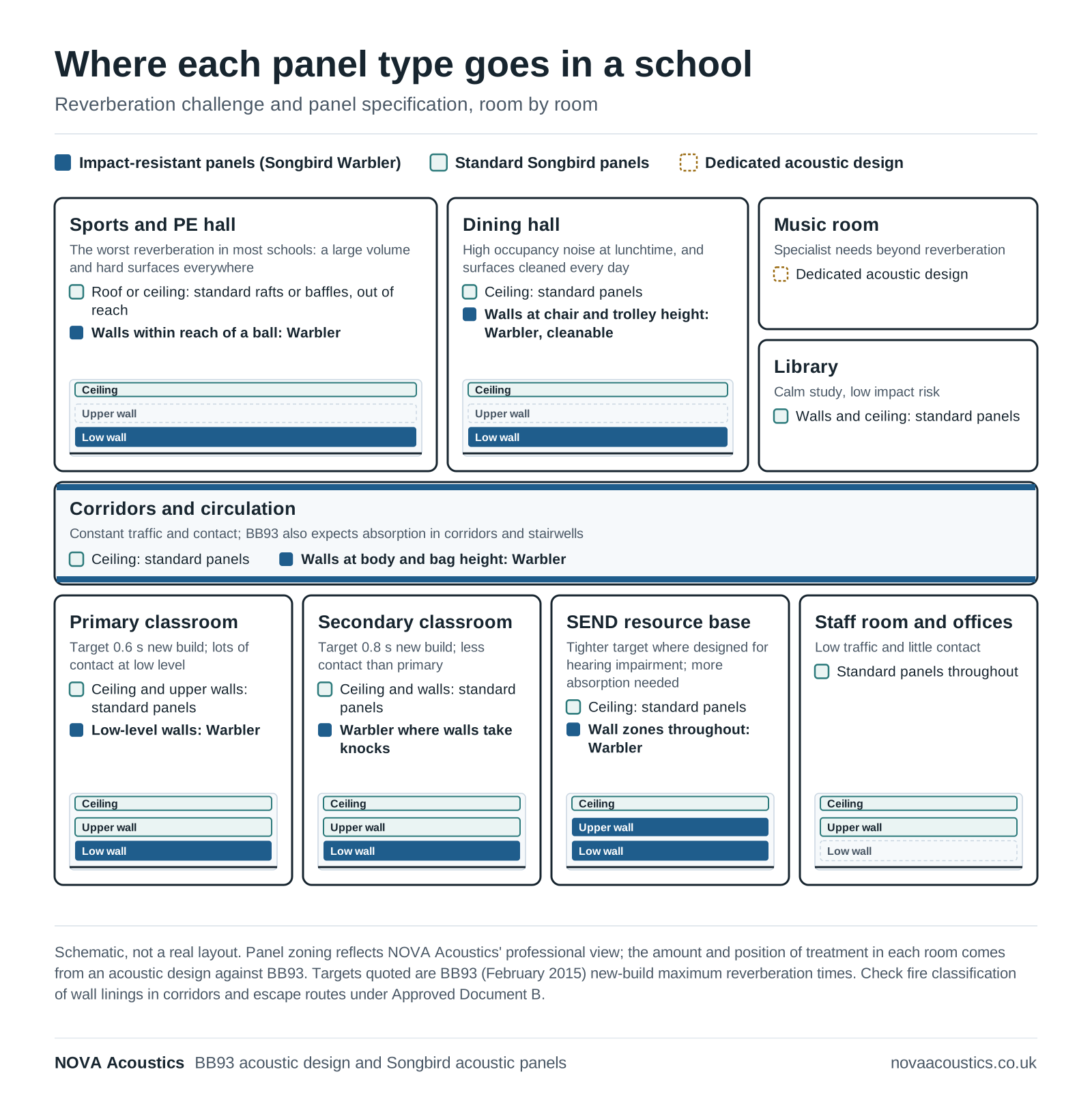
Mainstream classrooms. Moderate reverberation control, using wall panels, ceiling rafts or both. Skylark wall panels and rafts were the solution across the Lycée’s classrooms. In primary classrooms, think about how much contact low-level wall panels will get. See our classroom acoustics page.
SEND classrooms and resource bases. Tighter targets where the room is designed for hearing impairment, more absorptive area, and a careful look at how robust the wall treatment needs to be given how the room is used.
Sports and PE halls. A large volume with very hard surfaces, which usually makes these the worst reverberation problem in a school. Most of the absorption goes in at ceiling or roof level as rafts or baffles, with wall treatment below. Wall panels within reach of a ball should be impact-resistant, which is where Warbler comes in. See our sports hall acoustics page.
Dining halls and refectories. High occupancy noise and frequent cleaning. Most treatment can go on the ceiling; keep low-level wall panels to areas away from chairs and trolleys, or specify them for the contact they’ll get.
Corridors and circulation. High traffic and constant contact. BB93 also expects absorption in corridors, entrance halls and stairwells, calculated using the methods in Approved Document E. The ceiling is usually the best place for it, out of reach of bags and bodies.
Drama studios. Often a ceiling-only job, because walls and floor are needed for performance, as at Kidderminster, where black Finch panels went across the ceiling.
Music rooms. Music spaces have their own acoustic needs, which go beyond controlling reverberation, and they need dedicated design rather than a standard treatment package.
Libraries and quiet study. Reverberation control for a calm environment, with lower impact risk, so standard panels usually suit. See our library acoustics page.
Getting the amount and placement of treatment right across a whole school is a design calculation, not a guess. Our acoustic consultants can assess your spaces against BB93 and specify the treatment each room needs.