


Skip to content

NOVA Acoustics

Visit Songbird Acoustic Panels

Sound Absorption Vs Sound Insulation? What’s the big difference?

Sound absorption refers to the loss of sound energy when sound waves hit ceilings, walls and floors, and they are absorbed.

Materials that are absorbent are often used so that a particular building is soundproofed to reduce the amount of reverberation, which has an impact on the way a particular room sounds.

Reverberation time is an important factor, as a longer duration makes a room sound loud and noisy, causing speech to become muffled. Spaces that are designed for speech usually benefit from a shorter reverberation time of less than one second. Longer reverberation times are used for music halls to add the acoustic dynamics of that space.

Buildings including schools, concert venues, recording studios and sports halls are important when it comes to their design as sound absorption needs to be implemented effectively so that these spaces operate fully for their intended use. In offices and shared environments, Acoustic Room Dividers are increasingly used to improve speech clarity and reduce noise distractions without permanent construction.

What does sound absorption look like?

Floors, walls and ceilings are usually treated with a specific type of sound absorption, which is either porous absorbents, resonance absorbents or single absorbents.

Porous absorbents

This type of absorbent takes the form of either a fibrous material or open-celled foam. The use of fibrous material allows the sound to be absorbed as the sound waves push through so that the fibres are bent and generate heat. This conversion of acoustic energy to heat means that sounds are absorbed.

Open-celled foam consists of the air movement from the sound waves that force particles of air through passages to generate heat. The thickness of a particular material has a significant impact on how well it absorbs sound.

Resonance absorbents

This type of absorbent is made up of a mechanical or acoustic system, which oscillates, and an example of this type of absorbent is membrane absorbers, which consist of a solid plate and a compact airspace.

Cavities can be filled with porous materials so that the absorption is widened across the range of frequencies.

Single absorbents

Single absorbents are usually types of furniture or other household objects including tables and chairs. The materials vary, as do the characteristics of their absorbance. For low-frequency sounds that are below 500 Hz, then there may be some difficulty when it comes to absorbing compared to high frequencies that are above this range which are usually easier to absorb.

Sound absorption and sound insulation are not the same

When it comes to sound absorption and sound insulation, it’s important to remember that they are not the same thing. They each have different ways of helping the acoustics of a particular room or building.

Sound insulation is a technique that is used to restrict sound from travelling between separate spaces through walls, ceilings and floors.

Sound absorption occurs by converting some of the energy into heat, instead of transmitting it. This can be used in conjunction with sound insulation in order to maximise the opportunity to reduce and prevent acoustic problems from occurring, but it shouldn’t be viewed as a substitute for proper sound insulation in buildings.

Recent posts

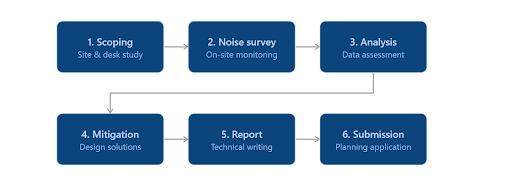
NIA Process

A noise impact assessment (NIA) is a technical report submitted as part of a planning application to demonstrate that a proposed development will not cause unacceptable noise. You will typically need one if your development is near a significant noise source (road, rail, or commercial premises), if it generates noise that could affect nearby residents, or if a planning authority has specifically requested one. NIAs are assessed against standards including BS4142, BS8233, and the NPPF. Without one, many planning applications are refused or delayed.
robin

Acoustic panels reduce echo, reverberation, and noise build-up within a room by absorbing sound. They do not block sound between rooms. The right panel depends on five things: the material (polyester fibre or fabric-wrapped), the thickness, how it will be mounted, the aesthetic requirements of the space, and whether durability or sustainability are priorities. Every panel in the Songbird range achieves Class A sound absorption (the highest performance rating available), so the choice between them comes down to application, environment, and finish rather than acoustic performance.

thumb 1000 767 0 0 crop 8

When it comes to specifying which partition wall or floor design to choose for a project or which product supplier or specifiers data sheet to trust, there’s a lot of confusion and mis-application.​