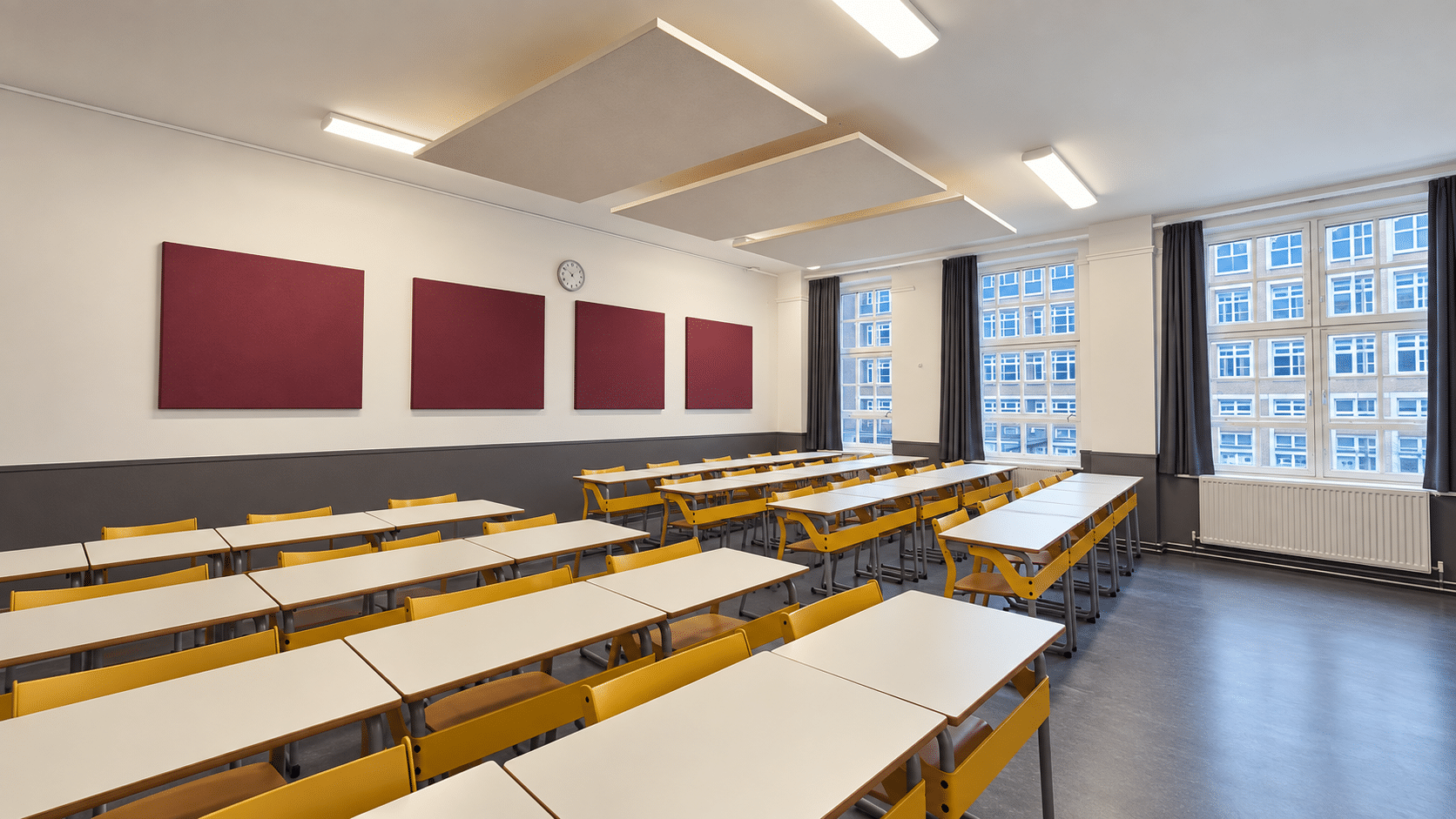





Quick Take
Open plan office acoustics comes down to three things: controlling reverberation so speech is clear, managing background noise so people can concentrate, and achieving speech privacy so conversations do not travel. The key targets for open plan offices are a reverberation time (RT60) of 0.4 to 0.6 seconds, a background noise level of around 40 to 45 dB LAeq, and a Speech Transmission Index (STI) that limits intelligible speech to the immediate vicinity of the speaker. Achieving these consistently requires an integrated approach. Acoustic panels alone are rarely sufficient without also considering layout, screening, ventilation noise, and room geometry. This guide covers the principles, the targets, and the practical steps to get there.
The open plan office acoustic challenge
Open plan offices are designed to promote collaboration, visibility, and a sense of shared purpose. The design choices that achieve those goals (hard surfaces, open sightlines, high ceilings, minimal soft furnishings) are acoustically hostile. The result is one of the most common workplace complaints across every sector: noise.
The acoustic challenge is multifaceted. Too much reverberation makes speech difficult to follow. Too little attenuation between zones means private conversations travel across the floor. Background noise from HVAC systems, equipment, and adjacent areas creates a constant cognitive load that accumulates through the working day.
The consequences go beyond irritation. Research consistently links poor workplace acoustics to reduced productivity, elevated stress, and increased absenteeism. In competitive labour markets, workspace quality is a factor in employee satisfaction and retention in ways that were not widely acknowledged a decade ago. Acoustic comfort is now part of the commercial case for a well-designed office, not an afterthought.
This guide addresses the full picture: the design principles, the performance targets, when and how to invest in acoustic treatment, and how to specify it correctly.
Our acoustic consultants work with architects, interior designers, and facilities managers on commercial office projects across the UK. If you need an assessment for a current or planned fit-out, get in touch.
The business case for good office acoustics
Research cited by TotalJobs places poor workplace conditions among the most significant sources of lost productivity in UK businesses. Noise is consistently identified as the primary workplace distraction, ahead of temperature, lighting, and air quality.
The stress dimension is equally well documented. Data from SAS International indicates that elevated noise levels are associated with increased workplace stress in a significant proportion of office workers. Under the Health and Safety at Work Act 1974 and associated guidance, employers have a duty of care that extends to the psychological environment. Persistent noise-related stress is a legitimate wellbeing concern, and one that HR and operations directors are increasingly expected to address.
Speech privacy carries a specific commercial risk that is less commonly discussed. In offices where confidential conversations take place (legal practices, financial services firms, HR functions, healthcare administration), inadequate privacy is not just an inconvenience. Where personal or sensitive information can be overheard by unintended listeners, GDPR obligations may be relevant. An acoustic problem in those environments is also a compliance problem.
The investment case for acoustic treatment follows from this. Acoustic panels and treatment are a capital expenditure with a measurable impact on output, absenteeism, and employee satisfaction. Framing the cost as a cost-benefit decision rather than an aesthetic preference tends to produce faster sign-off from budget holders.
Explore acoustic panel solutions designed for commercial office environments, including bespoke fabric-wrapped panels, slim-profile options, and self-adhesive panels for quick installation.
The core acoustic design principles
For a foundational grounding in acoustic concepts before getting into office-specific applications, see our introduction to the principles of building acoustics.
Speech intelligibility and the Speech Transmission Index
Speech intelligibility is the measure of how clearly speech can be understood. In office environments, it is the primary acoustic performance metric, because it governs both communication quality and privacy simultaneously.
The Speech Transmission Index (STI) runs from 0 to 1. At 0, speech is completely unintelligible. At 1, it is perfectly clear. In open plan offices, the design goal is to achieve Good or Excellent STI in the immediate vicinity of a speaker (so colleagues directly adjacent can communicate clearly) while keeping STI low enough at distance that speech is not intelligible across the room.
The rating framework:
- Excellent or Good (STI 0.75 and above): speech is fully intelligible. Appropriate for meeting rooms, call booths, and direct collaboration spaces.
- Fair (STI 0.45 to 0.75): speech is partially intelligible. Typical of a moderately treated open plan environment where some background noise and absorption are present.
- Poor (STI 0.30 to 0.45): speech is barely intelligible beyond immediate proximity. Appropriate for general open plan work zones where privacy matters more than across-room communication.
- Bad (STI below 0.30): speech is almost unintelligible. This can indicate over-treatment or very high background noise, and is rarely the right target in a standard office.
The underlying design insight is that there is a deliberate trade-off between intelligibility and privacy. Acoustic design in open plan offices is about managing where on that spectrum different zones sit, not about maximising one at the expense of the other.
Reverberation time (RT60)
Reverberation time is the time it takes for a sound to decay by 60 dB after the source stops. It is a measure of how long sound energy persists in a room.
In an office context, high reverberation means speech reflections accumulate, making it harder to distinguish the direct voice from its echoes. Noise from any source (a phone ringing, a printer, a loud conversation) continues to ring around the room long after the source has stopped. This persistent background energy raises the apparent noise level even when no one is actively making noise.
The Lombard Effect compounds this. In high-reverberation environments, speakers unconsciously raise their voices to be heard above the accumulated ambient noise. Higher ambient noise prompts further voice raising. The cycle is self-reinforcing and, once established, can only be broken by reducing reverberation through acoustic treatment.
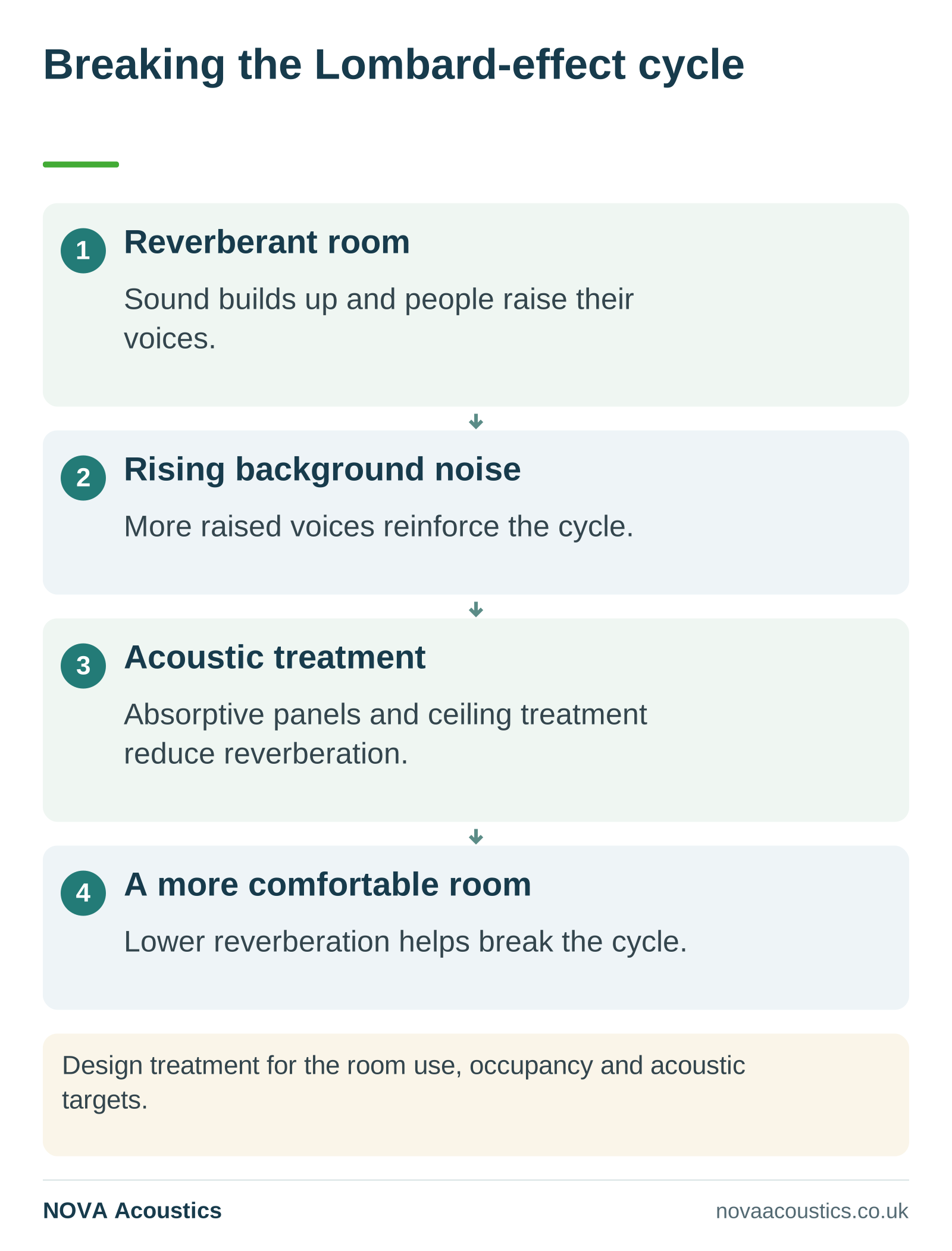
The broadly accepted target for standard open plan office environments is RT60 between 0.4 and 0.6 seconds. Below 0.4 seconds can feel unnaturally quiet; above 0.8 seconds is typically problematic for both speech clarity and speech privacy. RT60 is a function of room volume and the total sound absorption present. The larger the room and the harder its surfaces, the longer the RT60. Adding acoustic panels increases absorption and brings RT60 down.
Background noise levels
Background noise level is the steady ambient noise floor in a room, generated by HVAC systems, external traffic, equipment, and the general low-level noise of occupation.
In office acoustics, background noise plays a dual role. A consistent background level provides acoustic masking: it reduces the signal-to-noise ratio for any overheard speech, which improves privacy by making distant conversations less intelligible. At too high a level, background noise becomes a source of distraction and cognitive load in its own right.
BS8233 recommends a background noise level of 45 to 50 dB LAeq for open plan offices with ceilings above 3 metres. The British Council for Offices (BCO) Guide to Specification concurs with a target of around 45 dB LAeq. For private offices and meeting rooms, the appropriate range is lower: typically 35 to 40 dB LAeq.
HVAC systems are the primary source of background noise in most modern offices, and this is often a design advantage. A well-designed HVAC system provides masking noise at a controlled, consistent level. Over-specifying acoustic treatment without considering the HVAC contribution can result in a space that is too quiet. In that condition (sometimes called the “fishbowl” effect), every conversation becomes audible across the floor regardless of how much treatment is on the walls.
Speech privacy
Speech privacy is the degree to which conversations are unintelligible to unintended listeners. Research into workplace acoustic dissatisfaction consistently finds that people object more to hearing intelligible speech from colleagues they are not working with than to general background noise at comparable volume. Intelligible conversation is intrinsically distracting in a way that broadband background noise is not.
Speech privacy in open plan offices comes from four sources working together: distance (sound level reduces naturally with distance from the source); absorption (reducing reverberation reduces speech intelligibility at distance); masking (a consistent background noise level reduces the ratio of speech to background); and physical screening (barriers between workstations reduce the direct sound path between source and receiver).
The Privacy Index (PI) is sometimes used alongside STI to characterise speech privacy in a space. A PI above 95% is considered confidential. Between 80% and 95% is described as normal. Below 80% is poor privacy, and typical of an untreated open plan office.
Acoustic performance targets for offices
There is no single mandatory acoustic standard for open plan offices equivalent to Part E for residential buildings. Compliance is largely guidance-driven. The following reference points are widely applied by acoustic consultants in UK commercial office design.
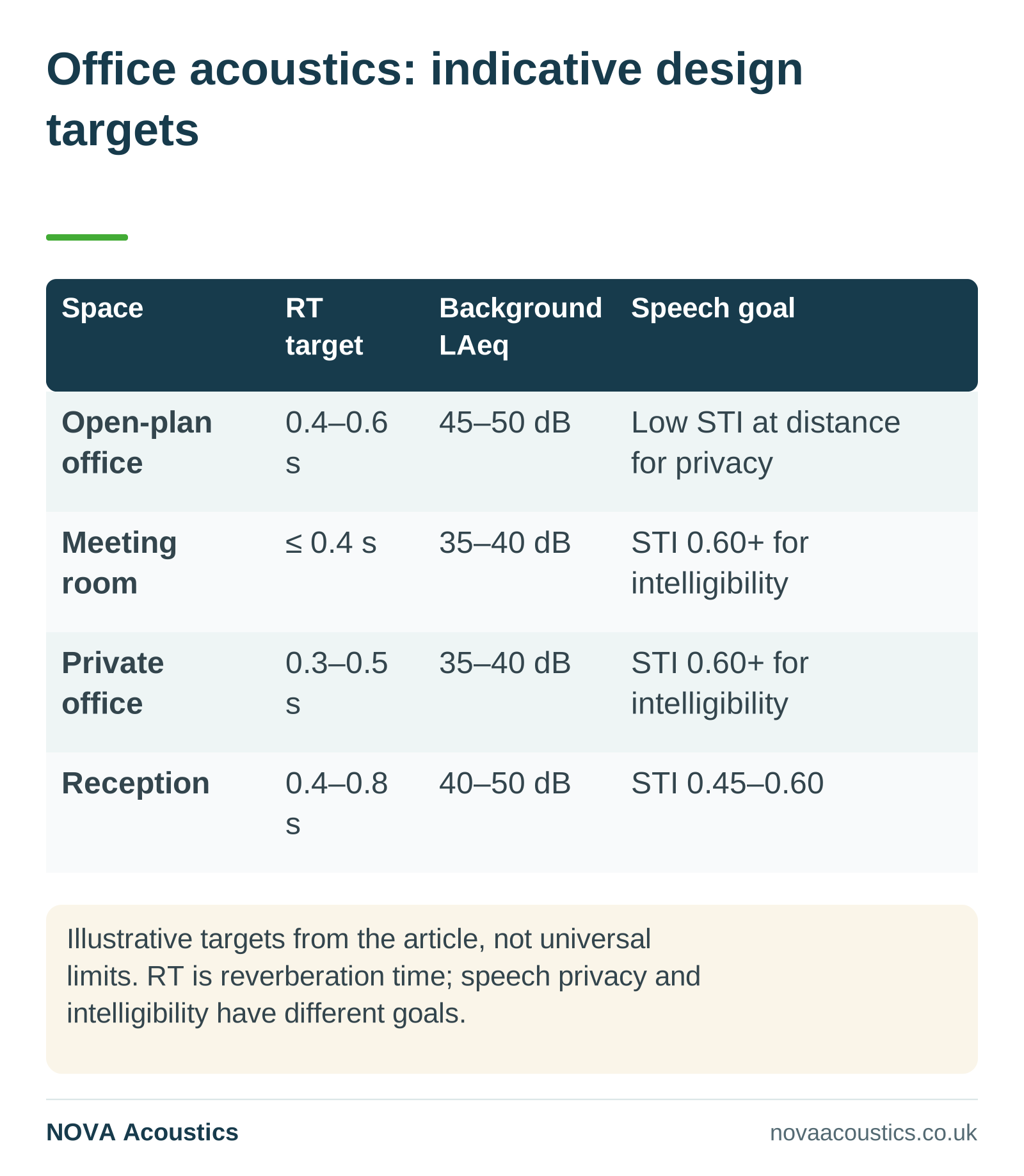
Reverberation time: 0.4 to 0.6 seconds RT60 for standard open plan. Some guidance allows up to 0.8 seconds for very large volumes.
Background noise level: 40 to 48 dB LAeq for open plan offices; 35 to 40 dB LAeq for private offices and meeting rooms; 45 to 50 dB LAeq where acoustic masking is deliberately deployed.
STI targets: Good (0.60 and above) at workstations and collaboration zones; Poor (0.30 to 0.45) across the general open plan to support privacy from adjacent zones.
The BCO Guide to Specification is the primary commercial reference document for UK office acoustic performance. The WELL Building Standard is an increasingly relevant framework for health-focused commercial fit-outs, and it includes specific criteria for background noise, reverberation, and sound isolation between spaces.
Call centres and customer service environments have materially different requirements from standard offices: higher background noise, stricter reverberation control, and tighter STI requirements at workstation level. These are worth noting as a distinct scenario when advising clients in those sectors.
The three pillars: absorb, block, cover
A common misconception is that acoustic panels alone are the solution to an open plan office noise problem. Panels are usually the most visible and most specifiable intervention, but they address only one of three distinct mechanisms for managing sound in a workspace.
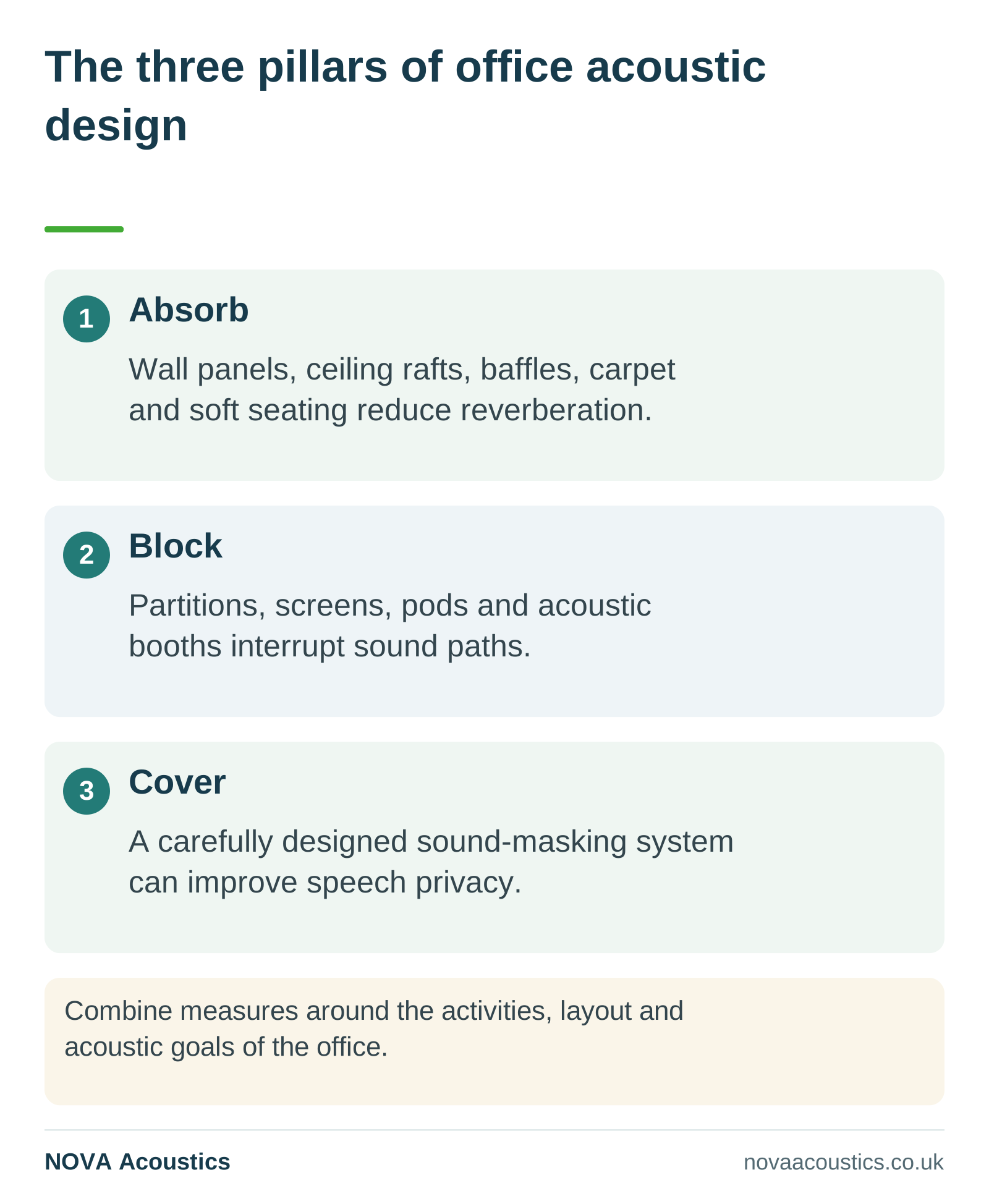
Absorb. Acoustic panels, ceiling baffles, soft furnishings, carpet, and other porous materials absorb sound energy and reduce reverberation. Absorption brings down RT60, interrupts the Lombard Effect cycle, and improves STI at close range. It is the most commonly specified intervention and the focus of the product and placement sections below.
Block. Physical barriers (full-height partitions between zones, glazed screens, raised floor pods, and acoustic booths) block the direct path of sound between source and receiver. Blocking reduces STI at distance and isolates zones from each other. An absorbing ceiling combined with a screening partition between workstation clusters is significantly more effective than either alone.
Cover. Acoustic masking systems introduce a controlled, broadband background noise at a level that raises the noise floor sufficiently to mask speech intelligibility at distance. Masking is common in financial services, legal, and healthcare office environments where speech privacy is critical. It is the least commonly implemented of the three pillars in standard commercial fit-outs, but its use is growing as awareness of its effectiveness increases. NOVA Acoustics can advise on masking system specification alongside panel treatment.
When to invest in acoustic treatment: recognising the signs
The case for acoustic investment is easier to make when you can identify the specific symptoms. The following indicators suggest an office has an acoustic problem worth addressing.
Noise is affecting productivity. Employees report difficulty concentrating. Output quality or speed declines during busy periods. People gravitate to quiet spaces (empty meeting rooms, corridors) to do focused work that should be possible at their desk.
The Lombard Effect is visible. Overall noise level rises during busy periods and does not naturally settle back. Conversations become louder over the course of a day without any obvious cause.
Meeting rooms are not functioning as intended. Calls and video conferences are affected by echo or background noise. Participants in the room struggle to hear each other or remote participants. Meetings run long because of miscommunication attributable to the acoustic environment.
Open plan areas feel uncomfortable. Employees report stress or fatigue. Absenteeism or noise-related complaints have increased. Staff feedback surveys identify noise as a problem without employees necessarily identifying the acoustic mechanism.
Speech from one zone travels to another. Private conversations (HR discussions, client calls, management conversations) can be heard across the office. In sectors handling personal data, this is a potential GDPR concern.
A refurbishment has made acoustics worse. Removal of carpet, replacement of suspended ceilings with exposed soffits, introduction of glass partitions (all common in contemporary office fit-outs) can dramatically increase reverberation and reduce privacy. If the office was quieter before the last refurbishment, the fit-out is almost certainly the cause.
Choosing the right acoustic panels for your office
Before selecting specific products, one distinction needs to be clear. Acoustic panels absorb sound within a room, reducing reverberation and improving speech clarity. They do not block sound from passing between areas. If the goal is to prevent sound transmission between a meeting room and the open plan outside it, the solution is physical partitioning. Panels and partitioning complement each other but perform fundamentally different functions.
For a detailed explanation of this distinction, see our guide on sound absorption vs sound insulation.
For standard open plan offices, fabric-wrapped panels are the typical specification. The Skylark is designed for exactly this context: bespoke sizing allows panels to be precisely dimensioned for the room, and a wide fabric colour range means the panels integrate into a corporate interior scheme rather than reading as an acoustic afterthought. Ceiling rafts and baffles using Skylark or the Finch are effective where wall space is limited or ceiling height varies across the floor plate.
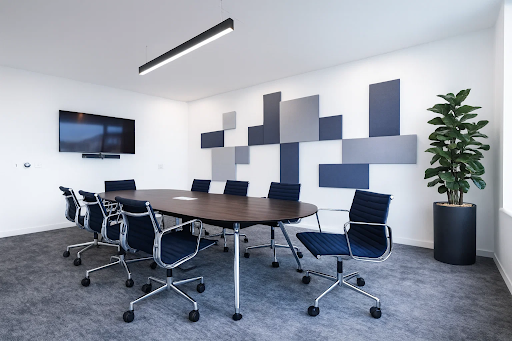
For smaller meeting rooms or breakout spaces, the Robin’s 12mm or 24mm profile is a cost-effective alternative that achieves Class A absorption while occupying significantly less wall space than a standard fabric-wrapped panel.

For informal or frequently reconfigured office environments, the Swift self-adhesive installation makes it suitable for settings where drilling or permanent fixings are not permitted, including serviced offices, leased spaces, and temporary fit-outs.

All Songbird panels achieve Class A sound absorption under EN ISO 11654, the highest available rating. Performance is consistent across the range. The choice between products is driven by application, aesthetics, and installation method.
On quantity: as a starting point, panels covering 15 to 25% of total wall and ceiling area will produce a measurable improvement in most open plan environments. Precise specification requires knowing the room dimensions, existing surface finishes, and target RT60. An acoustic consultant can calculate the required absorption area for a specific room.
For a full guide to choosing between panel types, including polyester fibre versus fabric-wrapped, thickness, and mounting options, see our acoustic panel buyer’s guide.
Where to install acoustic panels: placement for best results
The position of acoustic treatment matters as much as the quantity. Before placing panels, map the acoustic environment:
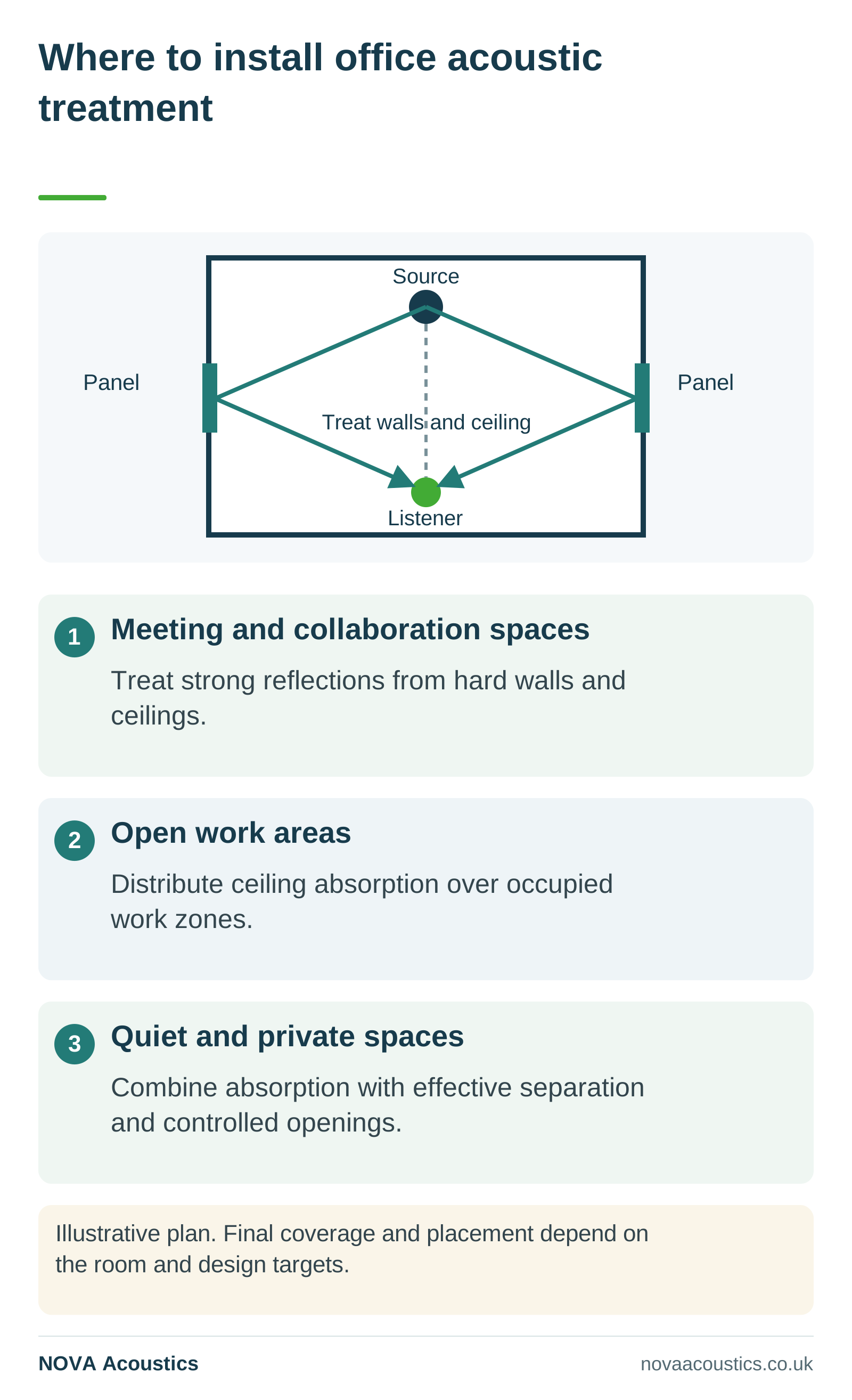
Where does external noise enter? Traffic, mechanical plant, and noise from neighbouring buildings typically enters through windows and thinner facade elements.
Where does internal noise originate? Printers, HVAC equipment, kitchenettes, and high-traffic circulation routes all generate point-source noise that can be intercepted at its reflection points.
Where do interpersonal noise problems occur? Phone calls, collaboration clusters, and video conferencing stations are the primary sources of human-generated noise in most offices.
This diagnostic step determines where panels will have the most impact. In larger or more complex office layouts, a professional noise survey can identify acoustic weak spots that are not obvious by inspection.
Open plan workstation areas
Place panels on the primary wall surfaces facing the main desk clusters. Panels here absorb the first reflections that contribute most to reverberation build-up. The first reflection from the nearest hard surface carries most of the acoustic energy that drives up RT60.
Position treatment behind desks on walls adjacent to phone-heavy zones such as reception, customer service, and sales teams. Intercepting sound before it travels across the open plan is more effective than trying to absorb it after it has bounced several times.
Install panels on walls opposite printers, copiers, and other point-source noise equipment. This absorbs sound at the reflection point rather than across the room.
Meeting rooms and conference spaces
Treat parallel walls first. Flutter echo (the rapid, audible repetition of a sound between two hard parallel surfaces) is the single most common acoustic problem in meeting rooms with hard front and back walls. Panels on those surfaces break the reflective cycle immediately.
Add treatment to side walls to improve overall speech clarity and ensure all participants can hear each other regardless of their position in the room.
Use ceiling baffles or acoustic clouds where room height is sufficient, particularly in rooms with exposed concrete soffits or high ceilings. These surfaces are often the primary contributor to long RT60 in modern commercial office fit-outs.
Rooms dominated by glazing need absorption on the opposing non-glazed surfaces to compensate. This is particularly relevant for video conferencing rooms, where microphones pick up room reverberation that is inaudible to people in the room but highly audible to remote participants. A meeting room that sounds acceptable in person can produce a poor remote experience on a video call. With hybrid working now standard across most UK offices, the remote acoustic experience is as commercially important as the in-room experience.
Corridors and reception areas
Reception areas are acoustically neglected more often than they should be. The acoustic character of a reception area is also a first impression for visitors, and a reverberant reception creates a stressful environment for staff who handle calls. Treatment behind the reception desk, on the primary facing wall, and on the ceiling above the waiting area addresses the most common failure modes.
Hallways and corridors represent a significant sound transmission path between zones, particularly in buildings where internal doors are frequently open. Focus treatment near doorways to meeting rooms and near workstation clusters that open onto circulation routes.
Balance and coverage
Avoid over-treatment. A space that is acoustically dead feels uncomfortable and can impair communication rather than improve it. The goal is to meet the RT60 target range (0.4 to 0.6 seconds), not to maximise absorption coverage. Panels work best in combination with other absorptive elements: carpet, soft seating, acoustic ceiling tiles, and planting all contribute to the total room absorption calculation.
Acoustic panels in corporate environments can be integrated as design features rather than functional additions. Skylark’s bespoke colour range means panels can match or complement any interior scheme. Feature walls, branded panels, and custom-printed fabric options are available, which is worth flagging to clients at the specification stage.
Songbird by NOVA Acoustics offers a full range of Class A acoustic panels for every office zone, from open plan workstations to glazed meeting rooms.
Meeting rooms, conference spaces, and hybrid working
Meeting rooms are acoustically distinct from open plan spaces. The goal is Good-to-Excellent STI throughout the room, low RT60, and adequate isolation from the open plan outside. Hard surfaces (glass walls, concrete soffits, polished floors) are the primary cause of meeting room acoustic failure. They create flutter echo, extend RT60, and reduce speech intelligibility even in relatively small rooms.
The specific challenge of video conferencing has become significantly more consequential since hybrid working became standard. Microphones pick up room reverberation and acoustic artefacts that are inaudible to people in the room. Attendees on the call hear a degraded version of the in-room conversation, which increases the cognitive load of remote participation and is consistently cited as a source of meeting fatigue. Treating the meeting room acoustically addresses both the in-person and the remote experience at the same time.
For hybrid calls, the acoustic priorities are: low RT60 (to avoid reverberation being picked up by microphones); directional absorption near the camera and microphone position; and adequate background noise masking to prevent external office noise from contaminating the call audio.
Very small rooms (under 15 m²) can suffer from over-absorption. Treating all surfaces heavily in a small space can produce a room that feels dead and uncomfortable, and can actually impair communication at close range. In small rooms, treat 30 to 40% of the surface area and prioritise the ceiling and the wall behind the screen first. Side walls and the rear wall can be addressed incrementally if the initial treatment does not bring RT60 within target.
Standalone acoustic pods and booths have grown significantly in adoption as a complement to panel treatment, particularly for individual video calls and deep focus work. Their acoustic performance is built into the product specification. NOVA Acoustics can advise on acoustic pod specification alongside panel treatment for a complete office acoustic strategy.
Hallways, reception areas, and communal spaces
Communal spaces (reception areas, breakout zones, kitchenettes, print rooms) are frequently acoustically neglected because they are not workspaces in the traditional sense. They are, however, significant noise sources that affect adjacent workstations.
Breakout zones warrant particular attention. If the breakout is intended as a genuinely quiet alternative to the open plan, it needs to be treated and partially screened from the main floor. A cluster of soft seating surrounded by hard walls is not a quiet breakout space. Acoustic treatment of the walls within the breakout zone reduces both the noise generated within it and the acoustic impact on adjacent workstations.
Kitchenettes and print rooms are hard-surfaced, equipment-dense spaces that generate significant noise. Where they open directly onto workstation areas, some acoustic treatment of the walls nearest the opening can meaningfully reduce the impact on the open plan without requiring any structural change.
The reciprocal benefit applies to reception areas. A treated reception absorbs incoming external noise (from the front door, the street, and lobby HVAC) before it reaches the office floor, not just the other way around.
Why choose NOVA Acoustics
Good office acoustics do not happen by accident. They are the result of a deliberate design process that balances absorption, blocking, and masking across every zone of a workspace, from the open plan floor to the meeting room to the reception desk. NOVA Acoustics brings acoustic consultancy expertise to that process, and the Songbird panel range to execute it.
NOVA’s acoustic consultants for office projects work with architects, designers, and developers on commercial fit-outs across the UK, advising on acoustic design principles, specifying panel quantities and placement, and providing post-completion assessments where required. The service is a consultancy engagement, not a product sale with acoustic advice attached.
The Songbird range covers the full spectrum of office acoustic treatment scenarios. Fabric-wrapped bespoke panels (Skylark), slim-profile polyester panels (Robin), and self-adhesive panels (Swift) address everything from open plan workstation walls to glazed meeting rooms to temporary fit-outs. All achieve Class A sound absorption. Bespoke sizing and a wide colour palette mean the panels integrate into any interior scheme.
NOVA holds UKAS accreditation. For commercial clients who need to evidence acoustic performance to building operators, investors, or building certification schemes such as BREEAM or WELL, independently audited technical standards matter in a way that self-certification does not.
With offices in Leeds, Manchester, London, Birmingham, Liverpool, Cambridge, Newcastle, Nottingham, Sheffield, Bristol, and Hull,
NOVA can support commercial projects across England. The breadth of the office network means that site visits, acoustic assessments, and panel installations can be organised quickly, which matters when a fit-out is on a tight programme.
NOVA provides complimentary CPD presentations on office acoustics for architectural and design practices. For design teams who encounter office acoustic questions regularly but do not specialise in acoustics, a CPD session is a practical starting point.
Whether you are designing a new commercial fit-out or addressing an existing acoustic problem, NOVA Acoustics can help, from initial assessment through to panel specification and supply. Get in touch.
Frequently asked questions
The broadly accepted target is RT60 between 0.4 and 0.6 seconds for standard open plan office environments. Above 0.8 seconds, speech clarity and privacy both deteriorate noticeably. Below 0.4 seconds can feel uncomfortably dead. The precise target depends on room volume, ceiling height, and the nature of the work being carried out.
BS8233 recommends a background noise level of 45 to 50 dB LAeq for open plan offices with ceilings above 3 metres. The BCO Guide to Specification recommends a similar range of around 45 dB LAeq. For private offices and meeting rooms, the appropriate range is lower: typically 35 to 40 dB LAeq.
No. Acoustic panels absorb sound within the room, reducing reverberation and improving speech clarity within that space. They do not block sound from passing between areas. If the goal is to prevent sound transmission between a meeting room and the open plan, physical partitioning is required. Panels and partitioning perform different functions and are most effective when used together.
As a starting point, panels covering 15 to 25% of total wall and ceiling surface area will produce a measurable improvement in most open plan environments. The precise number depends on room volume, existing surface finishes, ceiling height, and the target RT60. An acoustic consultant can calculate the required absorption area for a specific room.
On the primary wall surfaces facing the main desk clusters; on walls adjacent to high-noise zones such as phone-heavy teams, printers, or kitchenettes; and as ceiling rafts or baffles where wall space is limited. In meeting rooms, treat parallel walls (front and back) first, then side walls, then the ceiling if RT60 remains too high. Reception areas benefit from treatment behind the desk and on the primary facing wall.
Speech privacy is the degree to which conversations are unintelligible to unintended listeners. In open plan offices, poor speech privacy is the most common source of acoustic dissatisfaction: people find it more distracting to hear intelligible speech from colleagues they are not working with than to hear general background noise at comparable volume. In offices handling personal or confidential information, poor speech privacy also has data protection implications.
There is no single mandatory standard equivalent to Part E for residential buildings. The primary reference documents are the BCO Guide to Specification and BS8233. For health-focused commercial fit-outs, the WELL Building Standard includes acoustic criteria covering background noise, reverberation, and sound isolation. NOVA Acoustics can advise on which targets apply to a specific project and how to achieve them.
The Lombard Effect is the unconscious tendency of speakers to raise their voices in response to higher background noise. In reverberant offices, this creates a self-reinforcing cycle: higher ambient noise levels prompt louder speech, which increases ambient noise further. Breaking the cycle requires reducing reverberation, typically through acoustic panel treatment that brings RT60 within the 0.4 to 0.6 second target range.
Summary
Open plan office acoustics is a multidimensional design challenge. Acoustic panels are an important and often decisive intervention, but they address only one of three mechanisms (absorption, blocking, and covering) that together determine how a space sounds. The performance targets are well-established: RT60 of 0.4 to 0.6 seconds, background noise of 40 to 48 dB LAeq, and speech privacy that limits intelligible conversation to the immediate vicinity of the speaker. Hitting those targets consistently requires specification that addresses all three pillars, not just the most visible one.
The most common mistake in office acoustic projects is treating panels as a cosmetic addition rather than an engineered solution. Correct placement, adequate coverage, and integration with the room’s HVAC contribution all matter. Getting the specification right at the design stage is considerably less expensive than remediation after fit-out.
NOVA Acoustics provides acoustic consultancy for new fit-outs and refurbishments, and the Songbird panel range to supply and specify the treatment itself.
Explore Songbird acoustic panels for offices or speak to an acoustic consultant.
Sources
- BS 8233:2014, Guidance on Sound Insulation and Noise Reduction for Buildings. British Standards Institution (BSI). Referenced throughout for background noise level recommendations in office environments.https://www.bsigroup.com
- British Council for Offices Guide to Specification. British Council for Offices (BCO). The primary commercial reference document for UK office acoustic performance targets. https://www.bco.org.uk
- WELL Building Standard v2: Acoustic Comfort Concept. International WELL Building Institute (IWBI). Acoustic criteria for health-focused commercial fit-outs. https://www.wellcertified.com
- EN ISO 11654:1997, Acoustics: Sound Absorbers for Use in Buildings. International Organisation for Standardisation. The standard under which Class A sound absorption is rated. https://www.iso.org
- IEC 60268-16, Sound System Equipment: Methods of Measuring and Specifying the Performance of Speech Transmission Systems. International Electrotechnical Commission. The standard underpinning the Speech Transmission Index (STI). https://www.iec.ch
- Health and Safety at Work Act 1974. UK legislation establishing employer duties of care extending to the psychological work environment. https://www.legislation.gov.uk/ukpga/1974/37/contents
- UKAS Accreditation. United Kingdom Accreditation Service. NOVA Acoustics holds UKAS accreditation No. 8568. https://www.ukas.com
- Institute of Acoustics (IOA). Professional body for acousticians in the UK. https://www.ioa.org.uk