







ProPG: Professional Practice Guidance on Planning and Noise: A Deep Dive
- August 10, 2026
Quick take
ProPG (Professional Practice Guidance on Planning and Noise) is a 2017 document published jointly by the Association of Noise Consultants, the Institute of Acoustics, and the Chartered Institute of Environmental Health to guide acoustic professionals advising on new residential development in noise-sensitive locations. It does not replace BS8233 or BS4142; it sits alongside them, providing a two-stage approach: an initial noise risk assessment that categorises sites as negligible, low, medium, or high risk, followed by a full assessment built around good acoustic design and delivered through an Acoustic Design Statement. The assessment concludes with one of four recommendations to the decision maker: grant without conditions, grant with conditions, avoid, or prevent. ProPG is now widely cited in planning applications, environmental health responses, and appeal decisions across England. How closely it is applied varies from site to site, but it has become a common reference point for residential development in noise-sensitive locations, and many acoustic assessments engage with its framework as a matter of course.
What is ProPG?
ProPG stands for Professional Practice Guidance on Planning and Noise, formally titled ProPG: Planning & Noise – New Residential Development. It was published in May 2017 as joint guidance by three professional bodies: the Association of Noise Consultants (ANC), the Institute of Acoustics (IOA), and the Chartered Institute of Environmental Health (CIEH).
It is a professional practice document, not a British Standard, and the distinction matters. ProPG does not have the legal status of a standard referenced in regulation, but it carries the collective authority of the acoustics and environmental health professions, and local planning authorities and their acoustic advisers widely treat it as best practice.
ProPG exists because of a gap. The National Planning Policy Framework’s approach to noise is principles-based, and the Noise Policy Statement for England introduces the LOAEL and SOAEL significance framework, but neither tells an acoustic consultant how to actually scope, carry out, and present a residential noise assessment. Before 2017, practice varied considerably as a result. ProPG fills that methodological gap with a standardised, risk-based approach.
Its scope is deliberately narrow: new residential development (housing, flats, conversions to residential use, and similar noise-sensitive residential uses) in locations where noise from transport or other sources is a material planning consideration. It does not address workplace noise, entertainment noise, or construction noise. It is focused entirely on the interface between noise and residential amenity in the planning process. Readers who want the foundational acoustics before the policy detail can start with our principles of building acoustics guide.
ProPG was published in 2017 and remains the current guidance. A revision of BS8233 has been under consultation within the profession, and the eventual updated standard may absorb or build on parts of ProPG’s approach, but as of 2026 ProPG is the document planning authorities cite and expect.
For a practical overview of when noise assessments are required in the planning process and how guidance like ProPG fits within the broader framework, see our complete guide to noise impact assessments for planning permission.
Why ProPG matters: the planning context
Before ProPG, two groups had the same problem from opposite sides. Acoustic consultants advising on residential applications had no unified professional guidance on how to scope assessments, what criteria to apply, or how to present findings, so practice varied between consultants and between regions. Planning authorities, meanwhile, had no professional reference point against which to judge the quality of the acoustic evidence in front of them. Some submitted assessments were rigorous; others were superficial or applied methodologies that did not fit the site.
ProPG addressed both problems at once by giving consultants and local authority advisers a shared methodological reference. The result is visible everywhere in current practice: ProPG is routinely cited in planning officer reports, environmental health consultation responses, and appeal decisions. Because it has become a widely shared reference, assessments that engage with the ProPG framework, particularly on more sensitive sites, tend to sit more comfortably with reviewing officers, though the weight given to it still varies between authorities and between individual sites.
Its influence has also reached policy. Some local planning authorities have embedded ProPG’s approach into local plan noise policies and supplementary planning guidance, in some cases treating high-risk noise exposure as a policy trigger against residential development. On those sites, ProPG engagement can move from professional good practice toward a local policy expectation, depending on how the relevant policy is worded. .
For developers, the practical lesson is about timing. A site that looks deliverable can turn out to sit in ProPG’s medium or high risk range once the noise environment is properly characterised, and it is far better to learn that before the design is fixed than after the application is submitted. Early acoustic input is cheap relative to a redesign or a refusal.
How ProPG relates to the NPPF, the NPSE, BS8233, and BS4142
Confusion between the documents in the planning noise landscape is common, so it is worth being precise about who does what.
The NPPF sets planning policy. It establishes the principles: noise is a material consideration, the agent of change principle applies, and development should avoid significant adverse impacts on health and quality of life. It does not specify how to assess noise or what criteria to apply.
The NPSE provides the significance framework. The Noise Policy Statement for England introduces LOAEL (Lowest Observed Adverse Effect Level) and SOAEL (Significant Observed Adverse Effect Level), the conceptual thresholds for judging whether a noise impact is observable or significant. These are deliberately not fixed numbers; they are judgement criteria that the acoustic consultant contextualises for each site. ProPG operationalises the NPSE by giving consultants a practical method for placing a residential site on that spectrum.
BS8233 sets the acoustic criteria. BS8233:2014 specifies the target internal and external noise levels for residential development: the 35 dB LAeq daytime target for living rooms and bedrooms, the 30 dB LAeq night-time bedroom target, and the external amenity guidance. These criteria tell the consultant what needs to be achieved. ProPG supplements BS8233 with a site-level risk framework, an emphasis on the design process rather than criteria alone, and additional treatment of night-time noise events that BS8233’s averaged metrics do not capture. The BS8233 standards reference in our technical hub covers the standard itself.
BS4142 assesses commercial and industrial sources. Where the noise source is commercial or industrial, BS4142 assesses the significance of that source relative to the background sound level. On mixed-use sites or residential applications near existing commercial premises, BS4142 runs alongside BS8233 and ProPG. See the BS4142 standards reference for the framework detail.
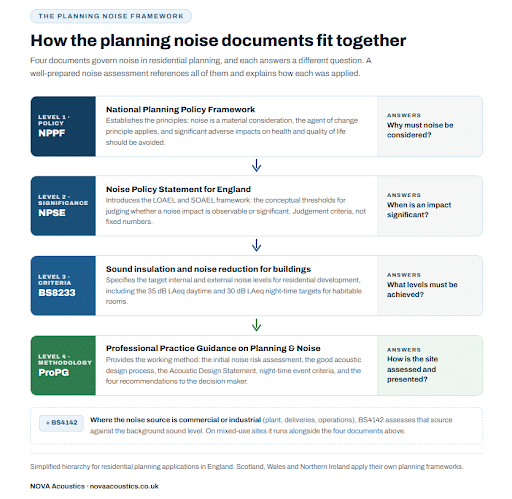
In a well-prepared residential noise assessment, they stack like this: the NPPF provides the policy requirement, the NPSE provides the significance framework, BS8233 provides the acoustic criteria, ProPG provides the risk categorisation and the assessment methodology, and BS4142 covers commercial sources where they exist. A report that references the relevant documents explicitly, and explains how each was applied to the particular site, tends to give a clearer and more defensible picture. Related regimes sit outside this stack: construction phase noise, for instance, is assessed under BS5228 and managed through Section 61 consents and construction noise monitoring, which is a separate exercise from the ProPG planning assessment.
The ProPG framework: risk categories, the ADS, and four recommendations
This is the core of the document, and it is worth getting the structure exactly right, because it is widely misquoted. ProPG does not use lettered “noise exposure categories”. That was the approach of PPG24, the planning guidance withdrawn in 2012, which classified sites into Noise Exposure Categories A to D. ProPG replaced that thinking with a two-stage, risk-based approach.
Stage 1: the initial noise risk assessment
Stage 1 categorises the site’s noise risk as negligible, low, medium, or high, based on the noise environment before any mitigation through building design is considered. The assessment is made against a “typical worst case” 24-hour day, using measured levels, predicted levels, or a combination, expressed as LAeq,16h for the daytime (07:00 to 23:00) and LAeq,8h for the night (23:00 to 07:00).
Deliberately, ProPG does not draw hard numerical boundaries between the categories. Its risk chart presents a continuum, and the consultant exercises judgement about where a site sits. As broad orientation, sites below roughly 60 dB LAeq,16h by day and 50 dB LAeq,8h at night tend toward the low risk range, with risk increasing as levels rise above that. Night-time events matter too, not just averages: ProPG indicates that a site should not be treated as negligible risk where more than ten maximum noise level (LAFmax) events exceed 60 dB during the night, and that regular events above 80 dB LAFmax push a site toward high risk. The precise figures and the risk continuum should always be taken from the ProPG document itself rather than from summaries, including this one.
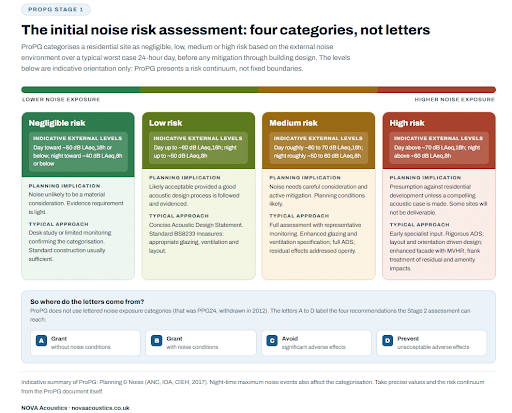
What the categories mean in practice:
Negligible risk. Noise is unlikely to be a material consideration. The acoustic evidence needed is light, often a desk study or limited monitoring confirming the categorisation.
Low risk. Noise needs addressing but the site is likely to be acceptable provided a good acoustic design process is followed. Standard measures described in BS8233 (appropriate glazing, ventilation, and layout) will usually suffice, and the acoustic case is relatively straightforward.
Medium risk. Noise requires careful consideration and active mitigation. A full assessment with representative monitoring is expected, planning conditions specifying glazing performance and ventilation are likely, and the consultant must demonstrate that the BS8233 internal criteria can be achieved with a feasible, proportionate scheme. Where residual adverse effects remain after mitigation, ProPG expects them to be identified and addressed openly rather than glossed over.
High risk. Noise levels are such that ProPG sets a strong presumption against residential development unless a compelling acoustic case can be made. ProPG does not absolutely prohibit development on high risk sites, but the evidential bar is set deliberately high: the applicant must demonstrate through rigorous design that internal criteria can be achieved (often through enhanced glazing with mechanical ventilation such as MVHR), that external amenity areas are not unacceptably affected, and that night-time noise events will not disturb sleep. Some high risk sites will not be deliverable for residential use at all, and an honest assessment says so.
Stage 2: the full assessment and the Acoustic Design Statement
Stage 2 is the full assessment, and its central deliverable is the Acoustic Design Statement (ADS), the document through which the consultant demonstrates that a good acoustic design process has been followed. ProPG’s Stage 2 examines four elements in parallel: the good acoustic design process itself (layout, orientation, screening, and building envelope considered from the earliest design stage rather than bolted on); the internal noise level guidelines (essentially the BS8233 criteria); external amenity area noise; and any other relevant issues specific to the site, such as ventilation and overheating strategy or the character of the noise.
The depth of the ADS scales with the Stage 1 risk category. A low risk site may need only a concise statement confirming how noise has been handled in the design. A medium or high risk site needs a full ADS demonstrating the design evolution, the options considered, and the residual position.
The four recommendations
The assessment concludes with one of four possible recommendations to the decision maker, and this is where the lettering actually appears in ProPG:
- A. Grant without noise conditions
- B. Grant with noise conditions
- C. Avoid, where significant adverse effects would occur
- D. Prevent, where unacceptable adverse effects would occur
This is the mechanism by which ProPG connects to the NPSE: “avoid” and “prevent” map onto the SOAEL and above-SOAEL policy language. It is also the discipline that distinguishes a ProPG-compliant report from a compliance exercise: the consultant is expected to make a genuine professional recommendation, including recommending against their own client’s scheme where the acoustic case does not stack up.
What this means for developers
On negligible and low risk sites, acoustic evidence is still required but the planning risk is modest, and early input mainly confirms the category and right-sizes the evidence. On medium risk sites, acoustic input should begin at pre-application stage, because the glazing and ventilation specification will carry cost implications that belong in the viability appraisal, not in a post-planning surprise. On high risk sites, early and experienced acoustic input tends to be especially valuable: the viability of the scheme can turn on whether a credible ADS can be produced, and the earlier that question is explored, the more options usually remain open.
For a detailed guide to how BS8233 assessments address the acoustic criteria for residential development, and how ProPG’s risk framework shapes the scope of those assessments, see our BS8233 practical guide.
ProPG and the agent of change principle
The agent of change principle was formalised in the NPPF in 2018, but ProPG anticipated its direction: the guidance consistently places responsibility on the party introducing the noise-sensitive use to demonstrate that acoustic conditions will be acceptable.
In practice, for residential applications, that plays out in three common scenarios. Residential near an existing road: the developer bears the cost and responsibility of demonstrating, and delivering, adequate acoustic protection. The highway authority is not required to reduce traffic; the developer must show the building can achieve the BS8233 internal criteria despite it. Residential near an existing commercial or industrial use: the developer must demonstrate, through a BS4142 assessment, that existing commercial sources will not create an adverse impact on future residents. The existing operator is not required to change how they work to accommodate new neighbours.
ProPG’s contribution here is practical rather than rhetorical. By categorising the site risk and scoping the mitigation early, it gives the developer a roadmap for discharging the agent of change responsibility. A site that lands in the medium or high risk range immediately signals the level of design effort required and the planning conditions likely to follow.
For a plain-English explanation of how the NPPF and the agent of change principle govern noise in planning decisions, see our NPPF and noise practical guide.
Sleep disturbance: ProPG's night-time criteria
This is one of ProPG’s most significant technical contributions, and it addresses a genuine weakness in relying on BS8233 alone.
BS8233 sets a night-time criterion of 30 dB LAeq,8h for bedrooms: a time-averaged level across the full eight-hour night. For sites where noise is essentially continuous, such as a busy road with steady traffic through the night, an averaged metric characterises the exposure reasonably well. For sites where noise is intermittent (railways, aircraft, night-time HGV movements, night-operating industrial sites), it does not. An average can sit comfortably within the target while concealing individual events loud enough to wake people.
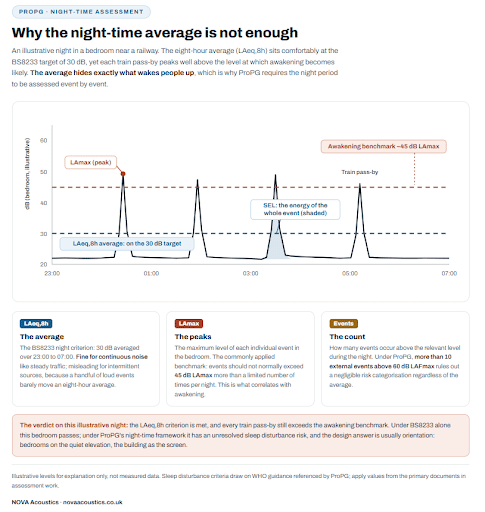
ProPG addresses this directly by requiring the night period to be assessed beyond the single LAeq statistic:
Maximum event levels (LAmax). The peak level of individual noise events in bedrooms, assessed against sleep disturbance guidance. The commonly applied benchmark, drawn from the guidance ProPG references, is that individual events in bedrooms should not normally exceed 45 dB LAmax more than a limited number of times per night. Events well above the background can cause awakening even when the LAeq,8h target is met.
Event levels and energy at the facade. For discrete events such as train pass-bys and aircraft movements, the external event levels (and where useful, the Sound Exposure Level of each event) characterise what the building envelope has to deal with.
Number of events. How many events occur above a given level during the night matters as much as how loud they are individually. ProPG builds event counts into its risk assessment: as noted above, more than ten LAFmax events above 60 dB at night rules out a negligible categorisation regardless of the average.
The sites where this framework earns its keep are exactly the ones you would expect: railway-adjacent sites (especially freight and high-speed lines, where individual pass-bys are loud but infrequent enough to barely move the average), sites near airports or under flight paths, roads carrying significant night-time HGV traffic, and industrial premises operating at night.
The implication for developers is uncomfortable but important. A sealed, triple-glazed facade with MVHR can achieve the 30 dB LAeq night-time criterion and still transmit individual pass-by events above the awakening threshold. On those sites, the answer is usually design rather than specification: orientation matters most, with bedrooms placed on the quietest elevation and the building itself used as a screen. Where the site geometry makes that impossible, ProPG expects the residual sleep disturbance risk to be presented to the planning authority frankly, with a professional judgement about whether it is acceptable, not buried in an appendix.
How ProPG shapes the scope of a noise assessment
Beyond the risk framework, ProPG’s most practical contribution is its guidance on how assessments should be scoped and conducted, which is where inconsistency used to be worst.
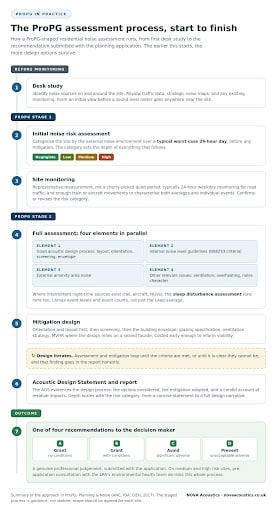
Desk study first. ProPG encourages a preliminary desk study before monitoring is commissioned: identify the noise sources on and around the site, review available data (traffic counts, strategic noise maps, any existing monitoring), and form an initial view of the likely risk category. A site clearly in the negligible range may not need extensive monitoring; a site heading for medium or high risk needs a properly designed survey. If you are new to what a survey involves, our what is a noise survey guide covers the basics.
Representative monitoring. ProPG emphasises that monitoring should represent typical conditions rather than a cherry-picked quiet period. It asks for the “typical worst case” 24-hour day. For road traffic that usually means weekday monitoring during term time, sometimes supported by calculation methods such as CRTN where prediction is appropriate; for railways it means capturing enough train movements, across day and night, to characterise both the average and the event levels.
The assessment periods. Daytime (07:00 to 23:00) and night (23:00 to 07:00) as standard, with the night period analysed beyond the LAeq statistic wherever intermittent sources are present, as described above.
Report content and presentation. ProPG expects the report to state the site’s risk category explicitly, describe the methodology transparently, present the design evolution through the ADS, acknowledge residual impacts (particularly on external amenity) candidly, and conclude with one of the four recommendations. That last point deserves emphasis: the recommendation is supposed to reflect the consultant’s professional judgement, not simply assert acceptability on the client’s behalf.
Professional judgement throughout. This is ProPG’s recurring theme. Noise assessment is not just measurement and arithmetic; context, character of the noise, the nature of the location, and competing planning considerations all bear on the conclusion. A report that demonstrates bare technical compliance with the BS8233 internal criteria, without engaging with the wider site context, may prompt further questions from a planning authority familiar with ProPG, and many now are.
NOVA Acoustics produces ProPG-compliant noise assessments for residential planning applications of all scales. Get in touch to discuss your development.
ProPG in practice: what planning authorities expect
ProPG has been widely adopted as a reference point by many local planning authorities and their environmental health departments across England, and understanding how it is commonly applied can help make for clearer, better-supported applications. How closely any given authority follows it still varies.
Check the LPA’s adopted guidance. A growing number of authorities reference ProPG explicitly in local plan noise policies, supplementary planning documents, or pre-application advice notes, and some treat high noise exposure as a policy trigger. Checking for ProPG references in the LPA’s adopted guidance is a sensible step before submitting in a noisy location.
Anticipate informed review. Many environmental health officers reviewing acoustic evidence are now familiar with ProPG. An assessment that sets out the site’s risk category, addresses sleep disturbance where night-time sources exist, and shows clear professional judgement is generally easier for a reviewing officer to work with. One that does not may attract follow-up questions, often as a request for further information, which can extend the determination timescale.
Conditions follow the framework. Where a medium or high risk application is approved, the conditions tend to mirror the ProPG-compliant assessment: minimum glazing performance (expressed as Rw + Ctr values), ventilation requirements including MVHR specification where the design relies on a sealed facade, orientation or layout restrictions, and limits on which rooms can face the noisiest elevation. If the assessment was done properly, the conditions hold no surprises, because they are the mitigation scheme the ADS already described. The same logic continues into construction: the sound insulation performance designed at planning stage is ultimately verified through Part E compliance and pre-completion sound testing once the building exists.
Use pre-application consultation. For medium and high risk sites, ProPG strongly encourages early consultation with the LPA’s environmental health team. Done well, this establishes the scope of evidence required, surfaces local concerns early, and can produce an agreed assessment framework that removes most of the post-submission challenge risk. NOVA regularly supports clients through exactly this kind of pre-application acoustic engagement.
At appeal, ProPG is the shared language. Planning inspectors know the document and expect acoustic evidence at appeal to engage with it. NOVA’s consultants can prepare ProPG-based acoustic evidence at appeal, including at public inquiry, where the rigour of the methodology is tested directly under cross-examination.
ProPG and mixed-use development
Mixed-use schemes (residential above or beside commercial) are the most demanding ProPG scenario, because the developer is often introducing the source and the receptor at the same time.
The assessment splits into two parts that must both be done. ProPG’s risk framework addresses the external noise environment: roads, railways, and other external sources, assessed exactly as for any residential site. The commercial use within or beside the building is a separate exercise under BS4142, assessing the plant, deliveries, patron noise, and operating pattern against the background sound level. A mixed-use site in a busy urban centre can easily sit in the medium or high risk range for transport noise before the commercial element is even considered, which is what makes these sites acoustically demanding.
The design consequences follow a familiar pattern. The schemes that succeed integrate acoustics from the structural design stage: separating floor construction designed well beyond minimum Part E performance, sealed facades with MVHR where the external environment demands it, bedrooms kept off the noisiest elevations, and commercial operating hours resolved contractually before they become an enforcement problem. Sector examples make the point concrete: a gym below flats brings structure-borne bass and early-morning classes; a restaurant below flats brings kitchen extract plant and late-evening patron noise. Each needs its own BS4142 treatment inside the overall ProPG-shaped assessment.
For a full explanation of how BS4142 and BS8233 interact in mixed-use development scenarios, see our BS8233 practical guide and BS4142 practical guide.
Common misunderstandings about ProPG
A handful of misreadings come up repeatedly in practice, and they are worth correcting directly.
“ProPG uses noise exposure categories A, B, and C.” It does not, and this is probably the most common confusion. Lettered noise exposure categories (A to D) belonged to PPG24, the planning guidance withdrawn in 2012. ProPG replaced that approach with the negligible, low, medium, and high risk categories described above. The letters A to D do appear in ProPG, but they label the four possible recommendations (grant, grant with conditions, avoid, prevent), not site categories. An assessment that classifies a site as “ProPG Category B” is mixing two different frameworks, and a well-briefed environmental health officer will notice.
“ProPG replaces BS8233.” It does not. BS8233 remains the source of the internal and external noise criteria; ProPG supplements it with the risk framework, the design process emphasis, and the night-time event assessment. A residential planning noise assessment should reference both.
“A high risk site cannot be developed.” ProPG sets a strong presumption against residential development on high risk sites, not an absolute prohibition. Regeneration priorities, exceptional design, and specific policy contexts can justify development, but the evidential bar is high and the consultant must be genuinely transparent about residual risks. High risk sites need specialist acoustic input from the earliest possible stage, and some will not be deliverable for residential use at all.
“Meeting the BS8233 internal criteria is enough.” Demonstrating that 30 dB LAeq can be achieved in bedrooms at night is necessary but not sufficient. ProPG additionally requires the site risk to be categorised, sleep disturbance from individual events to be assessed, external amenity impacts to be acknowledged, the design process to be evidenced through an ADS, and a professional judgement to be reached about overall acceptability.
“ProPG only applies to road and rail noise.” ProPG is framed primarily around transport noise, but its principles travel. The risk assessment logic and the night-time event framework are increasingly applied to residential development near commercial and industrial sources too, alongside the BS4142 assessment of those sources.
“ProPG is only relevant to acoustic consultants.” The document is technical, but its implications are commercial. Knowing a site’s risk category before design is fixed, and knowing what conditions a medium or high risk assessment will generate, directly affects development viability, design freedom, and programme. Architects and developers who understand the framework make better decisions earlier.
Why choose NOVA Acoustics
ProPG has helped raise the standard of residential planning noise assessments. It emerged partly because the acoustic evidence submitted with planning applications used to vary widely in quality and depth. NOVA Acoustics produces assessments that reflect the good practice ProPG describes.
For most residential planning applications, that means considering ProPG alongside BS8233 where it is relevant: site risk categorisation, night-time event assessment where intermittent sources exist, a properly evidenced Acoustic Design Statement, honest treatment of residual impacts, and a genuine professional recommendation. The depth of each scales with the site, so no two assessments look exactly alike.
That methodology is backed by experience across the full risk spectrum: negligible and low risk sites where the evidence can be proportionate and swift, medium risk sites where glazing and ventilation specifications need careful design, and high risk sites where the acoustic case is genuinely hard and the viability of the scheme depends on getting it right. Breadth of experience means the right approach is applied from the outset, without mid-programme scope changes.
NOVA regularly engages with local planning authority environmental health teams at pre-application stage to agree assessment frameworks for challenging sites, which is where post-submission challenge risk is most effectively removed.
NOVA’s acoustic consultants are members of the Institute of Acoustics, one of the three professional bodies that published ProPG, and the firm’s UKAS accreditation for sound insulation testing (No. 8568) reflects the same independently audited approach to technical rigour. With offices in Leeds, Manchester, London, Birmingham, Liverpool, Cambridge, Newcastle, Nottingham, Sheffield, Bristol, and Hull, ProPG-compliant assessment is available for residential developments across England, with local knowledge of how different planning authorities apply the framework.
Whether you need a ProPG-compliant noise assessment for a residential planning application, pre-application acoustic advice on a challenging site, or support at planning appeal, NOVA Acoustics can help. Get in touch.
Frequently asked questions
ProPG (Professional Practice Guidance on Planning and Noise) is a 2017 document published jointly by the Association of Noise Consultants, the Institute of Acoustics, and the Chartered Institute of Environmental Health. It guides acoustic professionals advising on new residential development in noise-sensitive locations, supplementing BS8233 and the NPPF with a risk-based site assessment framework, guidance on good acoustic design, and criteria for assessing sleep disturbance from night-time noise events. It is not a British Standard, but it carries professional authority and is widely cited in planning decisions across England.
ProPG is not legally mandatory. It is a widely used professional reference for residential planning noise assessments, and many planning authorities look for assessments to engage with its framework, though the weight given to it varies by authority and by site. On more sensitive sites, an assessment that does not reference ProPG may prompt further questions from the local authority’s environmental health team, which can affect the timescale for a decision.
ProPG’s Stage 1 initial noise risk assessment categorises residential development sites as negligible, low, medium, or high risk, based on the external noise environment over a typical worst case 24-hour day, before any mitigation through building design. Rather than fixed numerical boundaries, ProPG presents a risk continuum against daytime (LAeq,16h) and night-time (LAeq,8h) levels, supplemented by the number and level of maximum noise events at night. The higher the risk category, the greater the design effort and evidence required, and high risk sites carry a presumption against residential development. Note that ProPG does not use lettered noise exposure categories; that was the approach of the withdrawn PPG24 guidance.
The Acoustic Design Statement (ADS) is the central deliverable of ProPG’s Stage 2 full assessment. It demonstrates that a good acoustic design process has been followed: how noise influenced the site layout, building orientation, and envelope design, how the BS8233 internal criteria and external amenity guidance will be met, and what residual impacts remain. The depth of the ADS scales with the Stage 1 risk category, from a concise statement on low risk sites to a full design narrative on high risk sites.
ProPG requires the night-time period to be assessed beyond the single BS8233 LAeq,8h average, which does not adequately characterise intermittent sources such as railways, aircraft, and night-time HGV movements. The assessment considers the maximum levels of individual events in bedrooms (with 45 dB LAmax the commonly applied internal benchmark), the levels of events at the facade, and the number of events above relevant thresholds during the night. A scheme can meet the averaged criterion and still present an unacceptable sleep disturbance risk from individual events.
BS8233 sets the internal and external noise level targets for residential development. ProPG supplements it with the site risk framework applied before those targets are assessed, the good acoustic design process evidenced through an Acoustic Design Statement, additional night-time event criteria, and guidance on presenting the assessment to planning authorities. Both documents should be referenced in a residential planning noise assessment.
Mixed-use schemes require a dual assessment: ProPG’s risk framework addresses the external transport noise environment, while the commercial use within the building is assessed separately under BS4142.
ProPG was published in May 2017 and remains the current professional practice guidance for planning and noise in England. A revision of BS8233 has been under consultation within the acoustics profession and may in time build on ProPG’s approach, but ProPG remains the document planning authorities cite and expect assessments to follow.
Summary
ProPG is the current professional reference for residential planning noise assessments in England, and engaging with its framework can help a residential application in a noise-sensitive location present a clearer, better-supported acoustic case. How closely it applies depends on the site. Its practical core is the two-stage approach: the initial noise risk assessment that places a site in the negligible, low, medium, or high risk range, and the full assessment delivered through an Acoustic Design Statement, ending in one of four recommendations to the decision maker. That structure directly shapes the evidence required, the design of mitigation, and the planning conditions imposed.
NOVA Acoustics produces ProPG-compliant assessments for residential planning applications of all scales, from proportionate evidence on low risk sites to full Acoustic Design Statements, pre-application engagement, and appeal work on the hardest ones. The earlier the acoustic input starts, the more options the design retains and the fewer surprises the planning process holds.
For a ProPG-compliant noise assessment for your residential planning application, or for pre-application advice on a challenging site, contact your nearest NOVA office. Speak to our planning acoustics team or explore our acoustic consultancy services.
Sources
- Association of Noise Consultants, Institute of Acoustics, and Chartered Institute of Environmental Health, ProPG: Planning & Noise – Professional Practice Guidance on Planning & Noise: New Residential Development (May 2017): https://www.association-of-noise-consultants.co.uk/propg/
- Ministry of Housing, Communities and Local Government, National Planning Policy Framework, noise and agent of change provisions: https://www.gov.uk/government/publications/national-planning-policy-framework–2
- Department for Environment, Food and Rural Affairs, Noise Policy Statement for England (2010), including the LOAEL and SOAEL framework: https://www.gov.uk/government/publications/noise-policy-statement-for-england
- HM Government, Planning Practice Guidance: Noise: https://www.gov.uk/guidance/noise–2
- BSI, BS 8233:2014 Guidance on Sound Insulation and Noise Reduction for Buildings: https://www.bsigroup.com/
- BSI, BS 4142:2014+A1:2019 Methods for Rating and Assessing Industrial and Commercial Sound: https://www.bsigroup.com/
- World Health Organization, Environmental Noise Guidelines for the European Region (2018) and Night Noise Guidelines for Europe (2009), the evidence base for sleep disturbance criteria: https://www.who.int/europe/
- Institute of Acoustics, professional commentary on ProPG and the proposed evolution of BS 8233: https://www.ioa.org.uk/