

Skip to content

NOVA Acoustics

Visit Songbird Acoustic Panels

What is a Noise Survey?

Noise surveys, acoustic surveys or noise impact assessment come in all shapes and sizes… With a lot of confusing terminology! NOVA Acoustics attempts to clarify the uncertainty…

In any profession that a person can think of there are certain techniques and procedures that get used on a daily basis that can be considered ‚’bread and butter’ tasks – this can be debugging code for a programmer or performing a hearing test for an audiologist…

For an acoustic consultant, one such task is the humble noise survey. A noise survey is essentially an investigation undertaken by an acoustic consultant in order to establish whether the sound levels being emitted from the client’s operations are in excess of what is to be reasonably expected.

This is performed with a sound level meter, where measurements are taken which an engineer then uses to inform decisions about the noise; these decisions can be on whether the noise will impact nearby amenities or if the noise produced is likely to cause complaints, or falls within the thresholds outlined by certain regulations.

The term ‘noise survey’ is actually a catch all term that is often used to describe the measurement of noise stemming from a wide variety of sectors. There are many areas in which a noise survey can be undertaken. The main areas are outlined below:

Noise surveys for residential developments – planning permission must be applied for in the case of a new residence or when a longstanding residence is being altered significantly. Baseline measurements are obtained (using a sound level meter) against which levels of noise impact are gauged for the new residential developments; these should be made in-line with World Health Organization guidelines and British Standards. Recommendations can then provided to ensure the amenity of the occupants is protected.

Industrial noise surveys – when installing a new or noisier piece of equipment (for instance an air-conditioning unit), a business will often be tasked by their local council or environmental health team with obtaining an industrial noise survey in order to ensure that is doesn’t impact on other businesses and homes within the area. This should be performed with the relevant British Standard (typically BS4142).

Entertainment noise surveys – these are very similar to a noise survey performed for a residential development. However, as music is such a crucial element in these surveys, extra work is undertaken to analyse the frequency components emitted by the premises. This is done as troublesome low frequency noise commonly makes up a significant proportion of the musical content.

Wind-turbine noise survey – renewable energy systems are continuing to be installed throughout the country and the noise generated by wind-turbines if becoming of increasing concern. Analysis of noise generated by wind-turbines should be performed with reference to guidance issued by the Institute of Acoustics (ETSU-R-97).

Related articles:

BS 8233 (Residential, Hotels and Offices)

BS8233 Noise Survey & Assessment: A Practical Guide to BS8233 Noise Assessments and Planning Permission

Recent posts

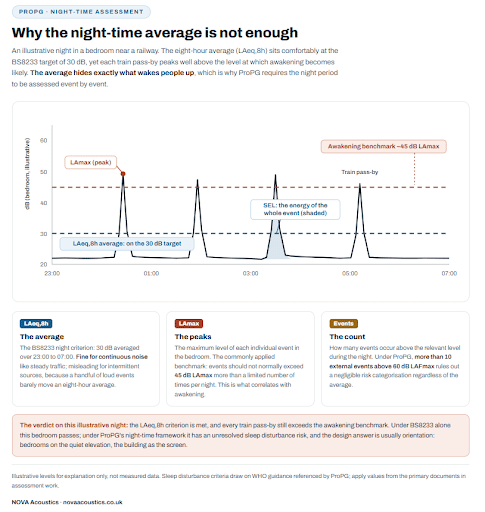
propg night time assessment

ProPG (Professional Practice Guidance on Planning and Noise) is a 2017 document published jointly by the Association of Noise Consultants, the Institute of Acoustics, and the Chartered Institute of Environmental Health to guide acoustic professionals advising on new residential development in noise-sensitive locations. It does not replace BS8233 or BS4142; it sits alongside them, providing a two-stage approach: an initial noise risk assessment that categorises sites as negligible, low, medium, or high risk, followed by a full assessment built around good acoustic design and delivered through an Acoustic Design Statement. The assessment concludes with one of four recommendations to the decision maker: grant without conditions, grant with conditions, avoid, or prevent. ProPG is now widely cited in planning applications, environmental health responses, and appeal decisions across England. How closely it is applied varies from site to site, but it has become a common reference point for residential development in noise-sensitive locations, and many acoustic assessments engage with its framework as a matter of course.

BREEAM contributions

Acoustic panels are rarely on the shortlist when sustainability teams review a fit-out's environmental credentials, but they should be. Conventional acoustic foam is petroleum derived, carries significant embodied carbon, and cannot be recycled at end of life. Higher quality alternatives vary considerably in their environmental profile. The questions worth asking are simple: what is the panel made from, how much of it is recycled or renewable content, is there an Environmental Product Declaration (EPD) or equivalent data available, and what happens to it when the building is refitted? The Finch panel by Songbird is made with more than 60% recycled polyester fibre, achieves Class A sound absorption, and can be installed on walls, ceilings, and as suspended rafts or baffles. For projects where acoustic performance and environmental credentials are both non-negotiable, it is the obvious specification.

thumb 1000 767 0 0 crop 1

Pre-completion sound testing is the on-site acoustic measurement required to demonstrate that a new residential building or conversion meets Part E of the Building Regulations before it can be occupied. Tests measure airborne sound insulation (through walls and floors) and impact sound insulation (through floors). The pass thresholds for new builds are DnT,w + Ctr ≥ 45 dB for airborne sound and L'nT,w ≤ 62 dB for impact sound; for conversions, 43 dB and 64 dB respectively. Testing must be carried out by an accredited body: NOVA Acoustics holds UKAS accreditation (No. 8568) for sound insulation testing. If a test fails, building control sign-off cannot be granted until remediation is completed and a passing re-test is achieved.