







Noise Impact Assessment for Planning Permission: The Complete Guide
- June 9, 2026
Quick Take
A noise impact assessment (NIA) is a technical report submitted as part of a planning application to demonstrate that a proposed development will not cause unacceptable noise. You will typically need one if your development is near a significant noise source (road, rail, or commercial premises), if it generates noise that could affect nearby residents, or if a planning authority has specifically requested one. NIAs are assessed against standards including BS4142, BS8233, and the NPPF. Without one, many planning applications are refused or delayed.
What Is a Noise Impact Assessment?
If a planner, architect, or planning consultant has told you that your application needs a noise impact assessment and you’re not entirely sure what that means in practice, you’re in the right place.
A noise impact assessment is a technical acoustic report that quantifies noise levels at or from a proposed development site, evaluates their significance against recognised standards, and recommends mitigation measures where levels are unacceptable. It is not an opinion piece or a tick-box exercise. Done properly, it gives planning authorities the objective, evidence-based analysis they need to make an informed decision on your application.
NIAs are produced by qualified acoustic consultants, not architects or planning consultants, though these professionals often commission them on behalf of their clients. That distinction matters. Acoustic consultants carry the professional liability for the technical content, and planning officers know the difference between a robust, independently prepared report and one that lacks rigour.
Two related terms are worth clarifying. A noise survey refers specifically to the data collection activity: the site visit, the sound level meters, the monitoring. It feeds into the NIA but is not the same thing. An acoustic report is sometimes used interchangeably with NIA, and the overlap is substantial. In a planning context, the two are essentially synonymous. For a broader introduction to how noise measurement works, see our guide on what a noise survey involves.
Why do NIAs matter so much? Planning authorities in England are required under the National Planning Policy Framework (NPPF) to treat noise as a material planning consideration. If your application doesn’t include adequate acoustic evidence, it will be refused or deferred. In a competitive development environment, that costs real time and money. This guide covers when you need an NIA, what the process involves, how long it takes, and what to expect in terms of planning conditions and outcomes.
Not sure whether your application needs an NIA?
Our acoustic consultants can advise quickly, usually within one conversation.
Request a QuoteWhe Do You Need a Noise Impact Assessment?
More often than many developers and architects expect. Here are the most common trigger scenarios.
Scenario 1: Residential Development Near a Noise Source
Housing proposed near a road, railway, commercial premises, industrial site, or mixed-use area will almost always require an NIA. The planning authority needs evidence that future residents won’t be exposed to harmful or unacceptable noise levels, whether that’s sleep disturbance from road traffic or low-frequency noise from a nearby factory. It’s the most common NIA scenario in UK planning by some margin, and it applies whether you’re building ten homes or ten thousand.
Scenario 2: New Commercial Premises Near Residential
Restaurants, bars, gyms, music venues, manufacturing units, and any other noise-generating business seeking planning permission near homes will need to demonstrate the impact of their operation on neighbouring residents. The assessment typically uses BS4142 to evaluate significance, comparing the noise level from the proposed use against the prevailing background noise at nearby properties. A good NIA here will not only demonstrate acceptability but also anticipate the questions a planning officer or environmental health team is likely to raise.
Scenario 3: Change of Use
Converting a building from one use class to another (offices to residential, commercial to mixed-use, barn to dwelling) often triggers noise assessment requirements, particularly where the new use introduces sensitive receptors into a noisy environment. Sensitive receptors means people sleeping or living in the building. Even where the structure itself is unchanged, the acoustic implications of the new use can be significant enough to warrant a full NIA.
Scenario 4: Fixed Plant and Mechanical Equipment
Any application that involves fixed plant generating noise that could affect neighbouring properties typically requires a BS4142 assessment. This includes HVAC systems, extraction units, cooling equipment, and generators. It’s one of the most frequently overlooked NIA triggers, and it commonly appears as a pre-commencement condition rather than a standalone requirement. Discovering this after you’ve broken ground is an expensive surprise.
Scenario 5: Explicit Requirement from the Planning Authority
Sometimes the trigger is unambiguous: the planning authority has stated in pre-application correspondence, or in a planning condition, that an acoustic report is required. In these cases the standard and scope may even be prescribed. An acoustic consultant can advise on scope quickly and make sure you’re responding to the LPA’s specific requirements rather than producing something broader (and more expensive) than necessary.
When You Might Not Need One
Not every application requires an NIA. Low-sensitivity sites in genuinely quiet rural areas, minor development unlikely to generate significant noise, or situations where pre-application confirmation from the LPA has explicitly ruled one out may not need a formal assessment. The safest approach is a brief conversation with an acoustic consultant before committing either way.
If you’re developing near a road, rail line, or commercial premises, our team can confirm whether an NIA is required and scope the work, often within 24 hours.
The Standards and Policy Framework
NIAs are assessed against a framework of technical standards and planning policy that has developed considerably over the past decade. This section provides an orientation. Each standard is covered in more depth in the linked guides below.
NPPF (National Planning Policy Framework)
The NPPF is the overarching planning policy framework for England. It requires planning authorities to avoid placing sensitive development in areas with unacceptable noise exposure, and to mitigate where some noise is unavoidable. A key principle in the NPPF is the agent of change: the developer or operator responsible for introducing a new noise-sensitive use (or a new noise source) into an area takes responsibility for managing the resulting impacts. If you’re building flats next to an existing nightclub, the responsibility for acoustic mitigation sits with you, not the nightclub.
BS4142:2014+A1:2019
BS4142 is the standard for assessing the impact of industrial and commercial noise on mixed residential and commercial areas. It is used when the development itself is the noise source, such as a restaurant, gym, manufacturing unit, or any fixed plant associated with a development. The assessment compares a calculated rating level for the specific source against the measured background noise level at nearby sensitive receptors. A positive difference of around +10 dB is generally considered likely to cause complaints.
See our practical guide to BS4142 for a full breakdown.
BS8233:2014
BS8233 provides guidance on sound insulation and noise reduction for buildings. In a planning context, it is primarily used to assess noise affecting residential development, when the building is the sensitive receptor rather than the source. It sets recommended internal noise criteria for different rooms and different noise environments. Achieving BS8233 criteria often requires a combination of building orientation, facade treatment, acoustic glazing, and mechanical ventilation. Our practical guide to BS8233 covers the methodology in detail.
ProPG (2017)
ProPG (Professional Practice Guidance on Planning and Noise) sits alongside the NPPF and provides detailed guidance for acoustic consultants working in planning contexts, particularly for residential development. It introduced the concept of the Good Acoustic Design approach and raised the bar for what constitutes an acceptable NIA. Planning officers and appeal inspectors are increasingly familiar with ProPG. Assessments that don’t engage with it are easier to challenge. See our ProPG guidance overview for more.
Other Relevant Standards
Depending on the development type, you may also encounter:
- BS5228: for construction noise and vibration, relevant during the build phase
- CRTN (Calculation of Road Traffic Noise): the standard methodology for predicting and assessing road traffic noise at development sites
- PPG (Planning Practice Guidance): supplementary guidance on noise in planning decisions
- Approved Document E: building regulations on sound insulation, which often applies alongside an NIA for residential or change-of-use schemes
One important note: Scotland, Wales, and Northern Ireland each operate under their own planning policy frameworks. The standards referenced above are consistent across the UK, but the policy context in which they’re applied varies by nation.
For a full breakdown of BS4142, see our practical guide. For residential assessments governed by BS8233, we’ve covered that separately.
What Does an NIA Involve? A Step-by-Step Guide
If you’ve never commissioned an NIA before, here’s what actually happens and in what order.
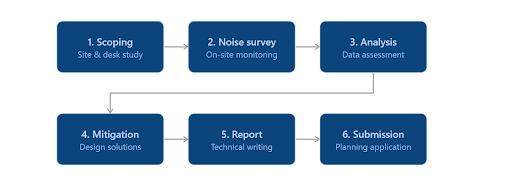
Step 1: Scoping and Desk Study
Before anyone visits your site, the acoustic consultant reviews everything already available: the site location, planning application details, proposed use, and any pre-application correspondence from the LPA. The goal is to establish which standards apply, which noise sources are relevant, and what monitoring will be required.
Scoping is not a formality. A well-scoped NIA is more focused and far less likely to generate LPA queries about sources that weren’t assessed. It also determines whether a full noise survey is even necessary, or whether existing noise data from nearby monitoring networks or previous assessments can be used instead.
Step 2: Noise Survey and Site Measurement
In most cases, a site visit is required to measure existing noise levels using calibrated sound level meters. Survey duration depends on the noise environment. A site adjacent to a busy A-road may need 24-hour unattended monitoring to capture the full diurnal noise pattern. A commercial noise source may be assessed during its specific operating hours. The survey captures background noise levels (LA90) and specific noise sources relevant to the assessment.
For more on what noise monitoring involves methodologically, see our comprehensive guide to noise and vibration monitoring.
Step 3: Analysis and Assessment
Measured data is then analysed against the relevant standard. For BS4142, this involves calculating the rating level of the specific source, accounting for any tonal, impulsive, or low-frequency character, and comparing it against the measured background. For BS8233, it involves comparing predicted or measured facade levels against the recommended internal noise criteria for the proposed building.
This is where professional judgement matters. Standards provide a framework, but the significance assessment requires an experienced consultant who understands both the technical methodology and how planning authorities interpret the results.
Step 4: Mitigation Recommendations
Where noise levels are unacceptable, the report proposes mitigation. Options include building orientation and massing, enhanced acoustic glazing, mechanical ventilation with heat recovery (to allow windows to remain closed), noise barriers or acoustic fencing, and operational controls for noise-generating plant. Mitigation must be proportionate, feasible, and capable of being enforced as a planning condition. A report that recommends mitigation which is technically unrealistic or commercially undeliverable will be challenged.
Step 5: Report Writing and Submission
The consultant produces a structured report suitable for submission with the planning application. Planning authorities have specific expectations for format, methodology, and technical content. An experienced consultant will be familiar with local authority preferences and will present findings in a way that supports rather than complicates the application.
NOVA Acoustics manages the full NIA process, from scoping to submission-ready report. Get in touch to discuss your project.
NIA by Development Type
Different development types call for different assessment approaches. Here’s a practical guide to the most common scenarios.
Residential Development Near Roads or Railways
Traffic noise assessment for residential schemes typically involves CRTN or DMRB noise modelling to predict facade levels, BS8233 internal noise criteria as the target, and ProPG sleep disturbance thresholds as an additional check. Early engagement with the acoustic consultant is particularly valuable here, as building orientation and layout decisions made at the design stage can significantly reduce the cost and complexity of mitigation later.
See our BS8233 guide for detail on the residential assessment methodology.
Residential Development Near Commercial or Industrial Premises
Where the noise source is an existing commercial or industrial operation, the assessment typically applies BS4142 to characterise the source and assess the level of impact at the receptor. This approach is common and requires careful coordination to make sure the same noise level is being considered from both perspectives. Our BS4142 guide covers the source assessment methodology in full.
Restaurants, Bars, and Hospitality
Hospitality premises present a distinctive acoustic challenge: late-night operating hours, amplified music, extraction systems, and delivery activity all contribute to the noise profile, and neighbouring residents are often at their most sensitive during peak operating periods. Planning applications for new or extended hospitality venues almost always require a BS4142 assessment and, in many cases, an operational noise management plan.
See our guide to restaurant acoustics for more on this sector.
Gyms and Leisure Facilities
Gyms and leisure facilities introduce impact noise from weights and equipment, music from fitness classes, and plant noise from ventilation and air handling, often in buildings not originally designed for these uses. Planning authorities are increasingly sophisticated in their approach to gym noise, and assessments need to address the full range of sources.
See our dedicated guides on gym noise and planning permission and gym noise impact assessments.
Fixed Plant and Mechanical Equipment
HVAC systems, cooling units, extraction equipment, and generators are among the most common sources of neighbour noise complaints and among the most underestimated in pre-planning assessments. A BS4142 assessment for fixed plant is almost always required where plant is located close to residential receptors, and the assessment needs to account for the full operating range rather than nominal rated outputs.
Our guides on plant noise surveys and air conditioning noise assessments cover the detail.
Construction Noise
Construction noise is typically addressed through Section 61 consent under the Control of Pollution Act 1974, which sets agreed noise limits for construction activity and gives the contractor a degree of legal protection against noise complaints during agreed hours. BS5228 is the technical standard underpinning construction noise assessment. Our construction noise monitoring service supports both Section 61 applications and ongoing compliance.
Mixed-Use Development
Mixed-use schemes are the most acoustically complex development type, because the building simultaneously functions as a noise source (the commercial element) and a sensitive receptor (the residential). The interaction between uses, the internal acoustic separation between floors, and the external noise environment all need to be addressed in a single, coherent assessment. NOVA regularly handles mixed-use NIA projects and can advise on the most efficient assessment approach from the outset.
How Long Does an NIA Take, and What Does It Cost?
Timescales
For a straightforward residential application with a single site and one or two dominant noise sources, allow three to four weeks from instruction to a submission-ready report. This covers the desk study and scoping, the site monitoring period, data analysis, and report writing.
Complex projects are a different matter. Major mixed-use developments, sites with multiple noise sources, sensitive locations such as quiet rural areas or conservation zones, or schemes requiring acoustic modelling rather than measurement alone can take considerably longer. For these, early instruction is essential. An acoustic consultant brought in at the pre-application stage can shape the scope of the NIA, influence design decisions that reduce the need for expensive mitigation later, and make sure there are no programme-critical gaps in the evidence base.
Costs
NIA costs vary considerably depending on scope, site complexity, survey duration, and the number of sources or receptors being assessed. Rather than give figures that may not reflect your specific project, we’d encourage a direct conversation. We can typically provide an indicative quote within one business day of understanding the project details.
What we can say with confidence: the cost of an NIA is almost always significantly less than the cost of a planning refusal, an appeal, or remedial acoustic mitigation after construction. The noise assessment is not the place to look for savings in a development budget.
Pre-application advice from the LPA can also narrow the scope of the NIA and, in turn, reduce cost. If you’ve received pre-application correspondence that references noise, share it with your acoustic consultant before instructing the full assessment. It often contains useful pointers on exactly what the LPA needs to see.
For a fast, no-obligation quote on a noise impact assessment, contact your nearest NOVA office. We typically respond within one business day.
Common Planning Conditions Related to Noise
One aspect of the NIA process that many developers don’t fully anticipate is what happens after the report is submitted. A successful NIA doesn’t just unlock planning permission. It often triggers a series of conditions that carry ongoing compliance obligations.
Pre-Commencement Conditions
“No development shall commence until a noise assessment has been submitted to and approved by the LPA.” If you haven’t commissioned your NIA before submitting your application, this condition can halt a project at exactly the point when the contractor is ready to start on site. It’s largely avoidable. That’s one of the strongest arguments for commissioning an NIA early in the planning process rather than as an afterthought.
Pre-Occupation Conditions
These conditions require specific acoustic measures to be in place before any part of the building is occupied: glazing specifications, ventilation strategies, internal noise level targets. A pre-occupation condition on acoustic glazing, for example, means the glazing specification must be approved by the LPA and installed before residents can legally move in. NOVA can assist with discharging these conditions, including producing the compliance documentation the LPA requires.
Operational Conditions
For commercial development, operational conditions are standard. These typically specify maximum noise levels at the site boundary (expressed in dB), restrictions on hours of operation for noise-generating activities, and in some cases requirements for ongoing noise monitoring once the premises are open. These conditions need to be understood and designed for during the planning stage. Retrofitting operational controls after opening is considerably harder.
Informatives and Advisory Notes
These aren’t legally binding, but they shouldn’t be ignored. Planning officers sometimes include informatives on noise management, neighbour liaison during construction, or future complaint handling. They signal the LPA’s expectations and can inform subsequent planning applications on the same site.
Post-Completion Verification
Some conditions require a follow-up noise survey once the development is operational, to confirm that the levels predicted in the NIA have actually been achieved. This is particularly common for commercial development near residential, or where specific mitigation measures such as acoustic barriers or specialist plant enclosures have been installed. NOVA can assist with post-completion verification surveys.
What If Planning Is Refused on Noise Grounds?
Refusal on noise grounds is more common than it should be, often because an NIA wasn’t commissioned at all, or because the one that was submitted didn’t adequately address the LPA’s concerns. But refusal is not always the end of the road.
In many cases, a revised application with an NIA that specifically addresses the reasons for refusal can succeed. The refusal notice will set out the LPA’s concerns in reasonable detail. An experienced acoustic consultant can review those concerns, assess whether they are technically founded, and advise on what mitigation is realistic and proportionate. Sometimes the concerns are legitimate and require genuine design changes. Sometimes they reflect a misunderstanding of the methodology or evidence, which can be addressed through a technical response rather than a full re-submission.
For schemes where a revised application isn’t the right route, acoustic evidence is regularly prepared and presented in planning appeals, including at public inquiry. NOVA has experience preparing acoustic evidence for appeal purposes, and our consultants are familiar with the additional rigour that an appeal process demands.
The most effective way to avoid refusal on noise grounds is to commission an NIA before the application is submitted and make sure it’s scoped to address the specific concerns a planning officer is likely to raise. Prevention is considerably less expensive than cure.
Why Choose NOVA Acoustics
A noise impact assessment is only as useful as the credibility of the consultant who produces it. Planning officers and appeal inspectors are experienced at distinguishing robust, well-evidenced acoustic reports from those that cut corners. NOVA Acoustics prepares reports that stand up.
Planning experience across all development types. NOVA works across residential, commercial, industrial, leisure, and mixed-use development. The breadth matters. BS4142 and BS8233 call for different methodologies, different survey approaches, and different ways of presenting findings. A consultancy that works primarily in one sector won’t necessarily understand the nuances of another.
UKAS Accreditation (No. 8568). UKAS accreditation is a formal recognition of technical competence and quality management. It signals that NOVA’s measurement and testing activities meet independently verified standards. Not all acoustic consultancies hold it, and its absence is a genuine risk in a planning context where methodology is scrutinised.
IOA-affiliated consultants. NOVA’s consultants hold membership of the Institute of Acoustics, the professional body for acousticians in the UK. IOA membership indicates compliance with professional standards and a commitment to continuing professional development.
National office network. With offices in Leeds, Manchester, London, Birmingham, Nottingham, Liverpool, Cambridge, and Newcastle, NOVA has local knowledge that matters in planning. Familiarity with local authority preferences, planning officer expectations, and regional noise environments adds practical value that a consultancy without that presence can’t reliably provide.
Full-service capability. NOVA can handle every stage of the NIA process: scoping, survey, assessment, report writing, planning condition discharge, and post-completion monitoring. Clients don’t need to manage multiple consultants or coordinate between specialists. One point of contact, from pre-application to completion.
Get in touch with your nearest NOVA office to discuss your planning application. We’ll confirm whether an NIA is required, scope the work, and provide a no-obligation quote.
Frequently Asked Questions
A noise impact assessment is a technical report prepared by a qualified acoustic consultant and submitted as part of a planning application. It quantifies noise levels at or from a proposed development site, evaluates their significance against relevant standards, and recommends mitigation where necessary. Planning authorities use it to determine whether a development is acceptable on noise grounds.
Not always. Whether one is required depends on the nature of the development, its location, and the requirements of the local planning authority. Development near roads, railways, or commercial noise sources, or development that generates significant noise near residents, will almost always need one. A brief pre-application conversation with an acoustic consultant can quickly establish whether one is required for your specific project.
The most commonly applied standards in UK planning are BS4142:2014+A1:2019 (for assessing the impact of commercial or industrial noise sources) and BS8233:2014 (for assessing noise affecting residential development). ProPG (2017) provides professional practice guidance in planning contexts. The NPPF sets the overarching policy framework within which these standards are applied.
For a straightforward residential application, allow three to four weeks from instruction to a submission-ready report. This covers site monitoring, data analysis, and report writing. Complex projects involving multiple noise sources, sensitive sites, or acoustic modelling requirements may take longer. Early instruction is always recommended to avoid programme delays.
Yes. Planning officers or their appointed acoustic advisers may raise technical queries about methodology, monitoring duration, or significance findings. A well-prepared report by an experienced consultant reduces this risk and responds to the specific questions a local authority is likely to ask. NOVA Acoustics is experienced in responding to technical queries from planning authorities and in negotiating agreed positions where genuine uncertainty exists.
A noise survey is the data collection activity: measuring sound levels at a site using calibrated equipment over a defined period. A noise impact assessment is the broader document that includes the survey data, the technical analysis, a significance assessment against relevant standards, and mitigation recommendations. The survey feeds into the assessment. They are related but not the same thing. The distinction is explained further in our guide to noise surveys.
It depends on the planning conditions attached to your permission. Pre-occupation conditions require specified mitigation (acoustic glazing, ventilation systems, internal noise targets) to be achieved and, in most cases, verified before occupation is permitted. Pre-commencement conditions require certain matters to be resolved before work begins. Understanding which conditions apply and building them into your project programme is essential. NOVA can assist with condition discharge at every stage.
Next Steps
Noise impact assessments are required for a wider range of planning applications than many developers and architects initially expect. The trigger scenarios covered in this guide (residential near roads or railways, commercial near residential, change of use, fixed plant, explicit LPA requirements) between them cover the majority of development activity in the UK.
Getting the NIA right, and getting it done at the right time, is one of the most cost-effective investments in a planning application. A robust, well-scoped report reduces the risk of refusal, minimises LPA queries, and gives the project team confidence that the acoustic evidence base will hold up to scrutiny. A poorly scoped or poorly executed NIA creates the opposite problem: delays, additional costs, and in some cases a refusal that could have been avoided.
NOVA Acoustics manages the full NIA process, from pre-application scoping through to submission and condition discharge. Our consultants are available to provide rapid initial advice on whether an NIA is required for your project and what it would involve.
Explore our full range of acoustic consultancy services.
Get in touch with your local NOVA team.
Sources
- National Planning Policy Framework (NPPF). Ministry of Housing, Communities and Local Government. The overarching planning policy framework for England, including the noise agent-of-change principle. https://www.gov.uk/guidance/national-planning-policy-framework
- Planning Practice Guidance: Noise. Ministry of Housing, Communities and Local Government. Supplementary guidance on how noise should be considered in planning decisions, including noise exposure categories and sensitivity thresholds. https://www.gov.uk/guidance/noise–2
- BS4142:2014+A1:2019, Methods for Rating and Assessing Industrial and Commercial Sound. British Standards Institution. The standard for assessing the impact of industrial and commercial noise on mixed residential and commercial areas. https://www.bsigroup.com/en-GB/products-and-services/standards/bs-4142/
- BS8233:2014, Guidance on Sound Insulation and Noise Reduction for Buildings. British Standards Institution. Sets recommended internal noise criteria for residential development and other noise-sensitive buildings. https://www.bsigroup.com/en-GB/standards/bs-8233/
- ProPG: Professional Practice Guidance on Planning and Noise (2017). Association of Noise Consultants (ANC), Chartered Institute of Environmental Health (CIEH), and Institute of Acoustics (IOA). Joint professional guidance that raised the bar for residential acoustic assessment in planning. https://www.association-of-noise-consultants.co.uk/propg-planning-noise/
- BS5228:2009+A1:2014, Code of Practice for Noise and Vibration Control on Construction and Open Sites. British Standards Institution. Parts 1 and 2 cover noise and vibration respectively, and provide the technical framework for Section 61 consent applications. https://www.bsigroup.com/en-GB/standards/bs-5228/
- Calculation of Road Traffic Noise (CRTN). Department of Transport and Welsh Office (1988). The standard methodology used for predicting road traffic noise levels at development sites. https://www.gov.uk/government/publications/calculation-of-road-traffic-noise
- Approved Document E: Resistance to the Passage of Sound. HM Government. The building regulations standard covering sound insulation for dwellings and rooms used for residential purposes, applicable alongside NIAs for residential and change-of-use schemes. https://www.gov.uk/government/publications/resistance-to-sound-approved-document-e
- Control of Pollution Act 1974. UK legislation governing construction noise and statutory nuisance, including Section 61 prior consent for construction works. https://www.legislation.gov.uk/ukpga/1974/40/contents
- UKAS Accreditation. United Kingdom Accreditation Service. The national body for the assessment and accreditation of testing, calibration, inspection, and certification organisations in the UK. NOVA Acoustics holds UKAS accreditation No. 8568. https://www.ukas.com
- Institute of Acoustics (IOA). The professional body for those working in acoustics, noise, and vibration in the UK. IOA membership is a recognised marker of professional competence for acoustic consultants. https://www.ioa.org.uk
- Design Manual for Roads and Bridges (DMRB), Volume 11, Section 3, Part 7: Traffic Noise and Vibration. National Highways. Used for predicting noise from trunk road and motorway schemes. https://www.standardsforhighways.co.uk/dmrb/