


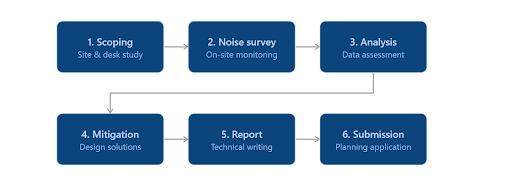
A noise impact assessment (NIA) is a technical report submitted as part of a planning application to demonstrate that a proposed development will not cause unacceptable noise. You will typically need one if your development is near a significant noise source (road, rail, or commercial premises), if it generates noise that could affect nearby residents, or if a planning authority has specifically requested one. NIAs are assessed against standards including BS4142, BS8233, and the NPPF. Without one, many planning applications are refused or delayed.
What is Structure Borne Sound? And how can it be reduced?
- November 21, 2018
When considering the installation of sound insulation in new buildings, one factor that must be taken into account is structure-borne sound. So, what is structure-borne sound and what steps can be taken to mitigate its effects?
What is structure-borne sound?
1. Generation: the actual originating source of the oscillation.
2. Transmission: the movement of the oscillation’s energy to the building from its originating source.
3. Propagation: the mechanism that distributes that energy across the entire structure.
4. Attenuation: refers to the reflection of sound waves as they bounce off surfaces within the structure, effectively reducing their energy and diminishing the sound.
5. Radiation: the production of vibrations from an unprotected surface. Airborne and structure-borne sound are intrinsically linked. The vibrations that rebound from a hard structure within a building create airborne sound.
In turn, the airborne sound can cause some constituent of the building to vibrate when it comes into contact with an unprotected surface.
How can structure-borne sound be reduced?
The effects of structure-borne sound can be mitigated in a number of ways:
• Carpets and padding can be installed to absorb sound waves.• In some environments, the use of resilient underlay made from foam, recycled rubber, and rigid fibreglass can provide an effective solution to structure-borne sound.
• Spring ceiling hangers, sound clips, and resilient mounts can be installed where appropriate.
• In areas of the structure such as subflooring, soundproofing compounds can be applied between the two rigid elements. The compound works by disseminating vibrations that are generated by sound saves as they travel around the structure.
• Structure-borne sound can be diminished through the use of a suspended ceiling system, a secondary wall structure, and raised floors.
• High-mass structures that incorporate cavities or offset construction can be utilised in order to prevent the passage of vibrations.
Although structure-borne sound can be mitigated through appropriate building design features, the subject is very complex. The nature of structure-borne sound is dependent on a number of factors, including structural composition, the nature and fabrication of the receiving spaces, and the radiating surface. The design of sensitive buildings may benefit from consultation with a specialist acoustic consultant.
Minimum expected impact sound insulation standard
The Building Regulations Approved Document E (referenced above) defines the lowest acceptable standard for noise insulation. Impact sound transmission should be measured in the structure, using a tapping machine to strike a test surface in order to produce sound in an adjacent area. The structure-borne sound impact is then measured and monitored.
How can we help?
We listen to our clients’ needs and present them with practical, cost-effective solutions. This means that we offer a truly bespoke acoustic consultancy service for prices that are considered among the most competitive in the industry. NOVA Acoustics Ltd have a published a huge amount of Free Sound Insulation Design Advice here, including soundproofing floor and wall systems, as well as how to approach acoustic detailing and flanking sound. Click through to our Sound Insulation Design Advice section. Or if you need Sound Testing or Consultancy, give us a call to chat with one of our friendly consultants.
Recent posts
Acoustic panels reduce echo, reverberation, and noise build-up within a room by absorbing sound. They do not block sound between rooms. The right panel depends on five things: the material (polyester fibre or fabric-wrapped), the thickness, how it will be mounted, the aesthetic requirements of the space, and whether durability or sustainability are priorities. Every panel in the Songbird range achieves Class A sound absorption (the highest performance rating available), so the choice between them comes down to application, environment, and finish rather than acoustic performance.
When it comes to specifying which partition wall or floor design to choose for a project or which product supplier or specifiers data sheet to trust, there’s a lot of confusion and mis-application.