







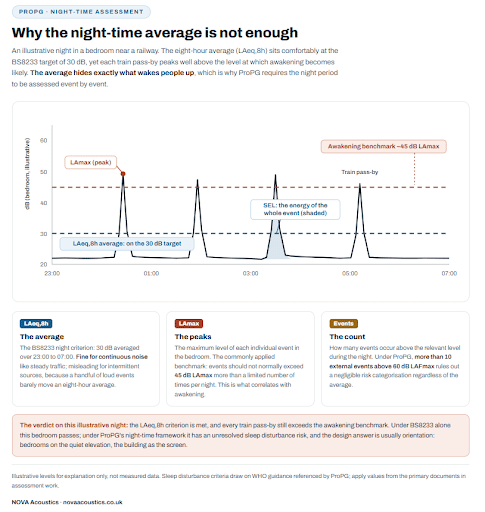
ProPG (Professional Practice Guidance on Planning and Noise) is a 2017 document published jointly by the Association of Noise Consultants, the Institute of Acoustics, and the Chartered Institute of Environmental Health to guide acoustic professionals advising on new residential development in noise-sensitive locations. It does not replace BS8233 or BS4142; it sits alongside them, providing a two-stage approach: an initial noise risk assessment that categorises sites as negligible, low, medium, or high risk, followed by a full assessment built around good acoustic design and delivered through an Acoustic Design Statement. The assessment concludes with one of four recommendations to the decision maker: grant without conditions, grant with conditions, avoid, or prevent. ProPG is now widely cited in planning applications, environmental health responses, and appeal decisions across England. How closely it is applied varies from site to site, but it has become a common reference point for residential development in noise-sensitive locations, and many acoustic assessments engage with its framework as a matter of course.
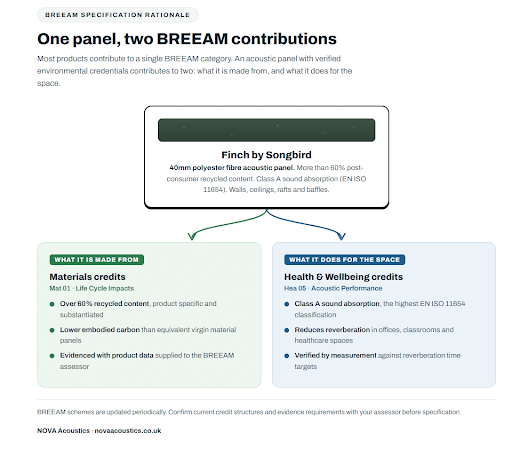
Acoustic panels are rarely on the shortlist when sustainability teams review a fit-out's environmental credentials, but they should be. Conventional acoustic foam is petroleum derived, carries significant embodied carbon, and cannot be recycled at end of life. Higher quality alternatives vary considerably in their environmental profile. The questions worth asking are simple: what is the panel made from, how much of it is recycled or renewable content, is there an Environmental Product Declaration (EPD) or equivalent data available, and what happens to it when the building is refitted? The Finch panel by Songbird is made with more than 60% recycled polyester fibre, achieves Class A sound absorption, and can be installed on walls, ceilings, and as suspended rafts or baffles. For projects where acoustic performance and environmental credentials are both non-negotiable, it is the obvious specification.
Pre-completion sound testing is the on-site acoustic measurement required to demonstrate that a new residential building or conversion meets Part E of the Building Regulations before it can be occupied. Tests measure airborne sound insulation (through walls and floors) and impact sound insulation (through floors). The pass thresholds for new builds are DnT,w + Ctr ≥ 45 dB for airborne sound and L'nT,w ≤ 62 dB for impact sound; for conversions, 43 dB and 64 dB respectively. Testing must be carried out by an accredited body: NOVA Acoustics holds UKAS accreditation (No. 8568) for sound insulation testing. If a test fails, building control sign-off cannot be granted until remediation is completed and a passing re-test is achieved.