







How to Choose the Right Acoustic Panel for Your Space: A Buyer’s Guide
- June 3, 2026
Quick Take
Acoustic panels reduce echo, reverberation, and noise build-up within a room by absorbing sound. They do not block sound between rooms. The right panel depends on five things: the material (polyester fibre or fabric-wrapped), the thickness, how it will be mounted, the aesthetic requirements of the space, and whether durability or sustainability are priorities. Every panel in the Songbird range achieves Class A sound absorption (the highest performance rating available), so the choice between them comes down to application, environment, and finish rather than acoustic performance.
Why Buying Acoustic Panels Is More Confusing Than It Should Be
The acoustic panel market has expanded considerably over the past decade. There are now dozens of products across a wide range of materials, thicknesses, finishes, and price points, and not all of them perform the way their marketing suggests.
Even once you narrow the field to credible products, the terminology creates problems. What does Class A actually mean, and does it matter? What is the difference between polyester fibre and fabric-wrapped? Does a thicker panel always perform better? Is 40mm always the right choice, or are thinner profiles sometimes the smarter option?
Performance classes (A through D), material types (polyester fibre, foam, fabric-wrapped, mineral wool), and the relationship between panel thickness and frequency response are all things manufacturers discuss inconsistently. Sometimes the important details are buried. Sometimes they are overstated. Either way, the buyer is left to figure it out.
The practical consequence of picking the wrong panel: you either over-specify and overspend, or you under-specify and end up disappointed with the result.
This guide works through the decisions you need to make, in the order you should make them, before settling on a product.
If you already know what you need, you can browse the full Songbird acoustic panel range here.
What Acoustic Panels Actually Do, and What They Don't
Get this wrong and the panels you buy will disappoint you regardless of quality.
Acoustic panels treat the room they are installed in. They absorb sound energy that would otherwise bounce off hard surfaces, which reduces the time it takes for sound to decay. Acoustic engineers measure this as RT60 (reverberation time). Less reverberation means clearer speech, less echo, and lower perceived noise levels within the space.
What they do not do is prevent sound from travelling between rooms. That is a different problem entirely, solved by different means: additional mass in the wall construction, structural decoupling, sealing of gaps, and sometimes specialist flooring or ceiling systems. Acoustic panels have no meaningful effect on sound transmission between spaces.
What panels will fix:
- A meeting room where speech is hard to follow because voices are bouncing off a glass wall and a hard ceiling
- A restaurant where the ambient noise level has crept up to the point where conversation is uncomfortable
- A home recording studio where tracks sound echoey or muddy despite decent equipment
What panels will not fix:
- Noise coming through the wall from a neighbouring flat
- Traffic noise from a busy road
- Bass from the floor below
If you are not sure whether absorption or insulation is what your situation actually requires, the distinction is explained in full in our guide to the difference between sound absorption and sound insulation. It is worth reading before you commit to a product. If you think your problem might be structural, the principles of building acoustics is a useful starting point, and our piece on whether adding mass alone is enough to soundproof walls and floors addresses one of the most common misconceptions directly.
What Class A Sound Absorption Actually Means
Most premium acoustic panels carry a Class A rating. All five Songbird panels do. But buyers rarely know what the classification system involves, which makes it hard to evaluate the claim.
Sound absorption is measured using the weighted sound absorption coefficient (αw), which is the metric used in the European classification system (EN ISO 11654). A panel’s αw is determined by testing how much sound energy it absorbs across a range of frequencies. Class A is the top of the scale, covering αw values from 0.90 to 1.00. In plain terms: a Class A panel absorbs the vast majority of sound energy that reaches it.
Lower-rated panels absorb less. That matters in practice because it means more panels are needed to achieve the same result in a given room, or the result will simply be less effective. A Class B or C panel is not “nearly as good”; it may require significantly more coverage area to reach the same acoustic outcome.
Because all five Songbird products achieve Class A, there is no performance hierarchy within the range. Finch does not outperform Swift. Robin does not underperform Skylark. The choice between them is about application, aesthetics, environment, and physical durability, not acoustic output.
One nuance worth knowing: thicker panels (40mm) absorb lower frequencies more effectively than thinner profiles (12mm). This is not about Class rating; it is about frequency response. For spaces with significant bass energy (music rooms, gyms, large open-plan offices with noisy HVAC systems), 40mm is the more appropriate specification. For spaces where low frequencies are not a dominant concern, a 12mm or 24mm panel can achieve Class A performance perfectly well.
The Five Key Buying Decisions
Decision 1: Material type. Polyester fibre or fabric-wrapped?
Polyester fibre panels (Finch, Robin)
Polyester fibre panels are made from compressed fibres. They are robust, easy to handle, and the panel face itself is the finished surface; there is no separate fabric wrap.
Finch contains more than 60% recycled material. For projects with sustainability targets, BREEAM requirements, or clients who want to document responsible material choices, this matters. The recycled content is part of the product story in a way that is genuinely communicable to building occupants.
Robin is available in a slim 12mm or 24mm profile. Where wall depth is constrained (listed buildings, retail environments, narrow corridors), Robin’s profile is often the practical answer when a 40mm panel simply will not fit the scheme.
Fabric-wrapped panels (Skylark, Swift, Warbler)
Fabric-wrapped panels have a rigid acoustic core (typically polyester or mineral wool) wrapped in a chosen fabric. The fabric is where the aesthetic flexibility comes from. Colour and texture can be matched to an interior scheme, which makes this format the default choice for commercial environments where the panels need to look like a deliberate design decision rather than a retrofit.
Skylark and Warbler are available in a wide range of colours and can be ordered bespoke to size. Swift comes in a fixed fabric finish and fixed sizes, which keeps things simple for buyers who want a straightforward installation rather than a custom specification.
Decision 2: Thickness. 12mm, 24mm, or 40mm?
The 40mm panels (Finch, Skylark, Swift, and Warbler) achieve Class A performance across the standard frequency range tested under EN ISO 11654.
Robin at 12mm or 24mm also achieves Class A, but the thinner profile means lower-frequency absorption is reduced compared to a 40mm panel. For most office and commercial applications this is not a significant issue. For music rooms, gyms, or any space with substantial low-frequency noise, 40mm is the right specification.
Where wall depth is tight, Robin’s slim format offers a practical route to Class A performance without the bulk. Retail environments with shelving, heritage buildings with strict planning constraints, and spaces with dimensional tolerances that rule out a 40mm profile are all situations where this matters.
Decision 3: Mounting method
Fixed wall mounting is the standard installation method for Finch, Skylark, Warbler, and Robin. Panels are attached using appropriate fixings for the substrate: timber, masonry, or plasterboard. Most competent DIYers can manage this; professional installation is required for more complex specifications.
Ceiling suspension as rafts or baffles is an option for Finch, Skylark, and Robin. This is worth considering in rooms where wall space is limited, or where treating the ceiling surface is the better acoustic strategy. Professional installation is recommended for suspended configurations.
Self-adhesive installation is unique to Swift. Peel-and-stick, with no fixings and no drilling required. This is the correct choice for renters, home studio users, or any space where putting holes in the wall is not an option. It is also simply the fastest installation method in the range.
Decision 4: Aesthetic requirements
If the panels are going to be a visible part of the interior design rather than something tucked behind furniture, the aesthetic question matters as much as the acoustic one.
- Skylark is the specification panel for design-led environments. Bespoke fabric colour and bespoke sizing mean the panels can be designed around the room rather than fitted around the room.
- Warbler covers a wide colour range and is available in bespoke sizes. It is built for environments where bold colour choices suit the space, such as school corridors, leisure centres, and sports halls.
- Finch is the option where sustainability credentials are part of the design brief. The recycled content story is legible and communicable; it is not just a box-tick.
- Robin offers bespoke sizing and a wide colour range in a slim format. Where a contemporary, low-profile look is the goal, Robin fits that brief without the cost of a full fabric-wrapped specification.
- Swift is the pragmatic choice. Fixed sizes, fixed finish, no bespoke options, but installed in minutes with no fixings required.
Decision 5: Durability and environment
For most commercial environments (offices, meeting rooms, recording studios), any of the 40mm Songbird panels is appropriate. The durability decision becomes important when the environment is physically demanding.
Schools, sports halls, gyms, and leisure centres are where Warbler earns its place. Its impact-resistant construction is specifically designed for ball strike, furniture contact, and the kind of daily wear that would damage a standard fabric-wrapped panel over time.
Outdoor or high-humidity environments: none of the Songbird range is rated for external use. This is worth flagging clearly before any outdoor installation is specified.
The Songbird Range: Which Panel for Which Scenario
Finch: the sustainable choice
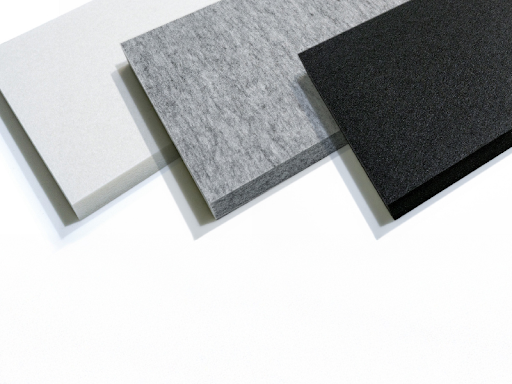
A 40mm polyester fibre panel with more than 60% recycled content. Class A sound absorption. Suitable for walls, ceiling rafts, and baffles. Finch is the right specification for projects with sustainability commitments: BREEAM targets, ESG reporting, or clients who want to evidence responsible material choices. The exposed polyester face has a clean, contemporary appearance without requiring a fabric wrap.
Skylark: the bespoke specification panel
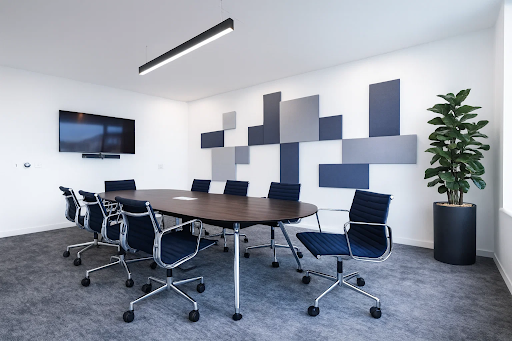
A 40mm fabric-wrapped panel available in a wide range of colours and bespoke sizes to order. Class A sound absorption. Suitable for walls, ceiling rafts, and baffles. Skylark is the default recommendation for architects and interior designers who need precise aesthetic control alongside acoustic performance. Meeting rooms, hospitality spaces, reception areas, and any commercial environment where the panels need to complement the design scheme rather than simply fill wall space.
Swift: the DIY panel
A 40mm fabric-wrapped panel with self-adhesive backing. Class A sound absorption. No fixings required. Swift is for homeowners, renters, home studio users, and small business owners who want effective acoustic treatment without professional installation. Fixed sizes and fabric finishes with no bespoke options. The trade-off for ease of installation is a more limited range of choices.

Warbler: the impact-resistant panel
A 40mm impact-resistant acoustic wall panel available in a wide range of colours and bespoke sizes. Class A sound absorption. Suitable for surface mounting to walls. Warbler is the correct specification for schools, sports halls, gyms, and leisure centres: any space where panels will face physical contact, ball strike, or heavy daily use. Where durability is as important as acoustic performance, Warbler is the answer.

Robin: the slim-profile panel
A 12mm or 24mm polyester fibre panel available in a wide range of colours and bespoke sizes. Class A sound absorption. Suitable for walls, ceiling rafts, and baffles. Robin is the practical choice where wall depth is constrained, where a slimmer aesthetic is preferred, or where bespoke sizing is needed without the cost of a full fabric-wrapped specification. Particularly well-suited to retail environments, listed buildings, and spaces with tight dimensional tolerances.

Songbird Product Comparison Table
All five panels achieve Class A sound absorption. Performance is equal across the range. The table below is a guide to application, not acoustic output.
Product | Material | Thickness | Mounting | Bespoke sizing | Colour options | Key strength | Best for |
Finch | Polyester fibre (>60% recycled) | 40mm | Fixed wall, ceiling raft/baffle | No | Limited | Sustainability credentials | Eco-conscious projects, BREEAM |
Skylark | Fabric-wrapped | 40mm | Fixed wall, ceiling raft/baffle | Yes | Huge range | Aesthetic flexibility, bespoke | Commercial, hospitality, design-led interiors |
Swift | Fabric-wrapped | 40mm | Self-adhesive only | No | Somewhat Limited | DIY installation | Home studios, renters, small offices |
Warbler | Impact-resistant fabric-wrapped | 40mm | Fixed wall only | Yes | Huge range | Physical durability | Schools, gyms, sports halls, leisure |
Robin | Polyester fibre | 12mm or 24mm | Fixed wall, ceiling raft/baffle | Yes | Huge range | Slim profile, bespoke | Retail, heritage buildings, space-constrained walls |
Choosing Acoustic Panels by Space Type
Offices and meeting rooms
Skylark is the typical recommendation for commercial office environments. Bespoke sizing means panels can be specified precisely for the room dimensions, and the wide fabric colour range suits most corporate interior schemes. For smaller meeting rooms or breakout spaces where budget matters, Robin’s slim profile and bespoke options offer a cost-effective alternative. Swift works well for informal or temporary office setups where permanent installation is not needed.
For more detailed guidance on office acoustic treatment, see our guides on the ins and outs of office acoustics and where to install acoustic panels in office spaces for the best results. If you are still at the stage of deciding whether acoustic treatment is the right investment, our piece on when to invest in acoustic panels for your office may help. You can also find space-specific guidance on our office acoustics and conference and meeting room acoustics pages.
Restaurants and hospitality
Hard-surfaced, high-occupancy commercial interiors are among the worst environments for reverberation. Stone floors, tiled walls, glass partitions: every hard surface reflects sound rather than absorbing it, and when a space fills with people the noise level compounds quickly.
Skylark is the natural fit here. The fabric options can be matched to the interior design, and bespoke panel sizing means treatment can be built into the fit-out from the start rather than added as an afterthought. Our guide to restaurant acoustics covers the full picture, including reverberation targets and practical installation approaches. For venue-specific advice, see our restaurant acoustics space page.
Schools and educational spaces
Warbler is the correct specification for most school environments. Its impact-resistant surface handles ball strike, furniture contact, and the general physical demands of corridors, classrooms, and sports halls. This is not an optional extra; standard fabric-wrapped panels will not last in these conditions.
Building Bulletin 93 (BB93) sets reverberation time targets for educational spaces in England. Our guide to BB93 acoustic design in schools explains what the standard requires and what it means for panel specification. The number and placement of panels needed to meet BB93 targets depends on the room’s dimensions and current acoustic conditions; a qualified acoustic consultant can advise on this.
Home studios and music rooms
Swift is the natural starting point for home studio users. Self-adhesive installation means no drilling, no landlord negotiation, and no mess. For a more permanent treatment with better low-frequency performance, Finch at 40mm or Robin at 24mm are both worth considering. The thicker profiles handle bass frequencies more effectively, which tends to matter more in music rooms than in speech-focused spaces.
Gyms and leisure centres
Warbler again. Gyms present the same durability challenge as schools: panels at low heights will face contact from equipment and users regularly. The impact-resistant surface is the non-negotiable requirement in this environment.
In large-volume spaces where wall area is insufficient for the required absorption, ceiling rafts using Finch or Robin can supplement the wall treatment. For more detail, see our gym acoustics and sports hall acoustics pages.
Retail
Robin’s slim 12mm profile is a practical answer for retail environments where shelving, display fixtures, and signage compete for wall space. A 40mm panel is often simply not practical when every surface has a commercial function. The wide colour range means Robin can integrate with brand colour schemes without drawing attention to itself. See our retail acoustics page for more.
Why Songbird by NOVA Acoustics
Songbird is NOVA Acoustics’ own range of Class A acoustic panels. It was designed, specified, and is supported by the same team that surveys, tests, and designs acoustic solutions for buildings across the UK. When you buy a Songbird panel, you are not buying from a panel retailer. You are buying from an acoustic consultancy that understands exactly what the panels need to do.
Every panel in the range achieves Class A sound absorption. There is no performance compromise anywhere in the range, and no hidden tier system where the cheaper panels quietly underperform.
NOVA Acoustics team hold membership to the Insitute of Acoustics. That ensures an independent quality standard; it does not happen by self-declaration, and it signals that the technical rigour behind Songbird’s specifications is the same rigour applied to NOVA’s consultancy work.
The range covers the full spectrum of acoustic environments. Self-adhesive home studio treatment (Swift). Bespoke fabric-wrapped panels for corporate fit-outs (Skylark). Impact-resistant panels for schools and leisure centres (Warbler). And for every one of those environments, there is a product designed with that environment in mind, not adapted from something built for a different context.
For Skylark, Robin, and Warbler, bespoke sizing and colour options mean the panels adapt to the design rather than the other way around. Lead times and minimum quantities vary by product; contact the team for specifics on bespoke orders.
NOVA’s acoustic consultancy team is also available to advise on specification, panel quantity, and placement for more complex projects. If you are specifying panels for a building with unusual dimensions or particularly challenging acoustic conditions, that conversation is worth having before you order.
Browse the full Songbird range or get in touch with our team for specification advice on your project.
Frequently Asked Questions
Polyester fibre panels (Finch and Robin) are made from compressed fibres. The panel face is the finished surface; there is no separate fabric layer. Fabric-wrapped panels (Skylark, Swift, and Warbler) have a rigid acoustic core wrapped in a chosen fabric, which gives more aesthetic flexibility and a wider colour range. Both types can achieve Class A sound absorption. The difference is primarily in appearance, application, and durability rather than acoustic performance.
Class A is the highest sound absorption classification under EN ISO 11654, the European standard. It means the panel has a weighted sound absorption coefficient (αw) of between 0.90 and 1.00, meaning the panel absorbs the vast majority of sound energy that reaches it. All panels in the Songbird range achieve Class A.
No. Acoustic panels absorb sound within the room they are installed in, reducing echo and reverberation. They do not prevent sound from passing between rooms. Blocking sound transmission between rooms requires structural measures: additional mass, decoupling, and sealing. If you need to prevent sound from travelling between spaces, speak to an acoustic consultant. Our guide to sound absorption versus sound insulation explains the distinction in detail.
It depends on the room’s dimensions, the surface materials, the current reverberation time, and the target acoustic performance. As a general rule, panels covering 15 to 25 percent of the total wall and ceiling surface area will produce a noticeable improvement in most rooms. For a precise calculation, contact the Songbird team or consult an acoustic specialist.
Yes, in many cases. Swift is designed for DIY installation with a self-adhesive backing, so no fixings or drilling are needed. The other Songbird panels (Finch, Skylark, Warbler, Robin) use standard wall fixing methods and can be installed by a confident DIYer or a general contractor. For suspended ceiling rafts or baffles, professional installation is recommended.
Warbler. Its impact-resistant surface handles the physical demands of school environments, including ball strike, furniture contact, and daily wear. It is available in a wide range of colours and bespoke sizes, and achieves Class A sound absorption. See our BB93 guide for information on reverberation targets in educational spaces.
Both are available bespoke to order with a wide range of colours and sizes. The key differences are material and profile. Skylark is a 40mm fabric-wrapped panel; Robin is a 12mm or 24mm polyester fibre panel with a slimmer profile. Skylark is typically specified for design-led commercial environments where the fabric finish is part of the brief. Robin is often chosen where wall depth is constrained or a slimmer contemporary look is the priority.
Finch is the standout option here. It is made with more than 60% recycled material and is the recommended choice for projects with BREEAM targets or ESG reporting requirements. The wider Songbird range uses polyester fibre and fabric materials; specific sustainability data for each product is available on the individual product pages.
Next Steps
The right acoustic panel is not necessarily the most expensive one, and it is not always the thickest one. It is the one that fits the environment, the installation method, the aesthetic brief, and the durability requirements of the space.
Because every panel in the Songbird range achieves Class A sound absorption, the performance question is settled. What is left is working through the five decisions in this guide: material, thickness, mounting, aesthetics, and durability, and applying them to your space. In most cases that process narrows the field to one or two products fairly quickly.
For straightforward applications, the comparison table and space-type sections above should be enough to make a decision. For more complex projects, or if you are specifying panels for an unusual environment, NOVA Acoustics’ consultancy team can advise on specification, panel quantity, and placement before you order.
Browse the full Songbird range or get in touch with our team for advice on the right panel for your project.
Further reading:
- Sound absorption vs. sound insulation: what is the difference?
- A comprehensive guide to acoustic wall panels
- The principles of building acoustics
- The ins and outs of office acoustics
- Guide to restaurant acoustics
- BB93 acoustic design in schools
Sources
The standards, classifications, and regulatory frameworks referenced throughout this guide are listed below, with links to official sources or publishers.
- EN ISO 11654:1997. Acoustics: Sound Absorbers for Use in Buildings. Rating of Sound Absorption. International Organization for Standardization (ISO). The European standard that defines the sound absorption classification system (Class A through E) and the weighted sound absorption coefficient (αw) used throughout this guide. https://www.iso.org/standard/19583.html
- BS EN ISO 11654:1997. Acoustics: Sound Absorbers for Use in Buildings. Rating of Sound Absorption. British Standards Institution (BSI). The British adoption of EN ISO 11654, the standard against which all Songbird panel Class A ratings are measured. https://www.bsigroup.com/en-GB/standards/bs-en-iso-11654/
- BREEAM UK New Construction Technical Standard. BRE Group. The UK’s leading sustainability assessment method for buildings. Referenced in relation to Finch’s recycled content and its suitability for projects with BREEAM credits or environmental reporting requirements. https://bregroup.com/products/breeam/
- Building Bulletin 93 (BB93): Acoustic Design of Schools. Performance Standards. Department for Education. Sets the reverberation time targets and acoustic performance standards for new and refurbished school buildings in England. Referenced in the schools and educational spaces section. https://www.gov.uk/government/publications/bb93-acoustic-design-of-schools-performance-standards
- Approved Document E: Resistance to the Passage of Sound. HM Government. The building regulations standard for sound insulation in dwellings and other buildings. Relevant context for readers needing to understand the distinction between acoustic absorption and sound insulation. https://www.gov.uk/government/publications/resistance-to-sound-approved-document-e
- UKAS Accreditation. United Kingdom Accreditation Service. The national accreditation body for the UK. NOVA Acoustics holds UKAS accreditation No. 8568 for sound insulation testing. https://www.ukas.com
- Institute of Acoustics (IOA). The professional body for those working in acoustics, noise, and vibration in the UK. IOA membership is referenced in relation to NOVA Acoustics’ consultancy team. https://www.ioa.org.uk