







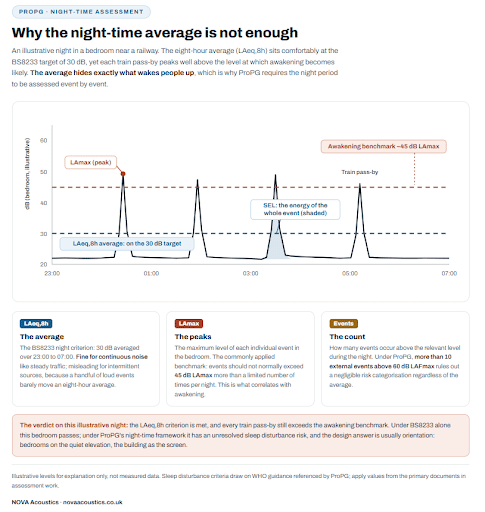
ProPG (Professional Practice Guidance on Planning and Noise) is a 2017 document published jointly by the Association of Noise Consultants, the Institute of Acoustics, and the Chartered Institute of Environmental Health to guide acoustic professionals advising on new residential development in noise-sensitive locations. It does not replace BS8233 or BS4142; it sits alongside them, providing a two-stage approach: an initial noise risk assessment that categorises sites as negligible, low, medium, or high risk, followed by a full assessment built around good acoustic design and delivered through an Acoustic Design Statement. The assessment concludes with one of four recommendations to the decision maker: grant without conditions, grant with conditions, avoid, or prevent. ProPG is now widely cited in planning applications, environmental health responses, and appeal decisions across England. How closely it is applied varies from site to site, but it has become a common reference point for residential development in noise-sensitive locations, and many acoustic assessments engage with its framework as a matter of course.
BS4142 Noise Survey & Assessment: A Practical Guide to BS4142 Noise Assessments and Planning Permission
- June 16, 2026
Quick Take
BS 4142 is the British Standard used to assess the impact of industrial and commercial noise on nearby sensitive premises. It works by comparing the rating level of a specific noise source (adjusted for acoustic character) against the prevailing background noise level at the nearest receptor. A difference of around +10 dB or more indicates a likely significant adverse impact. Around +5 dB indicates a likely adverse impact. At or below background indicates negligible impact. Most local planning authorities require a BS4142 assessment when new commercial or industrial premises are proposed near residential properties, or when fixed plant and equipment is being installed. The 2019 amendment (BS4142:2014+A1:2019) introduced important updates to methodology that all current assessments must reflect.
What is BS4142?
BS4142 is a British Standard with a specific job: to provide a consistent, repeatable methodology for quantifying the impact of industrial and commercial noise on nearby noise-sensitive premises. Its full title is BS 4142:2014+A1:2019, Methods for Rating and Assessing Industrial and Commercial Sound.
The standard has been around in various forms since the 1960s, but the version in use today is the result of a substantial revision in 2014 and a further amendment in 2019. The 2014 revision was significant. It replaced the relatively prescriptive criteria of the 1997 version with a more context-dependent significance framework, introduced formal character adjustment procedures, and updated monitoring requirements to reflect current professional practice. Assessments produced under the 1997 standard are now out of date for planning purposes. The 2019 amendment refined the methodology further. Any current BS4142 assessment should specify BS4142:2014+A1:2019 throughout.
The standard covers a defined scope of noise sources: sound from industrial and manufacturing processes, fixed mechanical and electrical plant (air conditioning, extraction systems, generators, cooling towers), loading and unloading operations, mobile plant that is intrinsic to a site’s operations (forklifts, delivery vehicles within a site boundary), and train or ship movements associated with industrial or commercial activity.
It does not cover road traffic noise in isolation (that falls under CRTN), construction noise (covered by BS5228), or noise in the internal workplace environment (governed by the Control of Noise at Work Regulations 2005).
The standard is used by environmental health officers at local authorities, acoustic consultants, planning authorities, and developers and operators of commercial or industrial sites. Understanding the basics puts you in a much stronger position when commissioning an assessment or reviewing one submitted with a planning application.
If you have been asked to submit a BS4142 assessment as part of a planning application, our acoustic consultants can scope and manage the process from start to finish.
When do you need a BS4142 assessment?
More often than many developers and operators expect. The standard applies across a range of planning scenarios, and several of the most common triggers are routinely overlooked until a planning condition makes them unavoidable.
New commercial or industrial development near residential
Any new commercial or industrial premises proposed in proximity to existing noise-sensitive receptors (residential properties, schools, hospitals, hotels) will almost always require a BS4142 assessment. The planning authority needs evidence that the noise impact of the new development on those receptors is acceptable. This applies whether the development is a restaurant, a manufacturing unit, a gym, a data centre, or any other commercial operation with noise-generating activity.
New or replacement fixed plant and equipment
This is the most common trigger in practice. Air conditioning units, extraction systems, HVAC plant, cooling towers, generators, and any other fixed mechanical or electrical equipment installed at commercial premises will typically require a BS4142 assessment before planning permission is granted or a planning condition is discharged. The assessment applies whether the plant is new or a like-for-like replacement, provided the premises are in a noise-sensitive location. Many operators are surprised to find that replacing an existing unit with a nominally identical model still requires a fresh assessment if the location is adjacent to residential.
See our dedicated guides on plant noise surveys and air conditioning noise surveys for more on fixed plant assessments specifically.
New sensitive development near existing industrial or commercial noise sources
BS4142 also applies in the reverse scenario: where new residential, educational, or healthcare development is proposed near existing industrial or commercial premises. This reflects the agent of change principle in the National Planning Policy Framework (NPPF). The developer introducing the sensitive use is responsible for managing noise impacts. If you are building flats near an existing food production facility, the BS4142 assessment is your responsibility, not the factory’s.
Change of use
Converting a building from one use class to another, particularly where the new use is noise-sensitive, may trigger a BS4142 assessment if industrial or commercial noise sources are present nearby. Office-to-residential conversions near commercial premises are a common scenario where this requirement is underestimated.
Pre-application requirements and planning condition discharge
A BS4142 report may be required at the pre-application stage, as a condition of planning approval, or to discharge a specific planning condition before construction or occupation begins. Which of these applies to your project matters for programme planning. A pre-commencement condition means no work can begin until the assessment is approved. Understanding this early avoids unnecessary delays.
When you might not need one
Not every commercial development requires a BS4142 assessment. Remote industrial sites well removed from sensitive receptors, very low-noise equipment with negligible emissions, and situations where the LPA has given clear pre-application confirmation that no assessment is required may not need one. The safest route is a brief conversation with an acoustic consultant before committing either way.
Not sure whether your project requires a BS4142 assessment? Our team can advise quickly. Get in touch for a no-obligation scoping conversation.
The BS4142 methodology: how the standard works
At its core, BS4142 is a comparison exercise. The rating level of the specific noise source is compared against the background noise level at the nearest sensitive receptor. The difference between the two determines the likely significance of the impact.

That framing makes it sound straightforward. In practice, the two inputs (background noise level and rating level) each require careful measurement and calculation, and the significance assessment requires professional judgement rather than arithmetic alone.
The standard distinguishes between daytime and night-time assessment periods. Night-time criteria are typically more stringent, because the background noise environment is quieter and the potential for sleep disturbance is a more serious concern. A source that passes the daytime assessment may still require mitigation for night-time operation.
The significance thresholds (+5 dB and +10 dB) are guidelines, not automatic pass/fail criteria. BS4142 is explicit that context must be considered. A +5 dB difference in a quiet rural area may be far more significant than the same difference in a busy industrial estate. The character of the area, the nature of the noise source, the time of day, and the sensitivity of the receptor all affect the interpretation.
Sections 4 and 5 below cover the two inputs in detail: background noise and rating level.
Background noise: what it is and how it is measured
Background noise level is the prevailing noise environment at the receptor location, measured in the absence of the specific industrial or commercial noise source being assessed.
In BS4142, background noise is expressed as the LA90: the sound level exceeded for 90% of the measurement period. This metric is used deliberately. It represents the underlying, steady noise environment rather than the peaks caused by passing vehicles or other brief events. A reading of 38 dB(A) LA90 means the ambient noise level was at or above 38 dB(A) for 90% of the time.
Why LA90 rather than LAeq? Because LA90 is relatively insensitive to occasional loud events. It filters out the lorry passing at 70 dB(A) and captures the quieter baseline that a resident would experience for most of the day. That baseline is the correct reference point for assessing whether a new noise source will be intrusive.
Measurement requirements are specific. The survey must be conducted at the receptor location (or as close to it as practically possible), using a calibrated sound level meter to IEC 61672 Class 1 standard. Critically, the specific noise source being assessed must not be operating during background monitoring. If the air conditioning unit is already installed, it must be switched off during the background survey.
BS4142 does not prescribe a minimum monitoring duration, but professional practice requires coverage sufficient to characterise the noise environment across all relevant operating periods: daytime, evening, and night-time as applicable to the source’s operating hours. In practice this typically means 24-hour or longer unattended monitoring for most sites. A restaurant with evening and late-night service needs evening data. A 24-hour logistics operation needs night-time data.
Background noise varies by season and by time of day. A site near a school is louder during term-time than in the holidays. A rural site near an agricultural operation may be quieter in winter. The assessment should reflect representative conditions for the time periods being assessed, and the consultant should review raw monitoring data to flag any atypical events that might distort the result.
All equipment must be calibrated before and after each monitoring session. Calibration records form part of the technical report. For a wider view of noise monitoring methodology, see our guide to noise and vibration monitoring.
Rating level: what it is and how it is calculated
The rating level is the measured or predicted sound level from the specific industrial or commercial noise source, adjusted to account for acoustic character. It is expressed as LAeq,T: the equivalent continuous sound level over the relevant assessment period.
The concept of character adjustment is what makes BS4142 more than a straightforward decibel comparison. The standard recognises that some noise sources are more annoying than their raw level suggests, because of how they sound rather than how loud they are. Character adjustments are added to the measured LAeq,T to produce the rating level.
The main character corrections are:
Tonal character: a noise with a clearly audible tone (a hum, whine, or whistle at a specific frequency) is more intrusive than broadband noise at the same overall level. A tonal correction of typically +5 dB is applied where tonal character is identified. Tonality is assessed using 1/3 octave band analysis to check whether any frequency band stands out from its neighbours.
Impulsive character: sudden, sharp sounds (bangs, impacts, clanks from production machinery or unloading operations) attract a correction, typically +5 dB. Impulsive character is both heard and identified through analysis of the time-history data.
Intermittent character: a noise that starts and stops irregularly may be more disturbing than a continuous noise at the same level, and may attract a correction depending on context.
Low-frequency character: where a noise source has enhanced low-frequency content relative to its overall level, this may attract a correction. Low-frequency noise is harder to attenuate and can be perceived inside buildings even at relatively low absolute levels.
Where the noise source is not yet operational (proposed new plant, development under consideration), the consultant uses acoustic modelling rather than direct measurement. This draws on manufacturer noise specifications, similar plant data, or the consultancy’s own database of measured plant noise levels, adjusted for the specific site geometry, distance, and screening conditions.
Distance attenuation matters significantly. Noise reduces with distance from the source: approximately 6 dB per doubling of distance for a point source in free-field conditions. Acoustic barriers, intervening buildings, and terrain all affect how sound propagates to the receptor, and all must be accounted for in the modelling.
Significance assessment: interpreting the result
The significance assessment is the comparison between the rating level and the background noise level.
The calculation is straightforward: Rating Level minus LA90 equals the difference. What that difference means requires judgment.

The headline thresholds from BS4142:
A difference of +10 dB or more is a likely indication of significant adverse impact. At this level, the noise source is substantially above the background environment and is likely to cause complaints and potentially harm amenity.
A difference of around +5 dB is a likely indication of adverse impact. The source is clearly audible above the background, and effects on amenity are probable.
A rating level at or below the background level indicates negligible impact. The noise source does not meaningfully alter the existing noise environment.
These thresholds are not automatic pass/fail criteria. BS4142 is explicit that context must play a role in interpretation. A +5 dB difference in a genuinely quiet rural location, where residents are exposed to a low background noise environment and have a reasonable expectation of quiet, will be treated differently from the same difference in an established commercial area where industrial activity is part of the existing character. The planning authority’s environmental health team will consider the full picture, not just the dB arithmetic.
Context includes: the existing acoustic character of the area, the sensitivity of the receptor, the time of day, whether the noise source is new or existing, and whether the impact is temporary or permanent. An experienced acoustic consultant’s interpretation of context is a fundamental part of what a BS4142 report provides.
The local planning authority may also apply its own noise criteria or local guidance alongside BS4142. Some authorities have noise policies in their local plans that set specific dB limits for certain types of development. An acoustic consultant familiar with local practice will be aware of these.
For more on how BS4142 fits within the planning system more broadly, see our complete guide to noise impact assessments for planning permission.
How a BS4142 survey is conducted: step by step
Step 1: Scoping and desk study
Before any site visit, the acoustic consultant reviews the planning application, pre-application correspondence, site plans, and any existing noise data. The goal is to establish which noise sources are relevant to the assessment, what the relevant assessment periods are (daytime, evening, night-time), where monitoring locations should be positioned, and whether acoustic modelling will be needed for plant that is not yet installed or operational.
Scoping is not a formality. A well-scoped assessment is more focused and far less likely to generate LPA queries about sources that were not addressed. It also determines whether a full noise survey is necessary or whether existing monitoring data from previous assessments can be used.
For general background on what a noise survey involves, see our introductory guide to noise surveys.
Step 2: Background noise monitoring
The consultant visits the site and deploys calibrated equipment to measure background noise levels at or near the relevant receptor location. The specific noise source being assessed must not be operating during this monitoring period. The duration and timing of monitoring reflects the operating hours of the source being assessed.
Raw data is reviewed after collection. The consultant checks for anomalous events (a passing vehicle at an isolated rural site, a brief alarm activation, wind affecting the microphone) that may need to be excluded from the background analysis, with the rationale documented in the report.
Step 3: Specific source noise measurement or modelling
If the noise source is already operational, the consultant returns to the site to measure the source while it is running. Measurements are taken at or near the receptor location, during the source’s normal operating conditions.
If the source is not yet installed, acoustic modelling is used. This draws on manufacturer-published sound power levels, similar plant databases, or measured data from comparable installations, adjusted for the specific geometry of the site, distance to the receptor, and any screening or reflecting surfaces.
Step 4: Character assessment
The consultant assesses whether any character corrections apply: tonal, impulsive, intermittent, or low-frequency. This involves both technical analysis (1/3 octave band data to identify tonal prominence) and direct listening assessment. The rationale for any correction applied (or not applied) is documented in the report.
Step 5: Rating level calculation and significance assessment
The rating level is calculated by applying any character corrections to the measured or modelled LAeq,T. This is compared to the LA90 background level. The consultant then assesses the significance of the difference in the context of the noise environment, the receptor type, and the relevant planning policy framework.
Step 6: Mitigation design (where required)
Where the assessment shows an adverse or significant adverse impact, the consultant identifies and models mitigation options. Measures are assessed for technical feasibility and planning enforceability. A report that recommends mitigation which cannot realistically be installed or verified will be challenged by the LPA. Section 10 of this guide covers the main mitigation options in detail.
Step 7: Technical report
The consultant prepares a structured technical report covering all of the above, suitable for submission to the local planning authority.
NOVA Acoustics manages the full BS4142 process, from background monitoring to submission-ready report. Get in touch to discuss your project and receive a quote.
What a BS4142 report contains
A complete BS4142 technical report should include the following:
Executive summary. A concise overview of findings and recommendations, written for a non-technical reader including planning officers who may not read the full document in detail.
Purpose and objectives. The scope of the assessment, the noise sources assessed, and the assessment periods covered.
Site description and surrounding area. The location, land uses nearby, the character of the noise environment, and any existing noise sources present.
Methodology. The standard applied (BS4142:2014+A1:2019), monitoring locations and the rationale for their selection, equipment used (make, model, serial number), calibration records, weather conditions during monitoring, and the dates and times of monitoring sessions.
Background noise results. LA90 values for each monitoring period, a commentary on the representativeness of the data, and a note on any anomalous events excluded from the analysis.
Specific source noise data. Measured or modelled LAeq,T values at the receptor, character corrections applied and their justification, and the resulting rating level.
Significance assessment. The numerical comparison of rating level to background, the significance conclusion, and the contextual interpretation.
Mitigation recommendations. Where the impact is adverse, a description of recommended measures, the predicted noise reduction, and the expected post-mitigation rating level.
Conclusion. A clear statement on whether the proposal is acceptable in noise terms, and any planning conditions the consultant recommends.
Typical planning conditions related to BS4142
A successful BS4142 assessment does not just unlock planning permission. It frequently triggers conditions that carry ongoing compliance obligations.
Pre-commencement conditions are the most restrictive. No development work can begin until the noise assessment has been submitted and approved by the LPA. If the assessment has not been commissioned before the application is submitted, this condition can halt a project at exactly the point the contractor is ready to start. Early instruction of an acoustic consultant is the straightforward fix.
Pre-occupation conditions require that specific acoustic measures are in place and verified before the premises are occupied or the equipment is operated. This often means a post-installation noise survey is required to confirm that the installed plant performs as predicted. The following wording is typical of this type of condition:
“Prior to first operation of the plant, a post-installation noise survey shall be submitted to and approved in writing by the local planning authority, demonstrating that the rating level of the plant does not exceed the background noise level at the nearest noise-sensitive receptor.”
This type of condition means the assessment process does not end when permission is granted. It continues through to installation and commissioning.
Operational conditions set ongoing noise limits that run with the planning permission indefinitely. The most common formulation:
“The rating level from all fixed plant and machinery shall not exceed the background noise level (LA90) at any noise-sensitive receptor.”
In practice this means the operator must ensure that any changes to plant or equipment do not increase the noise output above the assessed level. Adding a new extraction unit or increasing the operating hours of existing equipment may require a fresh assessment to confirm compliance.
Noise management plans are increasingly required for larger or more complex sites. These set out how noise will be managed across the site’s operation: monitoring arrangements, complaint-handling procedures, maintenance schedules for noise-critical equipment, and protocols for introducing changes.
Post-completion verification surveys require a follow-up noise survey once the development is operational, to confirm that the levels predicted in the report have been achieved in practice.
Mitigation measures
Where the BS4142 assessment identifies an adverse impact, the following mitigation options are available. The right choice depends on the specific source, the site geometry, and the level of attenuation required.
Low noise equipment specification. Choosing plant with lower sound power levels at the design stage is the most effective mitigation. It costs nothing extra if done at specification stage and avoids the need for secondary measures. Acoustic consultants can advise on the maximum sound power level a unit must achieve to satisfy the BS4142 assessment.
Distance separation. Positioning plant as far as possible from the site boundary facing the nearest receptor reduces noise levels at the source. For a point source in free-field conditions, noise reduces by approximately 6 dB per doubling of distance. Site layout decisions made early in the design process can deliver significant reductions without any additional cost.
Acoustic barriers and screening. Solid barriers between the source and receptor (masonry walls, close-boarded timber fencing, proprietary acoustic screen panels) can provide 5 to 15 dB of attenuation depending on height and geometry. The barrier must interrupt the line of sight between source and receptor to be effective. Diffraction over the top of the barrier limits performance, particularly at low frequencies.
Acoustic enclosures. Enclosing the noise source in an acoustically lined housing provides significant attenuation but requires careful design to manage heat dissipation and allow maintenance access. Correctly designed enclosures can provide 10 to 20 dB of insertion loss for mechanical plant.
Silencers and attenuators. Inline silencers on ductwork and inlet/exhaust attenuators on fans and air handling units are standard measures in mechanical engineering practice. The acoustic consultant specifies the required insertion loss; the mechanical engineer selects a unit to match. Our extraction system noise survey guide covers this in more detail.
Building layout and orientation. Using the building itself as a screen: positioning noise-generating equipment on the elevation facing away from the nearest receptor, or using service cores and plant rooms as buffer zones between the noise source and sensitive areas.
Acoustic glazing and sealed facades. Relevant where the noise source is inside a building and the concern is sound breakout through windows, or where residential receptors need enhanced facade insulation to achieve acceptable internal noise levels.
Alternative ventilation strategies. Sealing the residential facade and providing mechanical ventilation with heat recovery removes the pathway for external noise to enter through open windows. This is one of the standard approaches for residential development in noisy locations, and often the only practical solution where facade levels are high.
For plant and equipment assessments specifically, see our guides on plant noise surveys and air conditioning noise surveys.
Worked example: rooftop air conditioning unit at a restaurant
The following example illustrates how the BS4142 methodology works in practice. Numbers are illustrative and have been reviewed for plausibility, but this is not a calculation tool.
Scenario. A restaurant is proposing to install a rooftop air conditioning unit. The nearest residential property is 15 metres from the unit location. The LPA has conditioned the development to achieve a rating level no higher than the background noise level at the nearest property.
Step 1: Background monitoring. A calibrated sound level meter is deployed at the nearest residential facade during evening hours (the relevant assessment period for a restaurant in operation). The LA90 measured over the relevant evening period is 38 dB(A).
Step 2: Source prediction. The manufacturer’s published sound power level for the proposed unit is 75 dB(A) LW. Using standard propagation calculations accounting for distance attenuation (15 metres) and a +3 dB facade reflection, the predicted sound pressure level at the receptor facade is approximately 46 dB(A) LAeq.
Step 3: Character assessment. The unit is assessed for tonal and impulsive character. In this example, no audible tonality or impulsive features are identified. No character corrections are applied.
Step 4: Rating level and significance. Rating level = 46 dB(A). Background = 38 dB(A). Difference = +8 dB.

Significance conclusion. The difference of +8 dB falls between the +5 dB and +10 dB thresholds. This is a likely adverse impact. The planning condition requiring the rating level to not exceed background is not satisfied.
Step 5: Mitigation. An acoustic enclosure is specified around the unit, designed to provide 10 dB of insertion loss. Post-mitigation predicted rating level: 36 dB(A). This is 2 dB below the measured background of 38 dB(A), indicating negligible impact. The planning condition is satisfied.
Post-installation verification. A post-installation noise survey is conducted once the unit is commissioned to confirm the measured rating level at the receptor matches the prediction. The results are submitted to the LPA to discharge the pre-occupation condition.
The 2019 amendment: what changed in BS4142:2014+A1:2019
Understanding the difference between the 2014 and 2019 versions matters if you are reviewing an existing assessment or commissioning a new one.
The 2014 revision was the more substantial of the two changes. It replaced the prescriptive pass/fail criteria of the 1997 version with the context-dependent significance framework described in this guide. It introduced formal character adjustment procedures, updated the definition and measurement of background noise, and aligned the standard with modern professional practice. Assessments based on the 1997 standard are no longer acceptable to most planning authorities.
The 2019 amendment (A1:2019) made targeted refinements to specific aspects of the 2014 methodology. The changes addressed areas of ambiguity that had emerged in practical application since 2014, including clarifications around the treatment of low-frequency noise and the assessment of sources with complex acoustic character. Any BS4142 assessment submitted after the 2019 amendment came into force should reference the amended standard throughout.
In practice, many planning conditions now explicitly cite BS4142:2014+A1:2019. An assessment that references only BS4142:2014 may prompt a query from the LPA’s acoustic adviser asking why the amendment was not reflected. NOVA Acoustics conducts all BS4142 assessments to the current amended standard.
BS4142 and related standards
BS4142 is one of several standards used in planning-related noise assessments. Using the wrong standard for a given scenario wastes time and money. Here is a quick guide to what sits alongside it:
BS8233:2014 is the companion standard for assessing noise affecting residential development. Where BS4142 is source-focused (the commercial or industrial noise source being assessed against its impact on receptors), BS8233 is receptor-focused (the noise environment at a residential building). The two standards are often used together on mixed-use developments. See our BS8233 practical guide for detail.
ProPG (2017) is the professional practice guidance for planning and noise, published jointly by the Association of Noise Consultants, the Chartered Institute of Environmental Health, and the Institute of Acoustics. It is particularly relevant for residential development near road and rail noise. See our ProPG guidance overview.
BS5228 covers construction noise and vibration during the build phase. It underpins Section 61 consent applications under the Control of Pollution Act 1974. See our guides on Section 61 noise consent and construction noise monitoring.
CRTN (Calculation of Road Traffic Noise) is the standard methodology for predicting and assessing road traffic noise at development sites. It applies where highway noise is the primary concern, typically for residential development adjacent to A-roads or motorways. See our CRTN standards overview.
NPPF is the planning policy framework within which all of these standards are applied. The agent of change principle and the treatment of noise as a material planning consideration are both set out in the NPPF. See our complete guide to noise impact assessments for planning permission.
For a broader reference to how BS4142 relates to other acoustic standards in planning, see our BS4142 standards hub page and BS8233 standards hub page.
Why choose NOVA Acoustics
A BS4142 assessment is only as useful as the credibility and technical rigour behind it. Planning officers and environmental health departments are experienced at identifying under-scoped surveys, inappropriate methodology, and insufficient monitoring data. NOVA Acoustics produces BS4142 reports that withstand scrutiny.
Experience across commercial and industrial scenarios. NOVA has conducted BS4142 assessments across a wide range of scenarios: single rooftop AC units for restaurants, extraction systems for commercial kitchens, industrial manufacturing operations, leisure facilities, and mixed-use developments. That breadth means the right methodology is applied from the outset. For sector-specific examples, see our guides on gym noise impact assessments, gym noise and planning permission, and restaurant acoustics.
IOA membership. NOVA’s acoustic consultants hold membership of the Institute of Acoustics, the professional body for acousticians in the UK. IOA membership reflects ongoing continuing professional development and adherence to professional practice standards.
National office network. With offices in Leeds, Manchester, London, Birmingham, Nottingham, Liverpool, Cambridge, and Newcastle, NOVA can deploy site monitoring teams across England quickly. For time-sensitive planning programmes, this matters.
Full-service capability. NOVA handles every stage of the BS4142 process: scoping, background monitoring, source assessment, report preparation, planning authority queries, and planning condition discharge. Clients deal with one team throughout.
Talk to our team about your BS4142 assessment. We will confirm the scope, provide a competitive quote, and deliver a report your planning application can rely on. Get in touch.
Frequently Asked Questions
BS4142 is the British Standard used to assess the impact of industrial and commercial noise on noise-sensitive premises. It is most commonly applied in planning contexts: either to assess the impact of new commercial or industrial noise sources on existing residential properties, or to assess the impact of existing noise sources on proposed new sensitive development.
A BS4142 assessment involves measuring the background noise level (LA90) at the nearest sensitive receptor, calculating or measuring the rating level of the specific noise source with any character corrections applied, and comparing the two. The difference between them determines the likely significance of the impact. The full process covers a desk study, site monitoring, analysis, and a technical report.
The background noise level (LA90) is the prevailing noise environment at the receptor, measured without the specific noise source operating. The rating level is the measured or predicted level of the specific noise source, adjusted for any tonal, impulsive, or other acoustic character. The difference between the two determines the significance: +10 dB or more indicates likely significant adverse impact; around +5 dB indicates likely adverse impact; at or below background indicates negligible impact.
In most cases, yes. Fixed mechanical plant (air conditioning, extraction systems, cooling equipment, and generators) installed at commercial premises near residential properties almost always requires a BS4142 assessment. The local planning authority will typically condition this requirement as part of any planning approval. See our air conditioning noise survey guide for more.
BS4142 assesses the impact of commercial or industrial noise sources on sensitive receptors. It is source-focused. BS8233 assesses the noise environment affecting residential development. It is receptor-focused. The two standards are often applied together on mixed-use development sites. For residential development near road or rail, BS8233 is typically the primary standard. See our BS8233 guide for the detail.
For a straightforward commercial plant assessment, allow two to four weeks from instruction to a submission-ready report, covering background monitoring, source assessment, and report preparation. More complex assessments involving large sites, multiple sources, or acoustic modelling may take longer. Early instruction is always recommended to avoid delays to the planning programme.
The report will identify and model mitigation measures to reduce the rating level to an acceptable level. Common measures include acoustic enclosures, attenuators, barriers, and alternative equipment specification. The report will predict the post-mitigation rating level and confirm whether the planning condition is satisfied. In some cases, design changes to the site layout or equipment specification may be required before planning permission is achievable.
The 2019 amendment updated specific elements of the 2014 methodology, addressing areas of ambiguity that had emerged in practice. All current BS4142 assessments should be conducted to the amended standard. NOVA Acoustics applies BS4142:2014+A1:2019 to all assessments. An assessment that references only the unamended 2014 version may prompt queries from the LPA’s acoustic adviser.
Summary
BS4142 is the definitive standard for assessing industrial and commercial noise in planning contexts, but it is more nuanced than a simple dB comparison. The significance assessment requires professional judgement, contextual interpretation, and an understanding of how planning authorities apply the standard in practice. Getting the scoping right from the outset, conducting monitoring that genuinely represents the relevant operating periods, and applying character corrections correctly are all areas where poorly executed assessments fall short.
The cost of an inadequate BS4142 report is not just the fee for a second assessment. It is the programme delay, the planning condition that could not be discharged, or the refusal that required an appeal to resolve. NOVA Acoustics has the experience, UKAS accreditation, and national coverage to deliver assessments that planning authorities accept.
Whether you need a BS4142 assessment for planning permission, to discharge a planning condition, or to respond to an environmental health complaint, NOVA Acoustics can help.
Request a quote or explore our acoustic consultancy services.
Sources
- BS 4142:2014+A1:2019, Methods for Rating and Assessing Industrial and Commercial Sound. British Standards Institution (BSI). The current version of the standard on which this guide is based. https://www.bsigroup.com/en-GB/products-and-services/standards/bs-4142/
- BS 8233:2014, Guidance on Sound Insulation and Noise Reduction for Buildings. British Standards Institution (BSI). The companion standard for assessing noise at residential receptors, referenced throughout this guide. https://www.bsigroup.com/en-GB/standards/bs-8233/
- BS 5228:2009+A1:2014, Code of Practice for Noise and Vibration Control on Construction and Open Sites. British Standards Institution (BSI). Referenced in the related standards section. https://www.bsigroup.com/en-GB/standards/bs-5228/
- National Planning Policy Framework (NPPF). Ministry of Housing, Communities and Local Government. The overarching planning policy framework for England, including the agent of change principle. https://www.gov.uk/guidance/national-planning-policy-framework
- Planning Practice Guidance: Noise. Ministry of Housing, Communities and Local Government. Supplementary guidance on how noise should be considered in planning decisions. https://www.gov.uk/guidance/noise–2
- ProPG: Professional Practice Guidance on Planning and Noise (2017). Association of Noise Consultants (ANC), Chartered Institute of Environmental Health (CIEH), and Institute of Acoustics (IOA). https://www.association-of-noise-consultants.co.uk/propg-planning-noise/
- Calculation of Road Traffic Noise (CRTN). Department of Transport and Welsh Office (1988). The standard methodology for predicting road traffic noise at development sites. https://www.gov.uk/government/publications/calculation-of-road-traffic-noise
- IEC 61672-1:2013, Electroacoustics: Sound Level Meters. International Electrotechnical Commission. The standard specifying Class 1 sound level meter performance requirements referenced in the background monitoring section. https://www.iec.ch/iec61672/
- Control of Noise at Work Regulations 2005. UK legislation setting exposure limits for workplace noise. Referenced in the scope section to distinguish BS4142 from occupational noise regulation. https://www.legislation.gov.uk/uksi/2005/1643/contents/made
- Control of Pollution Act 1974. UK legislation governing construction noise and Section 61 prior consent. Referenced in the related standards section. https://www.legislation.gov.uk/ukpga/1974/40/contents
- UKAS Accreditation. United Kingdom Accreditation Service. The national accreditation body for testing, calibration, inspection, and certification organisations in the UK. NOVA Acoustics holds UKAS accreditation No. 8568. https://www.ukas.com
- Institute of Acoustics (IOA). The professional body for acousticians in the UK. https://www.ioa.org.uk
Recent posts
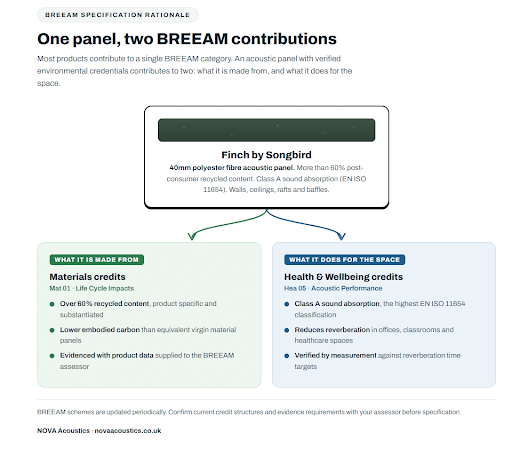
Acoustic panels are rarely on the shortlist when sustainability teams review a fit-out's environmental credentials, but they should be. Conventional acoustic foam is petroleum derived, carries significant embodied carbon, and cannot be recycled at end of life. Higher quality alternatives vary considerably in their environmental profile. The questions worth asking are simple: what is the panel made from, how much of it is recycled or renewable content, is there an Environmental Product Declaration (EPD) or equivalent data available, and what happens to it when the building is refitted? The Finch panel by Songbird is made with more than 60% recycled polyester fibre, achieves Class A sound absorption, and can be installed on walls, ceilings, and as suspended rafts or baffles. For projects where acoustic performance and environmental credentials are both non-negotiable, it is the obvious specification.
Pre-completion sound testing is the on-site acoustic measurement required to demonstrate that a new residential building or conversion meets Part E of the Building Regulations before it can be occupied. Tests measure airborne sound insulation (through walls and floors) and impact sound insulation (through floors). The pass thresholds for new builds are DnT,w + Ctr ≥ 45 dB for airborne sound and L'nT,w ≤ 62 dB for impact sound; for conversions, 43 dB and 64 dB respectively. Testing must be carried out by an accredited body: NOVA Acoustics holds UKAS accreditation (No. 8568) for sound insulation testing. If a test fails, building control sign-off cannot be granted until remediation is completed and a passing re-test is achieved.