

BS 4142 is the British Standard used to assess the impact of industrial and commercial noise on nearby sensitive premises. It works by comparing the rating level of a specific noise source (adjusted for acoustic character) against the prevailing background noise level at the nearest receptor. A difference of around +10 dB or more indicates a likely significant adverse impact. Around +5 dB indicates a likely adverse impact. At or below background indicates negligible impact. Most local planning authorities require a BS4142 assessment when new commercial or industrial premises are proposed near residential properties, or when fixed plant and equipment is being installed. The 2019 amendment (BS4142:2014+A1:2019) introduced important updates to methodology that all current assessments must reflect.
Section 61 Noise Consent
- December 23, 2023
We work with contractors to assess the suitability of any proposed on-site works and to provide guidance and support to reduce noise and vibration at the neighbouring receptors.
We will prepare a Section 61 consent that defines the measures that will be implemented to control and limit nosie emissions and vibration levels at residential propoerties and other sensitive receptors in the vicinity of the project. We will engage with contractors and local authorities at the early stages to seek formal consent in accordance with section 61 of the Control of Pollution Act 1974 to ensure the proposed works comply and that appropriate steps are taken to reduce and limit noise and vibration.
We also offer robust, cost effective and cloud-based noise vibration and dust monitoring systems can cover a range of applications and requirements. Whether you need to monitor construction sites, demolitions sites, industrial processes, outdoor festivals or music events, airports, or motorsport, we have you covered. We offer a tailored service to each project to ensure that it provides you with a cost effective and viable solution that achieves compliance with the regulatory requirements for your project. This can be basic hire only service with automated reporting and access to your data via a customisable website Or we can offer a fully managed service including consultancy advice, custom reporting and management of the equipment onsite. Our Services can Include:
Cloud Based Platform – Reliably and securely store your data in real-time.
Customisable Website – Display your live data via a customised website to the public or password protected or both.
Real Time Alerts – Multiple threshold triggers can be set-up to alert via SMS or email to an unlimited recipient.
Power – The systems can operate on 240v, 110v, Battery or Solar Power.
Reporting – Reports can be issued weekly, monthly or at request.
Consultancy – We can liaise with the Local Authority to agree the monitoring strategy and provide ongoing consultancy services.
Weather Stations – Weather stations can be integrated into the service, as required.
Related articles:
Construction Noise Management Plans
Noise Monitoring – Mitigating Construction Noise and Section 61 Regulations
Recent posts
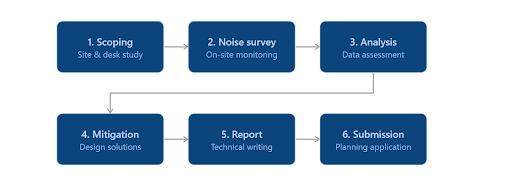
A noise impact assessment (NIA) is a technical report submitted as part of a planning application to demonstrate that a proposed development will not cause unacceptable noise. You will typically need one if your development is near a significant noise source (road, rail, or commercial premises), if it generates noise that could affect nearby residents, or if a planning authority has specifically requested one. NIAs are assessed against standards including BS4142, BS8233, and the NPPF. Without one, many planning applications are refused or delayed.
Acoustic panels reduce echo, reverberation, and noise build-up within a room by absorbing sound. They do not block sound between rooms. The right panel depends on five things: the material (polyester fibre or fabric-wrapped), the thickness, how it will be mounted, the aesthetic requirements of the space, and whether durability or sustainability are priorities. Every panel in the Songbird range achieves Class A sound absorption (the highest performance rating available), so the choice between them comes down to application, environment, and finish rather than acoustic performance.