

Pre-completion sound testing is the on-site acoustic measurement required to demonstrate that a new residential building or conversion meets Part E of the Building Regulations before it can be occupied. Tests measure airborne sound insulation (through walls and floors) and impact sound insulation (through floors). The pass thresholds for new builds are DnT,w + Ctr ≥ 45 dB for airborne sound and L'nT,w ≤ 62 dB for impact sound; for conversions, 43 dB and 64 dB respectively. Testing must be carried out by an accredited body: NOVA Acoustics holds UKAS accreditation (No. 8568) for sound insulation testing. If a test fails, building control sign-off cannot be granted until remediation is completed and a passing re-test is achieved.
Employers Guide to Health Surveillance
- February 11, 2019
What is health surveillance?
Health surveillance for hearing damage usually means:
• regular hearing checks in controlled conditions;
• telling employees about the results of their hearing checks;
• keeping health records;
• ensuring employees are examined by a doctor where hearing damage is identified.
Ideally, you would start the health surveillance before people are exposed to noise (ie for new starters or those changing jobs), to give a baseline. It can, however, be introduced at any time for employees already exposed to noise. This would be followed by a regular series of checks, usually annually for the first two years of employment and then at three-yearly intervals (although this may need to be more frequent if any problem with hearing is detected or where the risk of hearing damage is high). The hearing checks need to be carried out by someone who has the appropriate training.
The whole health surveillance programme needs to be under the control of an occupational health professional (for example a doctor or a nurse with appropriate training and experience). You, as the employer, have the responsibility for making sure the health surveillance is carried out properly.
Before implementing health surveillance, a noise at work survey is required to establish exposure levels.
Providing health surveillance
How can I arrange health surveillance?
What should I expect from an occupational health service provider?
A suitable occupational health service provider will be able to show you that they have the training and experience needed. They should be able to: advise you on a suitable programme for your employees;
• set up the programme;
• provide suitably qualified and experienced staff to carry out the work;
• provide you with reports on your employees’ fitness to continue work with noise exposure.
Remember
By law, as an employer, you must assess and identify measures to eliminate or reduce risks from exposure to noise so that you can protect the hearing of your employees.
Where the risks are low, the actions you take may be simple and inexpensive, but where the risks are high, you should manage them using a prioritised noise-control action plan.
Where required, ensure that:
• hearing protection is provided and used;
• any other controls are properly used; and
• you provide information, training and health surveillance.
Review what you are doing if anything changes that may affect the noise exposures where you work.
What do I have to do with the results of health surveillance?
Use the results to make sure your employees’ hearing is being protected. You will need to:
• keep records of the health surveillance and fitness-for-work advice provided for each employee (but not the confidential medical records which are kept by the doctor). A health and safety inspector can ask to see the health records as part of their checks that you are complying with the Regulations;
• make employees’ records available to them;
• act upon any recommendations made by the occupational health service provider about employees’ continued exposure to noise;
• use the results to review and, if necessary, revise your risk assessment and your plans to control risks.
Analysing the results of your health surveillance for groups of workers can give you an insight into how well your programme to control noise risks is working. Use the results to target your noise reduction, education and compliance practices more accurately. Make this information available to employee or safety representatives.
The information above is taken from the HSE website ( http://www.hse.gov.uk/noise/). Contains public sector information licensed under the Open Government Licence v3.0.
Recent posts
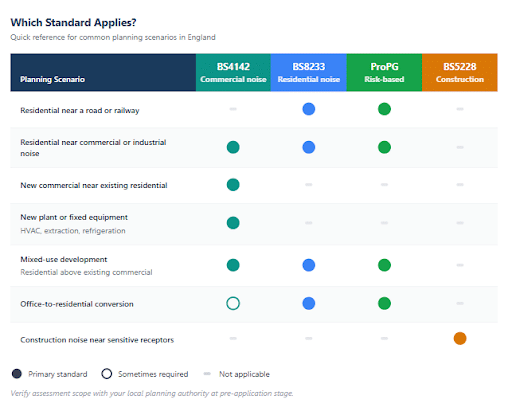
The National Planning Policy Framework requires planning authorities in England to consider noise as a material planning consideration. It does not set noise limits. Instead, it establishes the policy principles that govern when noise assessments are required, how significance is determined, and what mitigation is appropriate. The two most important principles for developers are the agent of change principle (the party introducing a noise-sensitive use near a noise source bears responsibility for managing the acoustic consequences), and the requirement to avoid placing noise-sensitive development in high-noise locations unless unacceptable impacts can be adequately mitigated. In practice, NPPF noise policy is implemented through technical standards including BS4142 and BS8233, and professional guidance including ProPG.
BS8233:2014 is the British Standard used to assess whether residential development near roads, railways, or other noise sources can achieve acceptable internal and external noise levels for future occupants. It sets out criteria for bedrooms, living rooms, and gardens across daytime and night-time periods. The most commonly referenced targets are 35 dB LAeq during the day and 30 dB LAeq at night for bedrooms. A BS8233 assessment is almost always required for residential planning applications in noise-sensitive locations, and is often conditioned by the local planning authority. ProPG (2017) sits alongside BS8233 and provides professional guidance on how assessments should be scoped and presented. This guide covers both.