







Sustainable Acoustic Treatment: Why Material Choice Matters
- August 3, 2026
Quick take
Acoustic panels are rarely on the shortlist when sustainability teams review a fit-out’s environmental credentials, but they should be. Conventional acoustic foam is petroleum derived, carries significant embodied carbon, and cannot be recycled at end of life. Higher quality alternatives vary considerably in their environmental profile. The questions worth asking are simple: what is the panel made from, how much of it is recycled or renewable content, is there an Environmental Product Declaration (EPD) or equivalent data available, and what happens to it when the building is refitted? The Finch panel by Songbird is made with more than 60% recycled polyester fibre, achieves Class A sound absorption, and can be installed on walls, ceilings, and as suspended rafts or baffles. For projects where acoustic performance and environmental credentials are both non-negotiable, it is the obvious specification.
Why material choice matters in acoustic treatment
Sustainability is now a routine part of building specification. Structural materials, facades, flooring, and M&E systems all get scrutinised for embodied carbon and supply chain credentials. Acoustic treatment has largely escaped that scrutiny. Most product comparisons focus on absorption class and aesthetics; material source rarely gets a mention.
That gap matters more than it looks. The built environment accounts for a large share of global carbon emissions, and embodied carbon (the carbon emitted while manufacturing, transporting, and disposing of building materials) is now assessed alongside operational carbon in most sustainability frameworks. Acoustic panels are installed in large quantities across commercial, educational, healthcare, and residential projects. At that scale, the material inside the panel affects the building’s overall embodied carbon profile.
For projects pursuing BREEAM certification, targeting Net Zero Carbon, or reporting against ESG frameworks, the environmental credentials of specified products are not a side issue. They feed directly into scoring, reporting, and sign-off.
The complication is that the acoustic panel market has grown quickly and the products are not equal. Some manufacturers make broad environmental claims with nothing behind them; others publish rigorous third party verified data. Telling the two apart is becoming a core specifier skill, and it is what this guide is for. We cover what embodied carbon means for acoustic specification, what BREEAM and ESG frameworks actually require, what to look for in a sustainable panel, and how to evidence the choices you make. If you are new to acoustic treatment generally, our guide to sound absorption vs sound insulation explains what panels do and do not achieve.
Skip straight to the product: Finch by Songbird is a Class A acoustic panel made with more than 60% recycled content, designed for projects where sustainability and performance are both required.
The environmental cost of conventional acoustic materials
Acoustic foam
Polyurethane foam is the most widely sold acoustic product for consumer and small commercial use. It is a fossil fuel product: petroleum derived, energy intensive to manufacture, and not recyclable through standard waste streams. It also underperforms. Foam does not achieve the absorption levels of higher quality panel products, and its environmental profile is poor at every stage: raw material, manufacturing energy, durability, and disposal. For commercial fit-out projects, foam fails on performance grounds and environmental grounds at the same time.
Mineral wool and glass fibre panels
Rock mineral wool and glass fibre are common core materials in commercial acoustic panels. Both have moderate embodied carbon and are broadly recyclable in principle, though in practice recycling rates are low and most panels end up in landfill. Neither contains recycled content in any meaningful proportion; they are energy intensive primary materials.
Polyester fibre panels
High density polyester fibre, the material used in Finch and Robin from the Songbird range, can incorporate a substantial proportion of recycled content, typically post-consumer PET from plastic bottles and packaging. This is a real environmental advantage rather than a cosmetic one: recycled PET takes far less energy to produce than virgin polyester and diverts plastic waste from landfill.
Polyester fibre panels are also more dimensionally stable and durable than foam, so they last longer, which means fewer replacement cycles and a lower whole life impact. At end of life, polyester fibre can in principle be recycled back into polyester, though take-back programmes vary by manufacturer and are worth confirming at specification stage.
Fabric wrapped panels
Fabric wrapped panels pair an acoustic core (usually polyester or mineral wool) with a woven fabric face. The sustainability profile depends on both parts. Natural or recycled fibre fabrics improve the picture; virgin synthetic fabrics do not. Bespoke fabric wrapped panels such as Skylark can be specified with fabrics from sustainable sources, which is worth raising with the supplier during specification.
Embodied carbon and what it means for acoustic specification
Embodied carbon is the greenhouse gas emissions associated with extracting, manufacturing, transporting, installing, maintaining, and disposing of a building material, expressed as kilograms of CO2 equivalent (CO2e). It is distinct from operational carbon, the emissions from running the building. As buildings become more energy efficient in operation, embodied carbon makes up a growing share of total lifetime emissions, which is why it now features so prominently in sustainability assessment.
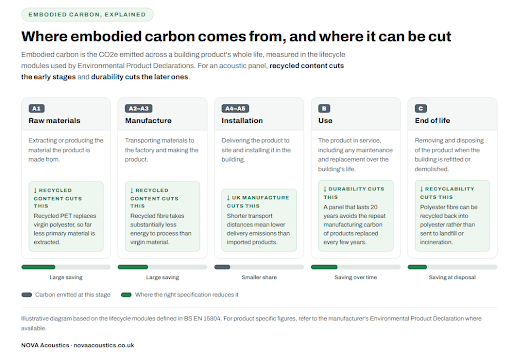
A few terms come up repeatedly:
Global Warming Potential (GWP) is the metric used in Environmental Product Declarations and BREEAM assessments to quantify embodied carbon. Lower GWP means lower embodied carbon.
Environmental Product Declarations (EPDs) are third party verified documents reporting a product’s environmental performance across its lifecycle: raw material extraction (module A1), manufacture (A2-A3), installation (A4-A5), use (B), and end of life (C). EPDs are the accepted standard for evidencing embodied carbon claims in BREEAM and similar frameworks.
For acoustic panels, embodied carbon varies significantly by material. A panel made from more than 60% recycled content has substantially lower A1-A3 embodied carbon than an equivalent panel made from virgin materials, because less energy and fewer primary resources go into production.
Durability matters as much as manufacture. A panel that lasts 20 years has a lower whole life carbon footprint than one replaced every five, even if the shorter lived product has lower initial embodied carbon. Polyester fibre panels generally outlast foam by a wide margin, which is worth factoring into any whole life comparison.
What to look for in a sustainably manufactured acoustic panel
If you are evaluating competing products, these are the questions to ask.
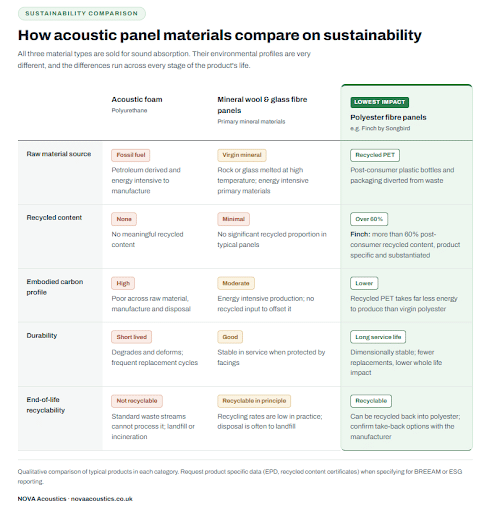
Recycled content. What percentage of the panel is recycled material, and is it post-consumer recycled content (PCR) or post-industrial (PIR)? PCR diverts material that would otherwise go to waste; PIR recycles manufacturing offcuts that would typically be reused anyway, so PCR carries more weight. Ask whether the claim is third party verified. Unverified claims are not usable for BREEAM or ESG reporting. Finch is made with more than 60% post-consumer recycled polyester: a substantiated, product specific figure rather than a general marketing claim.
An EPD. Does the manufacturer provide one? An EPD gives you independently verified, lifecycle based data including GWP, usable in BREEAM materials credits and carbon reporting. Check whether it covers cradle to grave (A1-C) or manufacturing only (A1-A3); the scope matters for reporting.
Third party certification. Relevant schemes include ISO 14001 for environmental management, Cradle to Cradle, FSC or PEFC for any wood based components, and the Global Recycled Standard (GRS) for recycled content claims. No manufacturer holds every certification, and that is fine. What matters is that environmental claims are substantiated rather than asserted.
Durability and service life. A longer lasting product has a lower whole life impact. Look for data on expected service life, resistance to deformation, colourfast fabric on wrapped panels, and structural integrity under normal installation conditions.
Packaging and transport. For large volume orders, packaging and logistics are worth a look. UK manufactured products carry lower transport emissions than imports, which is relevant on projects with strict supply chain emissions requirements.
End of life. Is the panel recyclable, and does the manufacturer offer a take-back scheme or disposal guidance? Polyester fibre can in principle be recycled back into polyester; confirm what programmes actually exist before relying on this in project documentation.
BREEAM and acoustic panel specification
BREEAM (Building Research Establishment Environmental Assessment Method) is the UK’s leading sustainability assessment framework for buildings. Certified projects are assessed across categories including Materials, Health and Wellbeing, and Energy, and awarded a rating from Pass to Outstanding. BREEAM is required or incentivised on a large share of commercial, education, and healthcare projects in the UK, and increasingly expected on major residential developments.
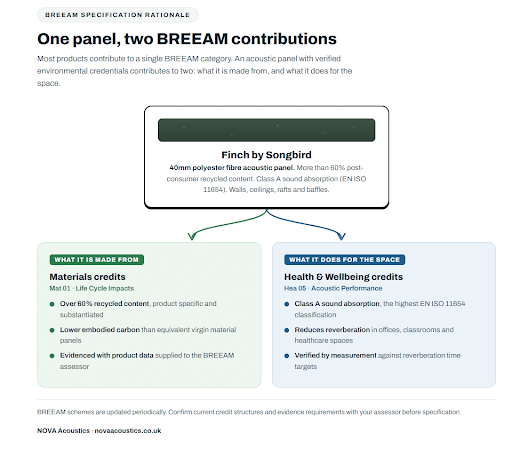
Acoustic panels can contribute to BREEAM in two distinct places, which is unusual for a single product category.
Materials credits (Mat 01: Life Cycle Impacts)
Mat 01 rewards products with low embodied environmental impacts, assessed through EPD data or equivalent. Acoustic panels specified across walls and ceilings can contribute here: products with lower embodied carbon, verified recycled content, and EPD documentation score better. Generic or unverified products do not contribute to credited performance, which is the practical reason verified data matters.
Health and Wellbeing credits (Hea 05: Acoustic Performance)
BREEAM also credits acoustic performance directly. Hea 05 assesses whether the building achieves appropriate standards for reverberation time, sound insulation, and background noise. Panels that reduce reverberation in classrooms, offices, and healthcare spaces contribute directly to this credit.
A panel like Finch therefore makes a dual contribution: Materials credits through its recycled content and environmental credentials, and Health and Wellbeing credits through its Class A acoustic performance.
BREEAM Education
For school and university projects, BB93 sets the reverberation time targets for teaching spaces, and BREEAM Education rewards meeting them. Finch or Warbler panels used to hit BB93 reverberation targets in classrooms can contribute to Health and Wellbeing credits on those projects.
One caveat: BREEAM schemes are updated periodically and credit structures change. Confirm the current requirements with your assessor before specification.
For acoustic specification in school and educational environments, including BB93 reverberation targets and BREEAM Health and Wellbeing credits, see our BB93 acoustic design guide.
ESG reporting and how acoustic material choices contribute
Environmental, Social, and Governance (ESG) frameworks are now standard for listed companies, large private businesses, institutional investors, and their supply chains. Reporting typically requires evidence of environmental performance across the built estate: offices, manufacturing facilities, retail, distribution. For facilities managers and sustainability teams responsible for fit-outs, acoustic panel specification is one of many material choices that feeds into ESG reporting. It is rarely the largest contributor, but it is a legitimate and evidenceable one, and evidenceable contributions are what reporting runs on.
Scope 3 emissions
Most ESG frameworks, including those aligned with TCFD and the GHG Protocol, require reporting on Scope 3 emissions: indirect emissions from the supply chain. Fit-out materials, acoustic panels included, sit within Scope 3 Category 1 (purchased goods and services). Specifying panels with verified recycled content and lower embodied carbon reduces a project’s Scope 3 profile in a way that can be documented and defended.
Social value and WELL
ESG frameworks increasingly weigh social value alongside environmental metrics, and this is where acoustic treatment earns its second contribution. Panels affect employee health and wellbeing by reducing noise related stress and improving speech intelligibility, which can be evidenced through pre and post installation acoustic measurements. The WELL Building Standard formalises this: WELL v2 includes acoustic credits covering background noise levels, reverberation time, and sound isolation. For projects pursuing WELL certification, panels that deliver measurable improvements contribute directly, provided the improvement is documented through measurement.
Procurement policy requirements
Many large organisations run procurement policies requiring specified products to meet minimum sustainability standards: ISO 14001, recycled content thresholds, or alignment with the organisation’s own supply chain carbon commitments. Finch’s verified recycled content supports compliance with these requirements.
For a practical guide to acoustic design in commercial offices, including performance targets and how panels contribute to WELL and BREEAM credits, see our open plan office acoustics guide.
Introducing Finch: the sustainable Songbird panel
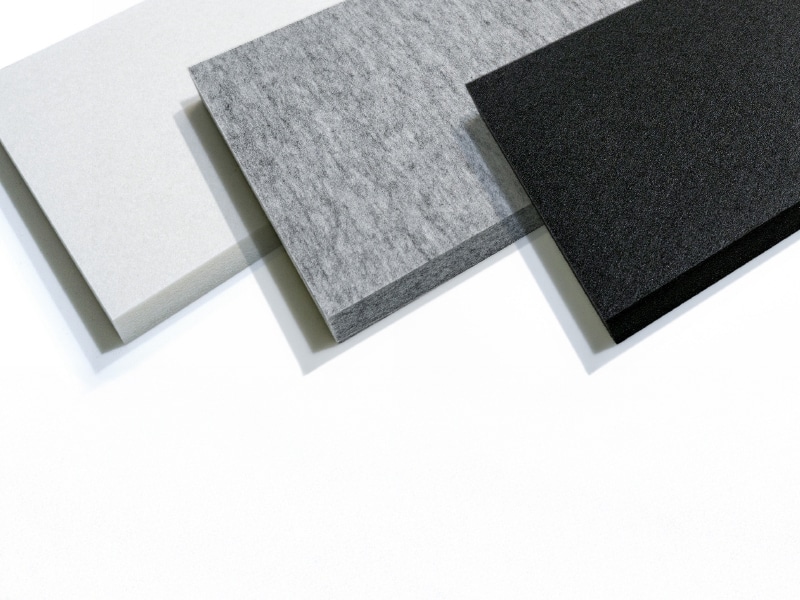
Performance first, because performance is the reason anyone buys an acoustic panel. Finch is a 40mm polyester fibre panel achieving Class A sound absorption, the highest classification under EN ISO 11654. It absorbs the large majority of sound energy reaching it across the standard frequency range, the same performance level as every other panel in the Songbird range. Choosing the sustainable option involves no performance trade-off at all.
The sustainability case is what sets Finch apart. It is made with more than 60% post-consumer recycled content, primarily recycled PET from post-consumer plastic waste. That figure is product specific and substantiated, which puts it ahead of most competing panels on the market. Turning plastic waste into a high performance building product is a genuine circular economy contribution: it diverts material from landfill or incineration and replaces virgin polyester production, cutting both waste and manufacturing energy at once.
There is also a design point worth noting. The exposed polyester face is the finished surface, so Finch needs no fabric wrapping. Less material overall, and a cleaner, more honest aesthetic that many sustainability minded designers actively prefer.
Finch tends to be specified by four groups: architects and designers on projects with sustainability briefs or BREEAM targets who need to justify material choices with evidence; sustainability managers and ESG leads who need verifiable supply chain data; procurement teams working to supply chain sustainability requirements; and educational and healthcare clients balancing acoustic performance with responsible specification.
Installation is straightforward. Finch mounts to walls and ceilings using standard fixings appropriate to the substrate, and can be suspended as ceiling rafts or baffles using standard suspension systems, which works well in large volume spaces where wall area is limited. It is supplied in standard sizes. For office applications and conference and meeting rooms, the Songbird space guides cover panel placement in more detail.
Explore the Finch panel: technical specifications, installation guidance, and environmental credentials.
How to evidence sustainable acoustic specification in a project
Specifying the right product is half the job. The other half is documentation, because BREEAM assessors, ESG auditors, and planning officers all work from evidence rather than intent.
For BREEAM projects: request product specific environmental data from the manufacturer, including any EPD, recycled content certificates, and ISO 14001 documentation. These are the formats assessors accept. Record the percentage of recycled content by weight for each product and the area of installation; Materials credits require evidenced claims, not assertions. For Hea 05, commission pre and post installation acoustic measurements to demonstrate that reverberation targets have been met. An acoustic consultant can specify the panel scheme and verify performance through measurement.
For ESG Scope 3 reporting: request GWP data from the manufacturer, typically expressed as kg CO2e per kg of product or per m² at standard thickness. Document the quantity installed and apply the GWP figure to calculate the Scope 3 contribution. Where an EPD exists, its GWP figure is the one to use: it is independently verified and therefore defensible in audit.
For planning submissions with sustainability commitments: where an application includes a net zero commitment, BREEAM target, or circular economy statement, acoustic panel specification can be referenced in the sustainability statement as an example of responsible material choice. You will need the product specification sheet, the recycled content certificate, and a short note on the acoustic performance contribution.
For WELL certification: document acoustic measurements (background noise, reverberation time, sound isolation where relevant) before and after installation using calibrated equipment. An acoustic consultant can conduct the measurements and report in the format WELL requires.
Across all of these, one habit pays off: maintain a product schedule recording the sustainability credentials of every acoustic product specified. Manufacturer, product name, recycled content percentage, GWP data source, certifications. One document, kept current, serves BREEAM, ESG, and planning purposes and makes audits far less painful.
NOVA Acoustics provides acoustic measurement services to support BREEAM and WELL certification, including pre and post installation reverberation measurements and acoustic performance reports. Get in touch to discuss your project.
Where Finch fits within the wider Songbird range
All five Songbird panels achieve Class A sound absorption, so the choice between them is never about performance. It comes down to application, aesthetics, durability, and now environmental profile.
Finch is the right choice when sustainability credentials drive the specification: BREEAM, WELL, or ESG requirements that benefit from evidenced recycled content, an exposed material finish that suits the interior, and no need for bespoke sizing.
Skylark is the right choice when aesthetic flexibility and bespoke sizing come first: a fabric wrapped panel in a chosen colour to match an interior scheme, and one that can be specified with sustainably sourced fabrics.
Robin is the right choice when a slimmer profile is needed (12mm or 24mm), or bespoke sizing without the cost of fabric wrapping. Polyester fibre construction, wide colour range.
Warbler is the right choice when impact resistance matters alongside acoustics: schools, sports halls, gyms, healthcare corridors.
Swift is the right choice when self-adhesive DIY installation is the priority: renters, home studios, informal commercial settings.
For a full comparison of all five Songbird panels, including material type, thickness, mounting method, and best fit applications, see our acoustic panel buyer’s guide.
Why choose Songbird by NOVA Acoustics
Sustainable specification requires more than choosing a product with a recycled content claim on the data sheet. It requires confidence that the claim is verified, that the acoustic performance is real, and that the supplier understands both dimensions. Songbird by NOVA Acoustics is the acoustic panel range backed by a UKAS accredited acoustic consultancy, which means the performance claims are held to the same standards as the rest of NOVA’s work.
Every panel in the Songbird range achieves Class A sound absorption, independently classified. Finch’s recycled content claim is product specific and substantiated. In a market where environmental claims are often vague or unverifiable, both of these matter.
NOVA is a UKAS accredited testing laboratory for sound insulation testing (Accreditation No. 8568). That independently audited standard applies to the technical rigour of everything NOVA does, including the acoustic performance standards applied to the Songbird range.
There is also a consultancy behind the product. Songbird panels are designed, specified, and supported by the same team that conducts acoustic surveys, prepares BREEAM acoustic assessments, and delivers acoustic design services for commercial, educational, and healthcare projects across the UK. A client specifying Finch for a BREEAM project can draw on the same team for measurement, verification, and reporting support.
The range covers every scenario, from standard size sustainable panels (Finch) to fully bespoke fabric wrapped options (Skylark), so sustainability conscious specifiers are not limited to one product or one aesthetic. And with offices in Leeds, Manchester, London, Birmingham, Liverpool, Cambridge, Newcastle, Nottingham, Sheffield, Bristol, and Hull, specification support, acoustic consultation, and product supply are accessible across England.
Specify Finch with confidence: explore the Finch panel, or get in touch with our team for acoustic consultancy support on your BREEAM, WELL, or ESG project.
Frequently asked questions
Four factors do most of the work: recycled content (what proportion of the panel is post-consumer recycled material), embodied carbon (the carbon emitted during manufacture, expressed as Global Warming Potential in kg CO2e), durability (a longer lasting product has lower whole life impact), and end of life recyclability. Third party verified data, such as an Environmental Product Declaration or a recycled content certificate, is required to evidence sustainability claims in BREEAM or ESG reporting.
Finch is a 40mm polyester fibre acoustic panel made with more than 60% post-consumer recycled content, primarily recycled PET from post-consumer plastic waste. It achieves Class A sound absorption and suits wall mounting, ceiling installation, and suspension as rafts or baffles.
Yes, in two ways. Its recycled content and environmental credentials can contribute to BREEAM Materials credits (Mat 01: Life Cycle Impacts) when product specific environmental data is provided to the assessor. Its Class A acoustic performance can also contribute to Health and Wellbeing credits (Hea 05: Acoustic Performance) when measurements demonstrate that reverberation targets have been achieved. Confirm current BREEAM credit structures with your assessor before specification, as schemes are updated periodically.
Embodied carbon is the greenhouse gas emissions associated with manufacturing, transporting, and disposing of a building product, expressed as kg CO2 equivalent. As buildings become more energy efficient in operation, embodied carbon makes up a growing share of total lifetime emissions. Acoustic panels installed in large quantities across a project contribute to the building’s embodied carbon profile, and products made from recycled materials carry substantially lower embodied carbon than those made from virgin materials.
Yes. Fit-out materials, including acoustic panels, fall within Scope 3 Category 1 (purchased goods and services) of the GHG Protocol framework. Specifying panels with lower embodied carbon and verified recycled content reduces a project’s Scope 3 contribution. Request Global Warming Potential data from the manufacturer for use in Scope 3 calculations.
No. All panels in the Songbird range achieve Class A sound absorption, the highest classification under EN ISO 11654. Finch achieves Class A at 40mm thickness, the same level as Skylark, Swift, and Warbler. Choosing Finch is an application and aesthetic decision that happens to carry the strongest sustainability credentials; it is never a performance compromise.
Yes. Finch suits wall mounting, ceiling installation, and suspension as ceiling rafts or baffles. Ceiling installation, particularly as suspended rafts in open plan offices, schools, and large commercial spaces, is often the most effective positioning in high volume rooms where wall space is limited.
Summary
Material choice in acoustic specification matters. Panels installed at scale across a fit-out contribute to a building’s embodied carbon profile, and the market contains both genuinely sustainable products and claims that fall apart under scrutiny. The way to tell them apart is evidence: verified recycled content, EPD data, and certification rather than assertion.
Finch by Songbird offers Class A acoustic performance with more than 60% post-consumer recycled content, a substantiated figure that holds up in BREEAM Materials credits, Scope 3 reporting, and procurement review. It is the appropriate specification for BREEAM, WELL, and ESG driven projects, with no acoustic compromise attached.
And because Songbird is backed by NOVA Acoustics, a UKAS accredited acoustic consultancy, the product comes with something most panel suppliers cannot offer: measurement, verification, and reporting support from the same team, so both the performance claims and the sustainability claims can be evidenced in your project documentation.
Specify the sustainable option without compromising on performance. Explore the Finch panel or speak to our team.
Sources
- BRE Group, BREEAM (Building Research Establishment Environmental Assessment Method), including the BREEAM UK New Construction technical manual (Mat 01: Life Cycle Impacts; Hea 05: Acoustic Performance): https://bregroup.com/products/breeam/
- Department for Education, Building Bulletin 93: Acoustic Design of Schools – Performance Standards (2014): https://www.gov.uk/government/publications/bb93-acoustic-design-of-schools-performance-standards
- Institute of Acoustics and Association of Noise Consultants, Acoustics of Schools: A Design Guide (2015): https://www.ioa.org.uk/
- BSI, BS EN ISO 11654: Acoustics – Sound Absorbers for Use in Buildings – Rating of Sound Absorption (sound absorption classification, Classes A to E): https://www.bsigroup.com/
- BSI, BS EN 15804: Sustainability of Construction Works – Environmental Product Declarations – Core Rules for the Product Category of Construction Products (EPD lifecycle modules A1-C): https://www.bsigroup.com/
- Greenhouse Gas Protocol, Corporate Value Chain (Scope 3) Accounting and Reporting Standard (Scope 3 Category 1: purchased goods and services): https://ghgprotocol.org/corporate-value-chain-scope-3-standard
- Task Force on Climate-related Financial Disclosures (TCFD), Recommendations of the Task Force on Climate-related Financial Disclosures: https://www.fsb-tcfd.org/
- International WELL Building Institute, WELL Building Standard v2, Sound concept (features S01-S07 covering background noise, reverberation time, and sound isolation): https://www.wellcertified.com/
- Textile Exchange, Global Recycled Standard (GRS) (third party verification of recycled content claims): https://textileexchange.org/
- International Organization for Standardization, ISO 14001: Environmental Management Systems: https://www.iso.org/iso-14001-environmental-management.html
- UK Green Building Council, guidance on whole life and embodied carbon in the built environment: https://ukgbc.org/
- NOVA Acoustics, Songbird acoustic panel range, product specifications for Finch, Skylark, Robin, Warbler, and Swift: https://www.novaacoustics.co.uk/songbird/