







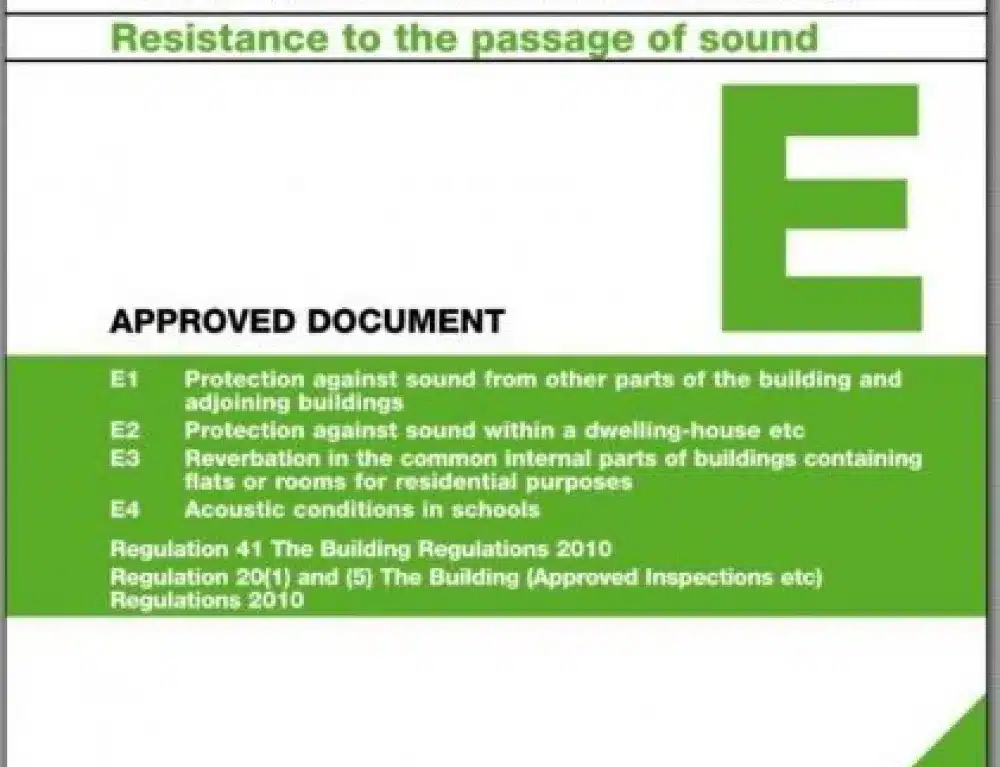
Pre-completion sound testing is the on-site acoustic measurement required to demonstrate that a new residential building or conversion meets Part E of the Building Regulations before it can be occupied. Tests measure airborne sound insulation (through walls and floors) and impact sound insulation (through floors). The pass thresholds for new builds are DnT,w + Ctr ≥ 45 dB for airborne sound and L'nT,w ≤ 62 dB for impact sound; for conversions, 43 dB and 64 dB respectively. Testing must be carried out by an accredited body: NOVA Acoustics holds UKAS accreditation (No. 8568) for sound insulation testing. If a test fails, building control sign-off cannot be granted until remediation is completed and a passing re-test is achieved.
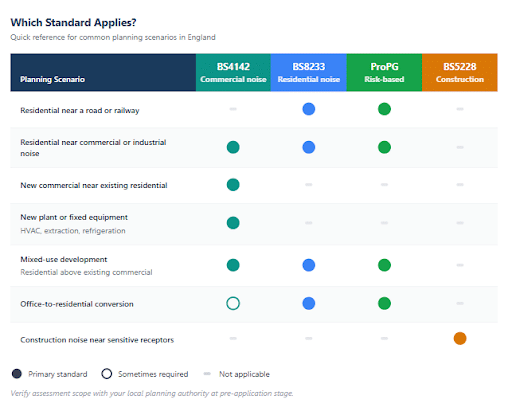
The National Planning Policy Framework requires planning authorities in England to consider noise as a material planning consideration. It does not set noise limits. Instead, it establishes the policy principles that govern when noise assessments are required, how significance is determined, and what mitigation is appropriate. The two most important principles for developers are the agent of change principle (the party introducing a noise-sensitive use near a noise source bears responsibility for managing the acoustic consequences), and the requirement to avoid placing noise-sensitive development in high-noise locations unless unacceptable impacts can be adequately mitigated. In practice, NPPF noise policy is implemented through technical standards including BS4142 and BS8233, and professional guidance including ProPG.

BS8233:2014 is the British Standard used to assess whether residential development near roads, railways, or other noise sources can achieve acceptable internal and external noise levels for future occupants. It sets out criteria for bedrooms, living rooms, and gardens across daytime and night-time periods. The most commonly referenced targets are 35 dB LAeq during the day and 30 dB LAeq at night for bedrooms. A BS8233 assessment is almost always required for residential planning applications in noise-sensitive locations, and is often conditioned by the local planning authority. ProPG (2017) sits alongside BS8233 and provides professional guidance on how assessments should be scoped and presented. This guide covers both.