

Skip to content

NOVA Acoustics

Visit Songbird Acoustic Panels

What is the Robust Details certification scheme?

If you are involved in the construction industry then you will know the importance of meeting all building regulations.

This is especially true in terms of sound insulation in buildings such as joined houses, bungalows or flats. Meeting the minimum regulations in this area will not only keep you within the law but provide more effectively insulated properties for people to live in.

How can the Robust Details scheme help you?

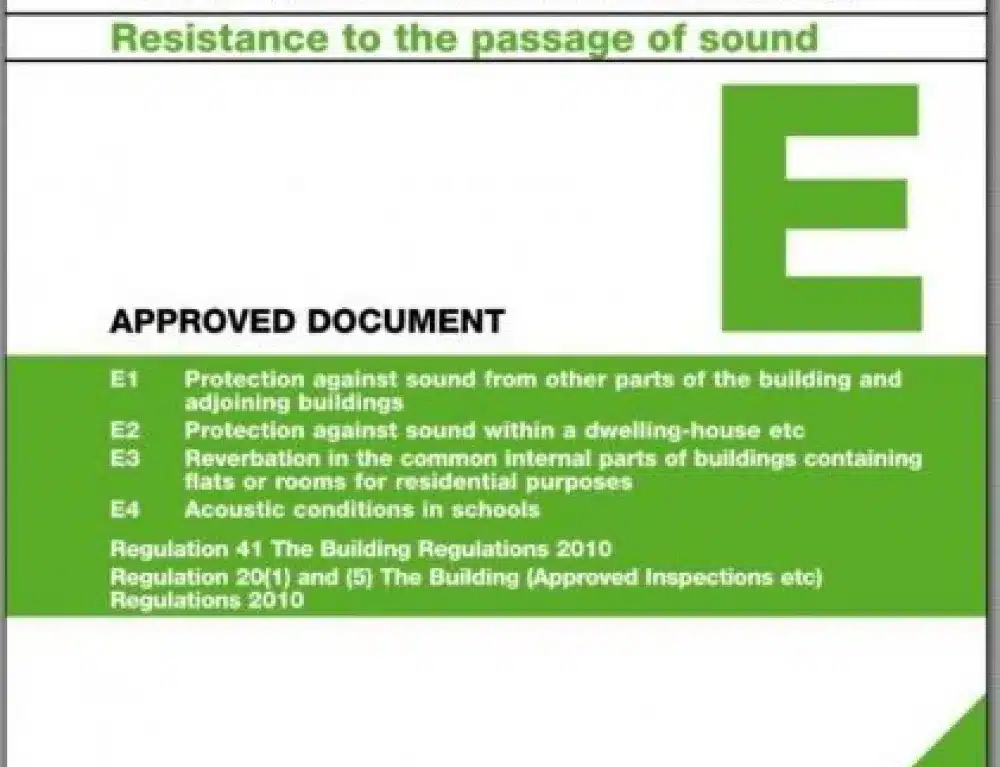
Robust Details Limited operates as a non-profit company that distributes and manages their Robust Details certification scheme. The scheme was set up with the aim of providing architects and engineers with a business-savvy way to comply with standards in the home building sector. It is designed to help when separating walls or floors in certain types of dwellings. The scheme itself offers an effective alternative to the usual pre-completion sound testing that would otherwise happen. It offers a more streamlined and efficient process while still satisfying Part E of the mandatory building stipulations. It must be noted that the certification scheme is not suitable for conversions, building renovations or property extensions.

How does the scheme work?

The scheme itself is financed via fees users pay to register with it. To begin with, a user would choose the relevant details from the scheme’s handbook. They would then register their plots of land on the scheme website before commencing work on site. Users are also required to notify Building Control themselves as part of the process and construct the details according to the specification shown in the scheme handbook. It is worth noting that due to the numerous complex design solutions this offers, it is not feasible to give a guarantee that details meet other criteria within building law.

How is compliance checked?

Robust Details take great measures to ensure that any plots registered on the scheme remain compliant. Plots are inspected at random to ensure this is the case, with more than 98% meeting or exceeding the minimum standards since 2004. In addition, no detail that has been correctly built according to the scheme handbook has ever failed.

If any tests on plots do fail, then Building Control is notified. This could lead to remedial work being undertaken and/or pre-completion sound testing also.

Peace of mind for homeowners too

Naturally, the main benefit of registering on the scheme is the business-friendly solution it offers to people within the industry. However, it also gives homeowners the knowledge that their property has been constructed and tested to the necessary standards. This will give them extra confidence when thinking of whether to purchase the property or not.

Of course, for the home builder, the benefits of using this scheme are apparent. Not only will it help to avoid potential handover delays but it could help slash your compliance costs. This is especially true in remote build sites or sites that only have a small number of joined dwellings. On top of all that, it will also ensure you meet the legal requirements that any developer faces when building new homes.

Related article: How To Pass Part E Of The Building Regulations

Recent posts

standards that deliver NPPF compliance

The National Planning Policy Framework requires planning authorities in England to consider noise as a material planning consideration. It does not set noise limits. Instead, it establishes the policy principles that govern when noise assessments are required, how significance is determined, and what mitigation is appropriate. The two most important principles for developers are the agent of change principle (the party introducing a noise-sensitive use near a noise source bears responsibility for managing the acoustic consequences), and the requirement to avoid placing noise-sensitive development in high-noise locations unless unacceptable impacts can be adequately mitigated. In practice, NPPF noise policy is implemented through technical standards including BS4142 and BS8233, and professional guidance including ProPG.

thumb 1000 767 0 0 crop 5

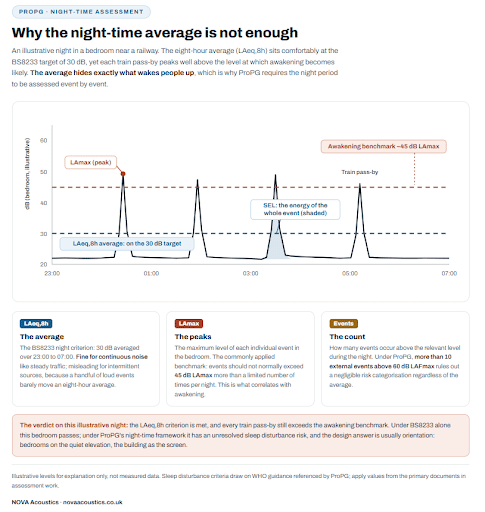
BS8233:2014 is the British Standard used to assess whether residential development near roads, railways, or other noise sources can achieve acceptable internal and external noise levels for future occupants. It sets out criteria for bedrooms, living rooms, and gardens across daytime and night-time periods. The most commonly referenced targets are 35 dB LAeq during the day and 30 dB LAeq at night for bedrooms. A BS8233 assessment is almost always required for residential planning applications in noise-sensitive locations, and is often conditioned by the local planning authority. ProPG (2017) sits alongside BS8233 and provides professional guidance on how assessments should be scoped and presented. This guide covers both.

Office

Open plan office acoustics comes down to three things: controlling reverberation so speech is clear, managing background noise so people can concentrate, and achieving speech privacy so conversations do not travel. The key targets for open plan offices are a reverberation time (RT60) of 0.4 to 0.6 seconds, a background noise level of around 40 to 45 dB LAeq, and a Speech Transmission Index (STI) that limits intelligible speech to the immediate vicinity of the speaker. Achieving these consistently requires an integrated approach. Acoustic panels alone are rarely sufficient without also considering layout, screening, ventilation noise, and room geometry. This guide covers the principles, the targets, and the practical steps to get there.