




Reverberation Testing, Consultancy, Design and Installation of Acoustic Panelling.
IOA Members
Trade Accounts
Price Promise
Rapid Reports
Industrial Noise Surveys
Our acoustic expertise guarantees that your industrial noise survey includes everything necessary to ensure your project or development meets the required standards.
Expert BS 4142 Assessments | Practical Mitigation Advice

Projects in 2025
1725
+
Projects to date
14248
+


Expert acoustic consultancy, delivered across the UK.
An industrial noise survey measures and assesses noise from industrial, commercial, or mechanical sources — such as plant, machinery, manufacturing processes, or logistics operations — evaluated against BS 4142 to determine the impact on nearby noise-sensitive receptors. NOVA Acoustics provides industrial noise surveys for planning applications, environmental permit applications, nuisance complaints, and proactive noise management programmes.
Simple, fast & fully managed
Request a quote
Confirm your survey date
On-site assessment
Rapid Report
Submit to decision maker
What our clients have to say
“I plucked this company out of the air and I am so glad I did. Jaime has been most helpful and produced a report within a short time scale. The service has been first class and I have absolutely no hesitation in recommending NOVA acoustics.”
– Arnot Wilson
“We commissioned NOVA to conduct a sound test at our new house. From the get go Adam was incredibly helpful and knowledgeable. It is rare to meet professionals like that, who also go above and beyond to help and guide you through the process.”
– Na’ama Zisser
“The engineer who conducted the testing was friendly, professional and incredibly thorough. Overall I would say that NOVA provided an outstanding service from start to finish and I would not hesitate to recommend them.”
– Joe Bentley
“Really pleased with the service received from NOVA Acoustics on a recent noise risk assessment of our production room. The engineer Tom was great throughout and the report was clear and has made managing our noise control measures simple and effective.”
– Daniel Pontin
“NOVA Acoustics have been beyond helpful. Super speedy response and excellent communication. The noise impact assessment has been completed at a very fair price, and I’m really happy I chose NOVA Acoustics for the job.”
– Kelly Creates
“I used NOVA for acoustic reports for a project I’m working on converting retail units to residential, they was prompt, informative and well priced. I wouldn’t hesitate to use them again.”
– Peter Goldthorpe
“We have used NOVA Acoustics for a sound testing for installation of a new floor. Tom the engineer was very thorough, prompt and professional.”
– Anna Jóga
“Ryan and his team were very professional, installing monitoring equipment regarding a proposed planning application. We can definitely recommend NOVA Acoustics Ltd.”
– Pauline Whittle
HOW WE SUPPORT YOU

Planning Ready Report

Fully Compliant

Clear Conclusions

Mitigation Advice

Jargon Free & Clear

Planning Approval Secured
Who We Work With
House Builders
Property Developers
Architects & Contractors
Homeowners
Project Managers
Housing Associations
Unlock benefits with a trade account.
Built around the needs of busy construction professionals, our trade accounts include preferential rates, dedicated project assistance, priority service and a named account contact to help deliver projects smoothly and efficiently.
Nationwide support for every project.
- Fast, flexible site attendance to fit your programme.
- Clear reporting with practical, easy-to-follow recommendations.
- Responsive service with expedited turnaround for strict timescales.
- National expertise delivered through consultants with local insight.
Expert consultancy across the UK.
Our experienced consultants work with residential, commercial and industrial clients across the UK, providing practical acoustic guidance, technical expertise and reliable support at every stage of a project.
Why choose NOVA Acoustics?
- Experienced in delivering acoustic assessments.
- Professionally qualified consultants accredited by the Institute of Acoustics.
- Regional expertise backed by a responsive nationwide consultancy.
- Practical advice designed to satisfy planning requirements.
What This Service Covers
Background sound level survey at nearest sensitive receptors
Specific/rating level assessment of the industrial source in question
BS4142:2014 impact rating (low, medium, or high impact)
Mitigation recommendations where adverse impact is identified (relocation, enclosures, barriers, unit specification changes)
Assessment of existing installations in response to noise complaints, as well as proposed installations
Reporting suitable for planning submission or local authority/EHO review
Understanding Rating Level vs. Background Level
At the heart of a BS4142:2014 assessment is a comparison between two figures: the rating level and the background level. The background level is the underlying sound level in the area when the noise source being assessed isn’t operating, essentially, what the area sounds like normally. The rating level is the sound level of the specific source being assessed, adjusted to account for certain acoustic characteristics, such as tonality or impulsivity, that can make a noise more noticeable or intrusive than its measured level alone would suggest.
BS4142:2014 works by comparing the rating level to the background level. Broadly speaking, the larger the difference, the greater the likelihood of an adverse impact, with the standard providing guidance on how to interpret differences of various sizes. Context also matters: the same numerical difference might be considered acceptable in one setting and significant in another, depending on factors such as the character of the area and the existing acoustic environment.
The Survey Process
While BS4142:2014 applies across many types of premises, certain sectors come up particularly often. Commercial kitchens and restaurants frequently need assessments covering extraction and refrigeration plant, particularly where premises are close to residential properties above or adjacent to the unit. Retail and logistics sites often need assessments covering HVAC plant, generators, and yard or loading bay activity. And light industrial units, especially on mixed-use sites where industrial and residential uses sit close together, commonly require assessments to support either new occupier fit-outs, planning applications for a change of use, or a response to a noise complaint from a neighbouring resident or business.
Book your assessment.
Frequently Asked Questions
What is BS4142:2014 and when does it apply?
BS4142:2014 is the British Standard for rating and assessing industrial and commercial sound, used to determine whether noise from a fixed source, such as plant or equipment, is likely to have an adverse impact on nearby noise-sensitive premises. It commonly applies to new installations like air conditioning or refrigeration units, as well as existing industrial or commercial noise sources where impact needs to be assessed.
What's the difference between background sound level and rating level in a BS4142 assessment?
The background level is the underlying sound level in the area without the source being assessed in operation. The rating level is the measured or predicted sound level of the source itself, adjusted where necessary for acoustic characteristics such as tonality. The assessment compares these two figures to determine the likely impact.
What kinds of equipment typically require an industrial noise survey?
Common examples include air conditioning and refrigeration units, kitchen extraction systems, generators, and various items of plant and machinery associated with manufacturing, logistics, or industrial processes.
How long does an industrial noise survey take to complete?
This depends on the specifics of the assessment, including whether background levels need to be measured across daytime and night-time periods. Once we have the information needed (site plans, equipment specifications, proposed operating hours), we aim to arrange surveys promptly and keep the process moving efficiently through to a completed report.
What happens if my installation is found to have a significant adverse impact under BS4142?
If an assessment identifies a significant adverse impact, we’ll provide tailored recommendations to address it. Depending on the situation, this might involve relocating or re-orienting the unit, selecting a different specification, or installing acoustic enclosures or barriers to reduce noise transmission.
What information should I provide before booking an industrial noise survey?
Helpful information includes site plans showing the location of the proposed or existing installation, manufacturer specifications for the equipment in question, and the proposed or actual operational hours. Access to a secure location for monitoring equipment is also useful where a background survey is required.
Do I need an industrial noise survey for a small commercial unit, like a shop or restaurant?
Potentially, yes, particularly if the unit includes plant such as air conditioning or kitchen extraction and is located near residential properties. Local authorities often request a BS4142 assessment as part of planning or licensing for these types of premises where noise-sensitive neighbours are nearby.
Can NOVA Acoustics assess noise from an installation that hasn't been built yet?
Yes. For proposed installations, we can carry out an assessment based on the manufacturer’s specification data for the proposed equipment, combined with a background sound survey of the existing noise climate at the site, to predict the likely impact before the installation goes ahead.
Can an industrial noise survey help if I've already received a noise complaint about an existing installation?
Yes. A BS4142 assessment of an existing installation works the same way as for a proposed one, measuring the rating level of the source against the background level to determine whether it’s likely to be causing an adverse impact. If the assessment confirms this, we can provide the same kind of mitigation recommendations, relocation, re-orientation, enclosures, or specification changes, tailored to an existing installation rather than one still being designed.
Can a BS4142 assessment be part of an ongoing noise management programme?
Yes. Once an assessment has established a baseline and any necessary mitigation is in place, ongoing or periodic monitoring can confirm that the installation continues to operate within acceptable limits over time. Our environmental monitoring service can be set up to check ongoing compliance against BS4142 assessment outcomes on a rolling or periodic basis.
What are some common industrial noise sources?
Industrial noise surveys cover a wide range of equipment and sources. HVAC and refrigeration plant, including air conditioning condenser units, chillers, and refrigeration compressors, are among the most common sources we assess, particularly for commercial and retail premises. Extraction systems, such as kitchen extraction in restaurants and food premises, are another frequent source, often combined with concerns about both noise and odour. Generators, whether for backup power or as part of a site’s primary power supply, can be significant noise sources, particularly where they operate during sensitive hours. And manufacturing processes and loading bay activity, including the noise from vehicle movements, reversing alarms, and goods handling, are common considerations for industrial and logistics sites.
Where do you provide industrial noise surveys?
We carry out industrial noise surveys and BS4142:2014 assessments across Leeds, Manchester, London, Birmingham, Nottingham, Liverpool, Cambridge, Newcastle, Sheffield, Bristol and Hull.
Recent Projects

Acoustic Consultancy and Design for Breeam HEA05 and POL05.
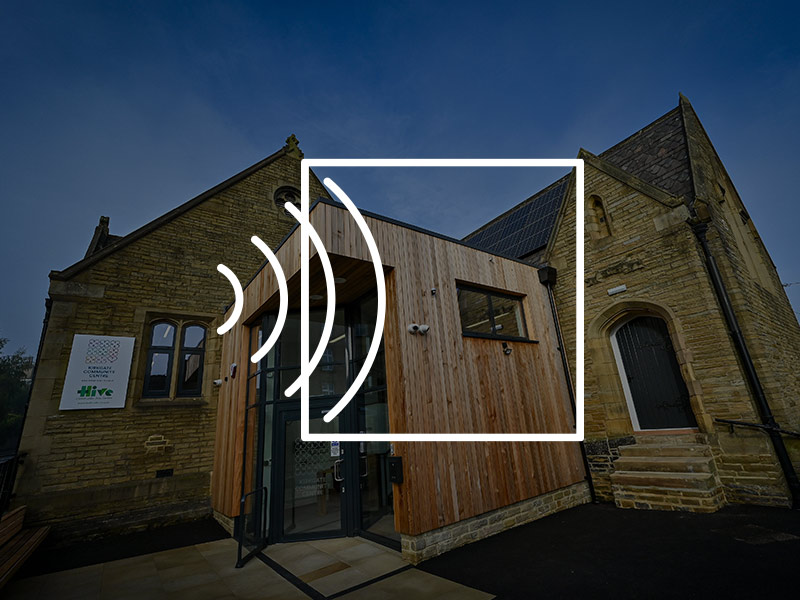
Reverberation Testing, Consultancy, Design and Installation of Acoustic Panelling.
Who we work with